
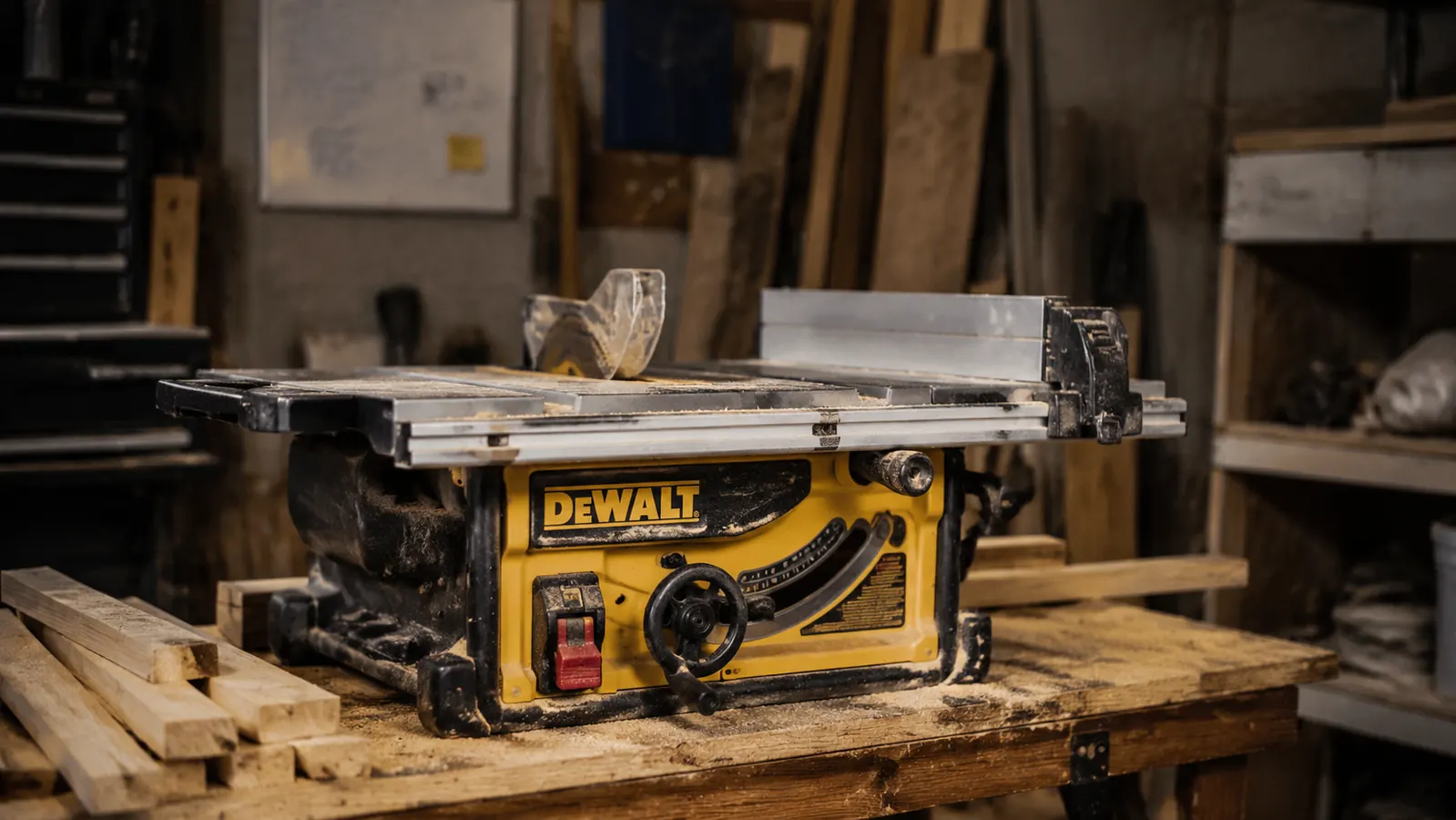
I want to be straight with you before you read another word. I like the DeWalt DWE7485. I own one. It lives in my one-car garage shop and it gets used every weekend. But I have spent 25 years watching guys walk into their first real saw purchase based on YouTube review videos that were either paid for or written by someone who has owned the tool for six weeks. That is not going to happen here. So this is the review I wish existed when I was standing in the aisle trying to decide.
The DWE7485 is a 15-amp, 8-1/4 inch compact jobsite saw. It weighs 48.5 lbs, folds down for transport, and retails for around $329 most days. It has nearly 5,800 Amazon reviews averaging 4.8 stars. That is an almost suspiciously high number. The truth is that for what it is designed to do, it earns that rating. But it is designed to do a specific set of things, and there are several things it is not designed to do that DeWalt's marketing team would prefer you not think too hard about.
The Quick Verdict
A genuinely capable compact saw for hobbyists who understand its 8-1/4 inch blade limits and don't need dado capability or deep bevel cuts on thick stock.
Amazon Check Today's Price →If you've read enough, check today's price and reviews on Amazon before it changes.
The DWE7485 sells around $329 but the price moves. Amazon reviews also surface real owner complaints that the product listing doesn't mention.
Amazon Check Today's Price on Amazon →How I've Used This Saw
I bought mine about 14 months ago specifically to replace a 1980s-era contractor saw that was taking up half my garage. The contractor saw cut beautifully but the thing weighed 220 lbs and I could not move it. The DWE7485 promised compact, portable, and reasonably accurate. I've used it on furniture projects ranging from a small walnut side table to a set of shop cabinets built entirely from 3/4 inch birch plywood. I've ripped hardwood stock and made hundreds of crosscuts with the miter gauge. I've also loaned it to my neighbor twice when he needed a portable saw for deck projects.
That range of use is what lets me be specific about where it works well and where it will frustrate you. Let me go through the five things nobody talks about before you hand over your money.
Thing One: The 8-1/4 Inch Blade Is More Limiting Than DeWalt Admits
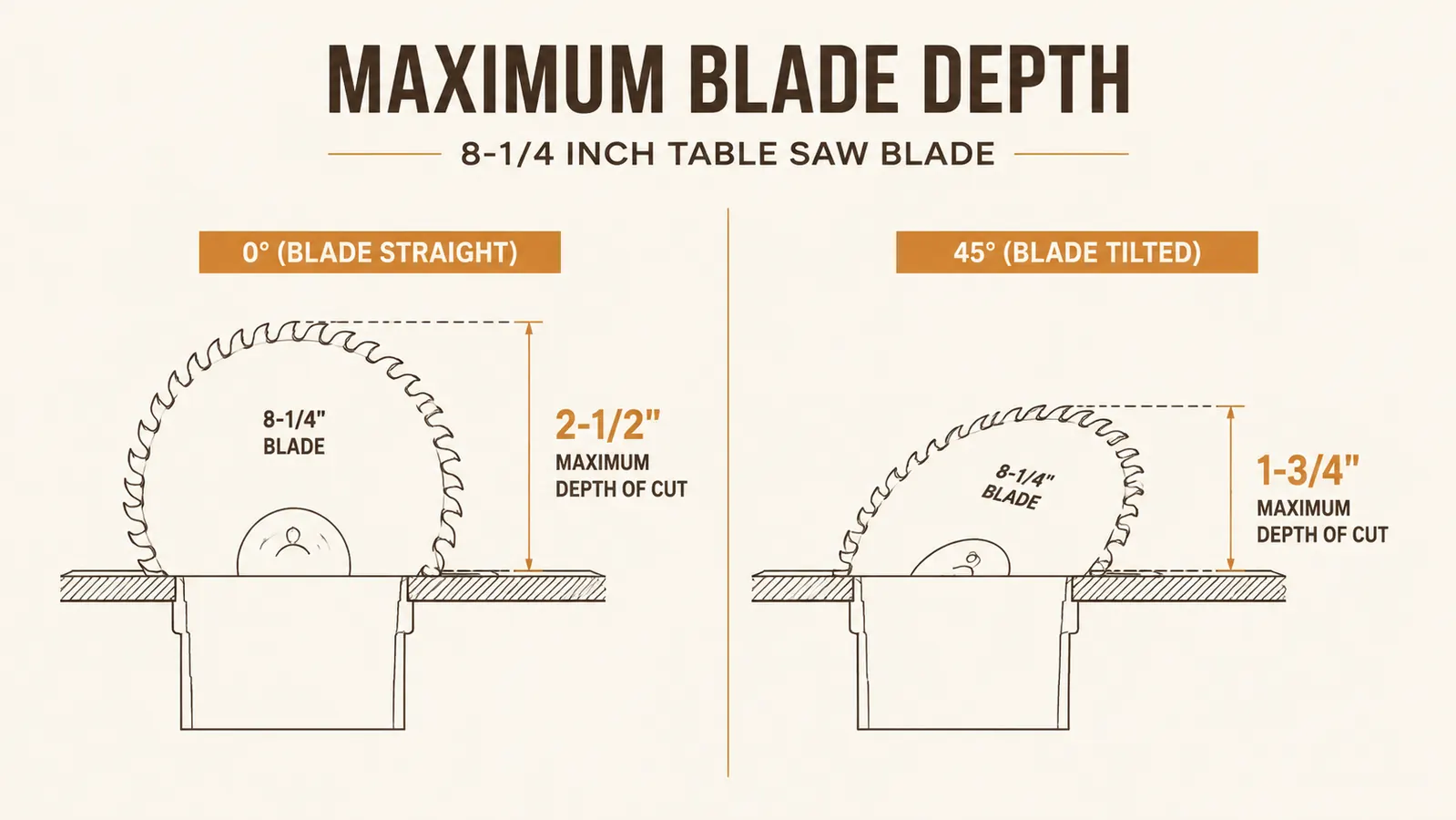
Most jobsite table saws run a 10-inch blade. The DWE7485 runs an 8-1/4. DeWalt markets this as a feature because it lets them keep the saw lighter and more compact. And that is true. The tradeoff is blade depth, and the difference is significant. At 0 degrees, the DWE7485 gives you roughly 2-1/2 inches of cut depth. That is enough for most dimensional lumber and sheet goods. But tip that blade to 45 degrees for a bevel cut and you drop to about 1-3/4 inches. You cannot bevel-cut 2-inch stock cleanly at full angle. I found this out the hard way making the legs for a trestle table out of 8/4 walnut. I had to flip the piece and run it through twice, and the results were acceptable but not ideal.
The 8-1/4 inch diameter also means a smaller blade selection. The 10-inch blade market is enormous. CMT, Freud, Forrest, Diablo, every premium blade manufacturer makes a dozen 10-inch options at every price point and tooth configuration. The 8-1/4 market is much thinner. You will find good blades, but you will pay a premium for the premium ones and your choices narrow. If you care about blade quality, which you should for clean cuts in hardwood, factor this in.
Thing Two: No Dado Capacity, Period
The DWE7485 cannot run a dado stack. This is not a quirk or a workaround situation. The arbor is sized for an 8-1/4 inch blade and there is not enough clearance to stack a dado set. DeWalt does not list dado capacity as a spec at all, which is their polite way of telling you it does not exist.
If you build boxes, drawers, cabinets, or basically any kind of furniture with joints in it, you use dadoes and rabbets constantly. You can cut them with a router, and many people do. But having dado capability at the table saw is faster and, for many operations, more accurate. If dadoes matter to you, this is a real limitation. Shopfox, Ridgid, and some of the larger contractor saws accept dado stacks at a similar or only slightly higher price point. Worth knowing before you buy.
The DWE7485 fence is better than most saws at this price. It is not as good as DeWalt's own marketing photos suggest.
Thing Three: The Fence Is Good, Not Great
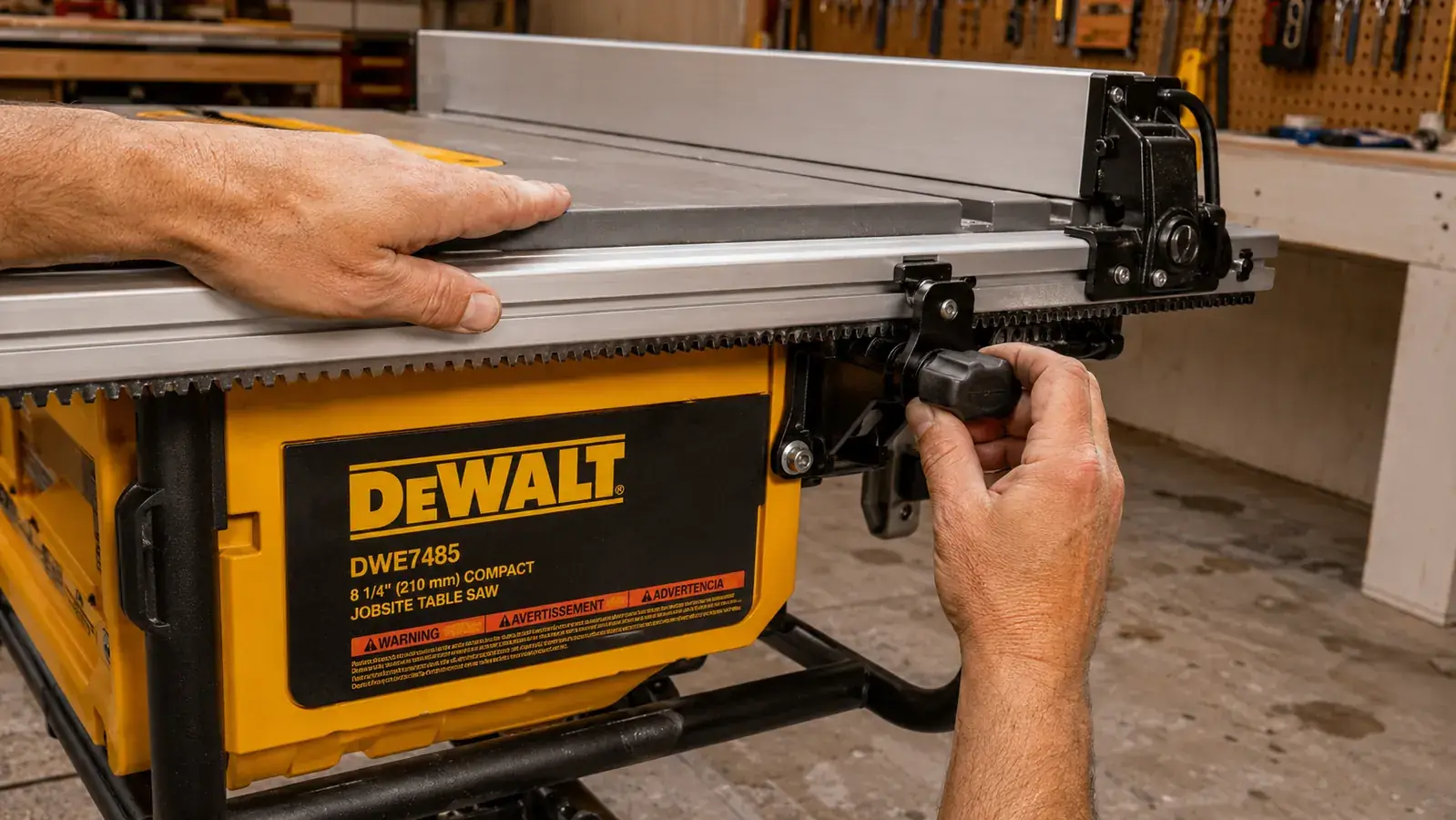
DeWalt's rack-and-pinion fence system gets a lot of praise and it deserves some of it. The fence adjustment is smooth, the scale is easy to read, and out of the box it is acceptably square to the blade. On mine, the fence read dead-on at 12 inches but was about 1/32 off at 6 inches. That is within the range of what most setups will tolerate, but it is not the precision machining you get on a full contractor saw or a cabinet saw.
The bigger issue is that the fence can develop a slight twist over time if you are not careful about how you set it. When you lock the fence, the locking action can introduce a tiny amount of cam pressure that tips the fence slightly off parallel if it is not seated perfectly before you lock. Every experienced woodworker learns to apply slight forward pressure on the fence head while locking. That is a learned behavior. The saw does not teach it to you, and a new woodworker making rip cuts at 24 inches may not notice that their board is slightly tapered until they go to fit it into a joint.
For my long-term review of the DWE7485, I covered the fence adjustment process in detail. The short version: budget 30 minutes to check and adjust alignment when the saw is new, and re-check it every couple of months.
Thing Four: The Dust Port Is a Compromise
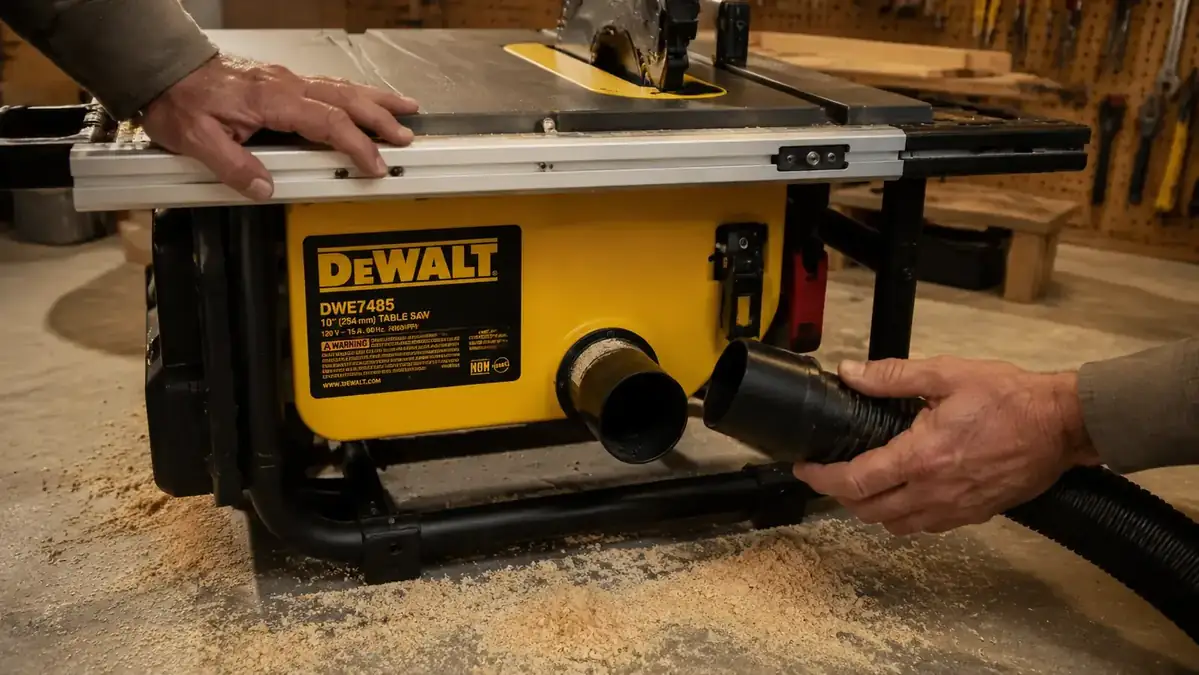
This one irritates me more than any other issue. The DWE7485 has a 2-1/2 inch dust port on the rear of the saw. Standard shop vac hoses are often 2-1/4 or 2-1/2 inch, so in theory you should be able to connect a shop vac directly. In practice, the port shape and the way the housing is arranged means many shop vac hoses do not seal cleanly. I went through three different adapters before I found one that fit without air gaps.
Even with a good connection, the dust collection is mediocre. The port is designed for chip collection below the blade, not fine dust. Fine dust still escapes from the blade guard area and the riving knife slot. If you are cutting MDF or running a session of heavy crosscuts in hardwood, you will still have significant fine dust in the air. I have a separate dust collector for my shop and I still wear a respirator when running this saw. If you have respiratory concerns, or you are building a shop where dust collection matters, plan to spend time and money getting the dust hookup right. The out-of-box port is a starting point, not a solution.
Thing Five: The Rip Capacity Is a Real Constraint for Sheet Goods Work
The DWE7485 offers 24-1/2 inches of rip capacity to the right of the blade. That is enough to rip a full sheet of plywood to rough width if you have outfeed support, but it is tight. A standard sheet is 48 inches wide. You are taking it from 48 down to somewhere manageable, and at 24-1/2 inches you can do it in two cuts. But there is zero margin for error on fence placement. If you are doing a lot of sheet goods work, this saw will feel cramped. A bigger contractor saw with 30 or 32 inches of rip capacity gives you more breathing room.
The table surface itself is also smaller than a contractor saw. There is no extension table in the box. DeWalt sells a table extension as an accessory. If you do not buy it, you are wrestling sheet goods across a table that is about 22 inches deep. A sturdy outfeed table helps enormously and is basically mandatory for solo sheet goods work.
What I Liked
- Accurate 15-amp motor that does not bog on 3/4 inch hardwood or full-depth plywood cuts
- Rack-and-pinion fence adjusts smoothly and is repeatable once you learn its quirks
- 48.5 lbs means one person can move it, which matters in a one-car garage where everything has to share space
- Blade guard and riving knife setup is genuinely better than average for this class of saw
- Strong resale value if you later upgrade to a larger saw
Where It Falls Short
- 8-1/4 inch blade limits bevel depth and dado stack compatibility
- No dado capacity at all, period
- Dust port design requires aftermarket adapters for a real shop vac seal
- 24-1/2 inch rip capacity is tight for full sheet goods work
- Fence can tip slightly off parallel under locking pressure if not seated carefully
- Smaller blade selection and generally higher blade prices compared to 10-inch market
What the High Reviews Are Actually Telling You
Nearly 5,800 reviews and a 4.8 average is real data. The people giving this saw five stars are, by and large, not wrong. They are describing the saw accurately for what they need it to do. The five-star reviews tend to come from people who are new to the table saw world, or who are replacing a truly terrible cheap saw, or who primarily work with dimensional lumber and not a lot of hardwood joinery. For all of those situations, the DWE7485 is a genuine upgrade and it delivers on the things it promises.
The negative reviews cluster around two things: shipping damage and fence calibration frustration. The shipping damage issue is a real problem with this saw and with Amazon's fulfillment of large power tools in general. Inspect the box carefully before you sign for it, and test the saw immediately after unpacking. DeWalt's warranty process for DOA units is functional but slow.
Who This Is For
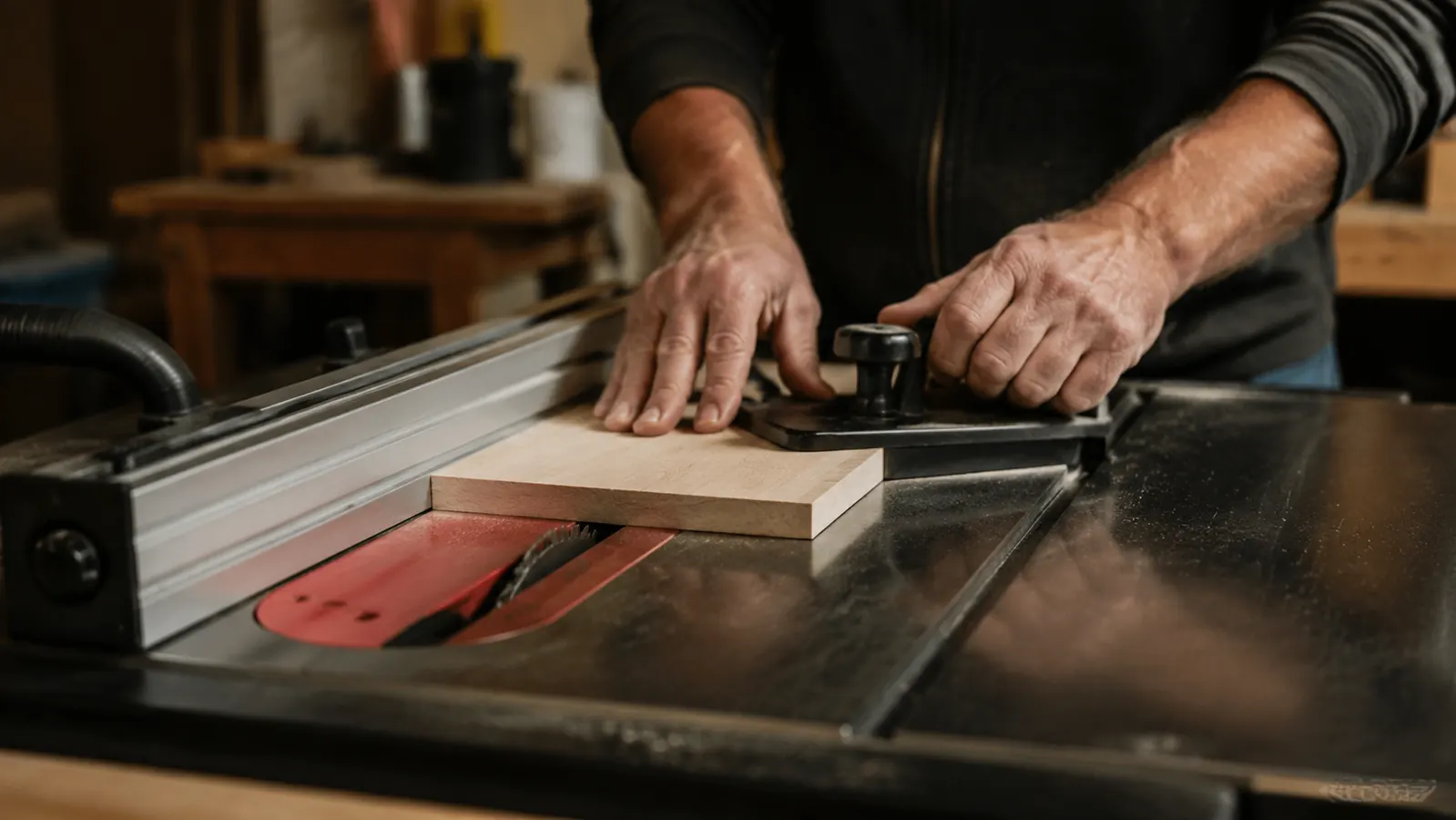
Buy the DWE7485 if you are setting up your first real table saw in a space-constrained shop, you work primarily with dimensional lumber and sheet goods up to 3/4 inch, you do not plan to cut dadoes at the table saw, and portability or storage matters to you. It is also a great choice if you already own a router setup and plan to use the router for dadoes, grooves, and rebates anyway. If your cuts are mostly rips and crosscuts, this saw does those things well. Check out the 10 reasons the DWE7485 earns its place in a home shop if you want a more detailed breakdown of the use cases where it excels.
Who Should Skip It
Skip the DWE7485 if you cut a lot of 8/4 stock at bevel angles, if dadoes and rabbets are central to your joinery work and you want to do them at the table saw, or if you have the space for a full contractor saw and storage is not a constraint. At $329, you are within reach of used contractor saws with 10-inch blades, dado capacity, and larger rip tables. If you are not space-constrained, a used Ridgid R4512 or a Craftsman 21833 often turns up in the $300-400 range and will give you more raw capability for the same money. The DWE7485 earns its price in compactness, not in raw feature set.
Still the right saw for your shop? Today's price is worth a look before it moves.
The DWE7485 consistently comes in around $329, but prices shift. Amazon also surfaces recent buyer Q&A that sometimes answers questions I did not cover here.
Amazon Check Today's Price on Amazon →