
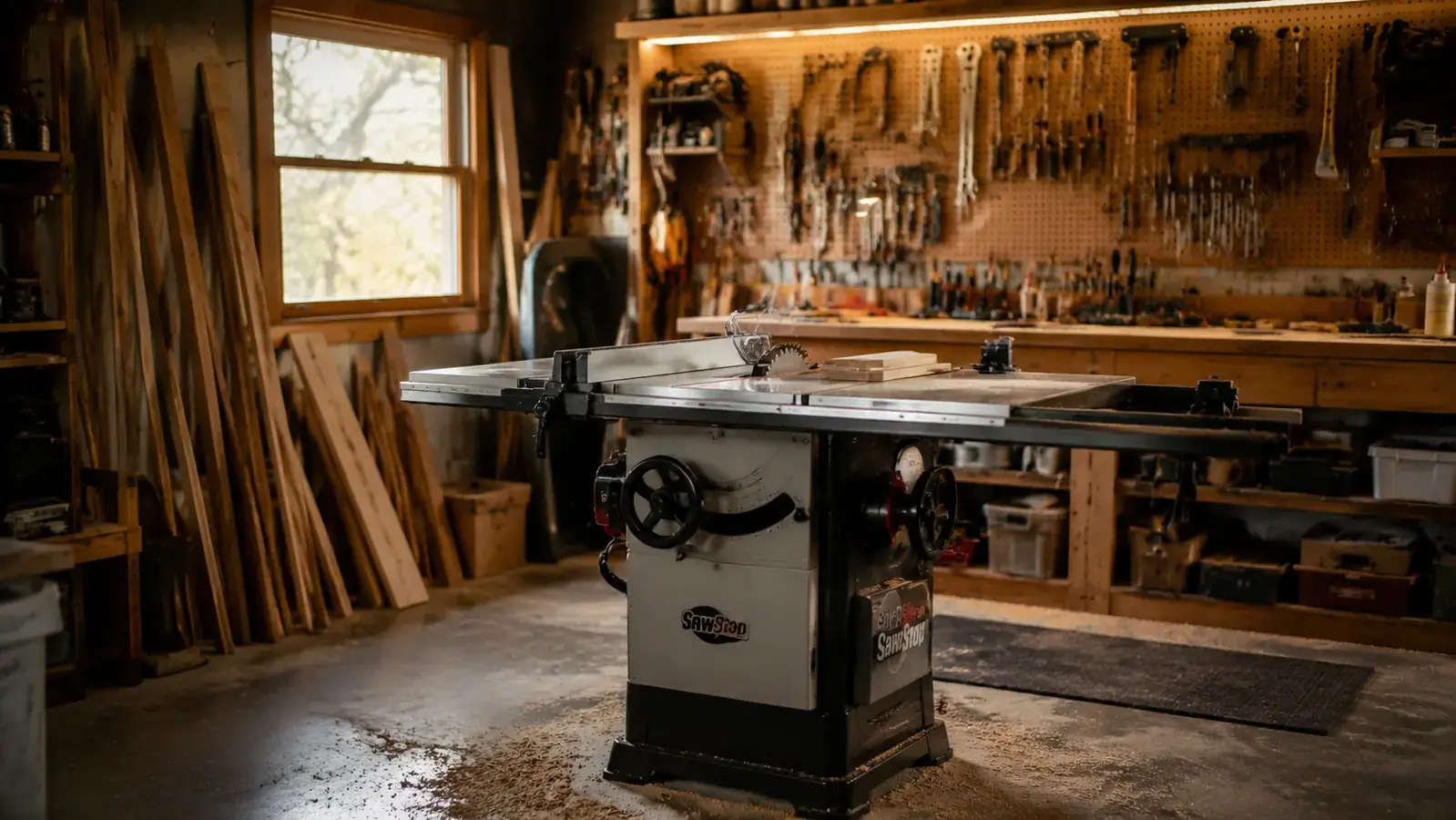
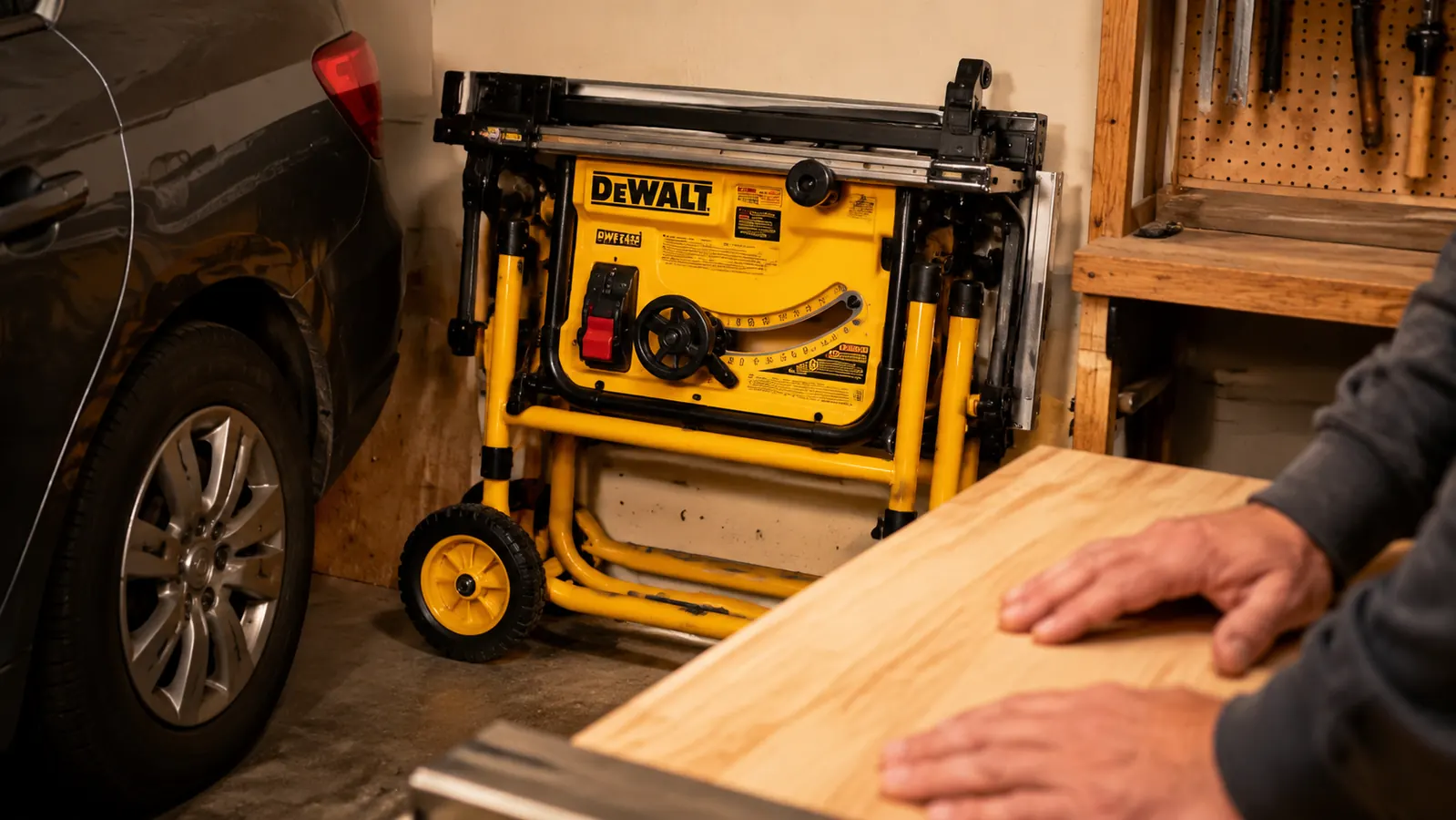
My one-car garage is 20 feet by 22 feet. Half of it still belongs to my wife's Honda. That leaves me roughly 200 square feet to fit a table saw, a router table, a band saw, a drill press, a workbench, and everything else that makes a shop a shop. I have been making it work for 25 years, but when my old contractor saw blew a capacitor for the third time in five years, I had to make a real decision. Cabinet saw: not a chance. Floor space alone kills it. Another contractor saw: I was done throwing money at something that needed a dedicated circuit and still wobbled on the fence. The DeWalt DWE7485 kept coming up in conversations with guys who had the same problem I did: real woodworkers in real small shops who needed a saw that could do actual work without eating the whole floor. I bought one in early 2024. I have put two solid years on it since then.
This is the long-term review. Not a box-open video, not three practice cuts on pine. Two years of ripping hardwood, cutting sheet goods, making cabinet parts, and doing all the annoying setup-and-put-away dance that comes with a shared garage. I will tell you what held up, what disappointed me, and who this saw is genuinely built for. If you want the short-term take with a different angle, I wrote a separate honest review of the DWE7485 covering things dealers skip over.
The Quick Verdict
The best jobsite table saw for a small home shop if you do not need to rip wider than 24-1/2 inches. Fence is accurate, motor handles hardwood well, and the whole rig folds up small enough to share a garage with a car. The 8-1/4 inch blade is the real tradeoff.
Amazon Check Today's Price →Still fighting a fence that won't hold its line? Two years in, this one still does.
The DWE7485 holds a consistent rip cut in oak, maple, and walnut without constant re-checking. Check today's price on Amazon before you settle for anything less.
Amazon Check Today's Price on Amazon →How I Have Used It
In two years I have cut through a lot of material on this saw. The biggest project was a set of walnut floating shelves for our living room, which meant ripping 8/4 rough-sawn walnut down to consistent 3/4-inch slabs, then trimming to final width. That is demanding work for any jobsite saw. Before that, I built a blanket chest in cherry, a small side table in white oak, and a cabinet for my shop that holds all my router bits and accessories. I have also run more sheet goods through it than I want to admit, including full sheets of 3/4-inch maple plywood broken down into cabinet parts.
Setup and teardown are a real part of my workflow, not an afterthought. I pull the saw out when I start a project, unfold the stand, dial in the fence, and put it away when I am done so the car can get in. That means I have set up and broken down this saw somewhere around 60 to 70 times. The stand is one of the better parts of this package. It locks up solid and rolls well on a concrete floor, and nothing has loosened up or rattled loose in two years of repeated use.
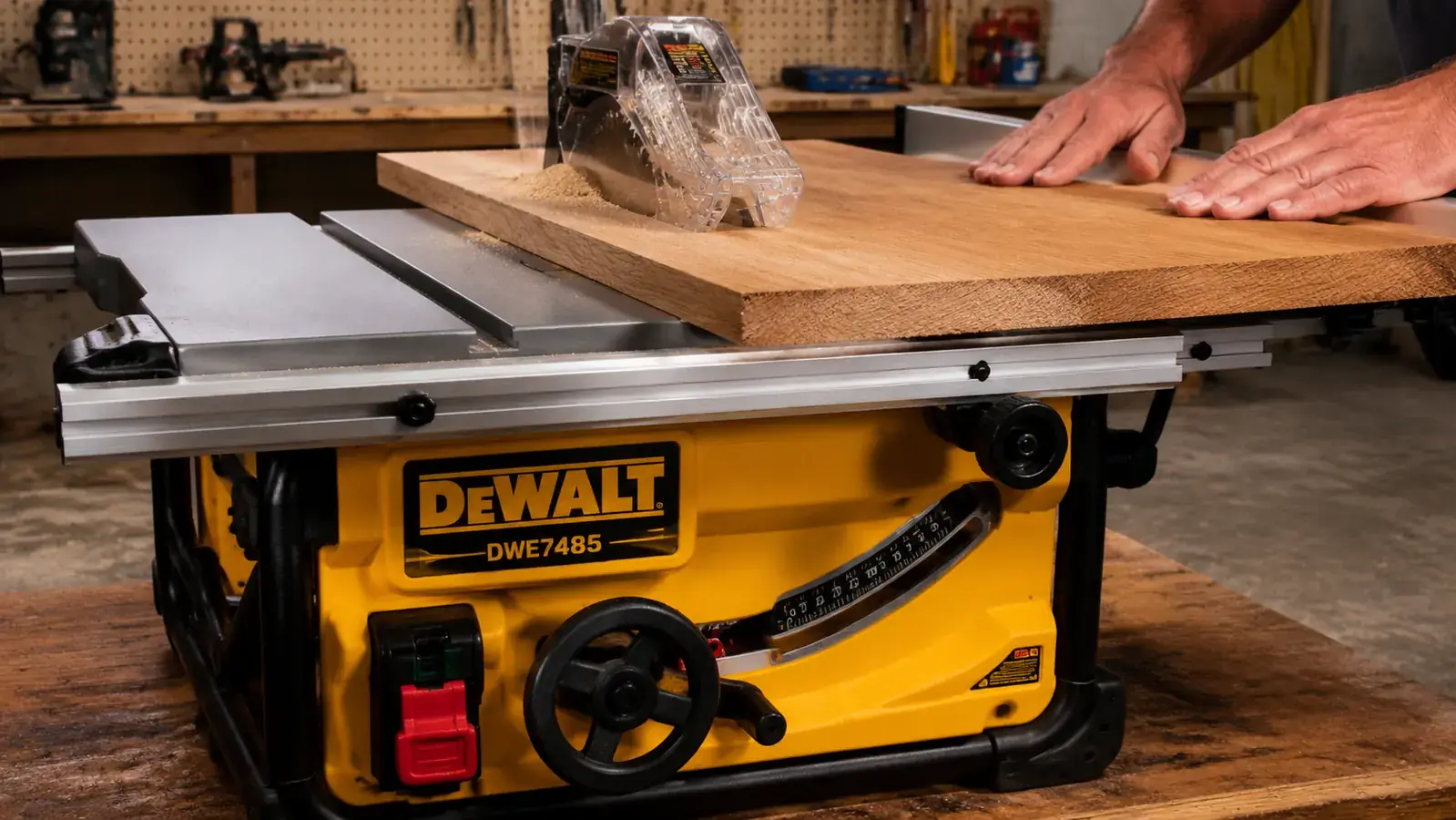
I keep a dedicated crosscut sled on this saw, one I built from scrap Baltic birch with a hardwood runner. The miter slots on the DWE7485 are consistent enough that the sled runs without slop. That matters more than people realize. A sled that fits right on Monday and wobbles by Friday because the slot is worn or was never true to begin with is a problem. I have had that problem on cheaper saws. Not on this one.
The Fence: Where This Saw Earns Its Reputation
The rack-and-pinion fence on the DWE7485 is legitimately good. I set it with a tape measure and a test cut, and it stays where I put it. That sounds like a low bar until you have used a saw where you set the fence to 4 inches, make a cut, and get 4-1/8 inches because the fence walked when the blade loaded up. I spent years tolerating that on my old contractor saw, adjusting my technique to compensate, telling myself it was a skill issue when really it was a tooling issue.
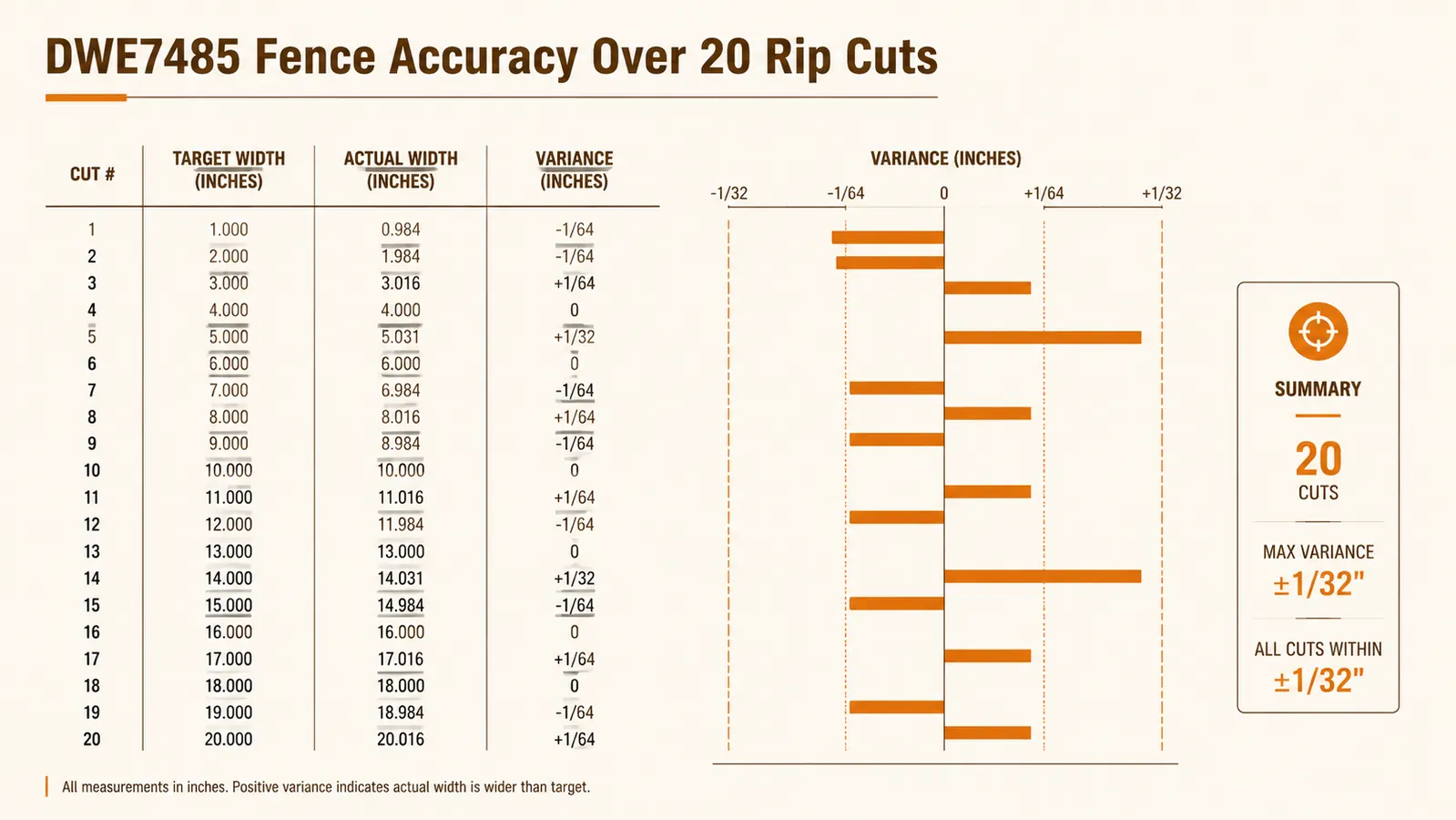
The fence locks firmly with the lever and does not move under load. I tested this repeatedly in the first few months, dialing in a width, making 10 or 12 rip cuts, then checking each piece. They came out within 1/32 inch of each other consistently. Not perfect, and not what a sliding table saw or a good cabinet saw would give you, but plenty accurate for furniture work. The scale on the fence rail reads accurately right out of the box, which is not always true on jobsite saws.
The rip capacity to the right of the blade is 24-1/2 inches. That is enough for most furniture parts, but you will feel it when you try to rip a full sheet of plywood down the long way. I work around this by using a circular saw with a guide rail to break down full sheets before they come to the table saw. Annoying, yes. A dealbreaker, no. It is the honest tradeoff you make for a saw that fits in a compact space.
Motor and Cutting Performance Over Two Years
The 15-amp motor runs at 4,800 RPM and has not given me a moment of trouble in two years. I cut 8/4 walnut, which is one of the heavier hardwoods most hobbyist woodworkers will encounter, and the motor pushed through without bogging. It slows noticeably in hard maple if you push the feed rate, but I have never had it stall or trip a breaker. I run it on a 20-amp circuit in the garage, and that is what I would recommend. On a 15-amp circuit it works fine for lighter material, but with hardwood you want the headroom.
The 8-1/4-inch blade is the most significant limitation of this saw, and I want to be honest about it. You cannot cut full 3-1/2 inch tenons in a single pass with a dado stack because standard dado sets do not fit an 8-1/4-inch arbor. I use a wobble dado for grooving and shallow rabbets, which works fine, but if your joinery relies heavily on through-tenons or wide housing dadoes, you will hit the ceiling of what this saw can do. That said, for furniture-scale work, dadoes for shelves, rabbets for back panels, grooves for drawer bottoms, it handles everything I throw at it.
I set the fence to 4 inches, made 12 rip cuts in white oak, and checked every piece. They came within 1/32 inch of each other. That is when I knew this saw had earned its spot in my shop.
Dust Collection: Better Than Most, Not Good Enough Alone
The DWE7485 has a 2-1/2-inch dust port that connects to a shop vac or dust collector. I run mine to a dedicated shop dust collector and capture probably 80 to 85 percent of the fine dust. That is better than any other jobsite saw I have used, but I still get fine airborne dust in the shop. I wear a respirator any time the blade is spinning, and I would tell you to do the same regardless of which saw you run. The dust port is positioned well and does not create a conflict with the rip fence at common settings, which is a small design detail that matters when you are connecting and disconnecting a hose a hundred times a year.
The one complaint I have is that the port reduces to 2-1/2 inches from a wider internal path, and at that diameter you get some resistance in the airflow if your dust collector hose has any kink in it. Not a major issue but worth knowing if you are planning a more elaborate dust collection setup. Use the shortest, straightest hose run you can manage.
What I Learned About Setup and Calibration Over Time
Out of the box, the DWE7485 was close but not dialed in. The blade was about 1/32 inch out of parallel with the miter slot, which is typical for any saw fresh from a warehouse. Squaring it up took about 20 minutes with a reliable square, a dial indicator, and the adjustment bolts under the table. I did it once when I bought it and have not needed to revisit it since. That speaks well to the rigidity of the trunnion design. On cheaper saws, blade alignment drifts with use, especially if you run hardwood regularly.
Blade height adjustment is smooth and stays where you set it. Bevel adjustment is accurate and the positive stops at 45 degrees are solid. I built a quick ripping jig for thin strips using a toggle clamp mounted to a piece of plywood, and the miter slot accepted the runner without any fitting needed. That tells you the slots are machined to a consistent dimension, which again is not guaranteed on a saw at this price point.
What Has Worn or Needed Attention in Two Years
The blade guard and riving knife are the original ones from the factory. The guard is the kind you pop off frequently when using a sled, which I do. After two years of being handled and stored, it shows minor cosmetic wear but functions fine. The riving knife is non-removable for through-cuts and swaps to a lower-profile splitter for non-through cuts. I use the splitter setup when I make shelf grooves, and I have never had a binding or kickback incident, which is all I ask.
The original DeWalt blade that came with the saw is a 24-tooth framing blade. I replaced it immediately with a quality 40-tooth combination blade, and the saw has run on that ever since. Blade quality matters more on a jobsite saw than on a cabinet saw because the motor has less torque reserve, and a sharp, quality blade reduces the load substantially. If you buy this saw, budget for a good blade from the start. Do not run the stock blade on furniture wood.
What I Liked
- Rack-and-pinion fence holds accurate settings cut after cut in real hardwood
- 15-amp motor handles 8/4 walnut and hard maple without stalling
- Folds compact enough to store against the wall in a shared one-car garage
- Miter slots are machined consistently enough for accurate shop-made sleds
- Rolling stand is solid, locks up without wobble, and has not loosened in two years
- Blade alignment held after one initial setup over two years of repeated use
Where It Falls Short
- 8-1/4 inch blade limits dado stack options, no standard stacked dado sets
- 24-1/2 inch rip capacity means full-sheet plywood needs a first-pass breakdown with a circular saw
- Dust collection captures most but not all fine dust, respirator still required
- Stock blade is a framing blade, replace it before cutting furniture-grade wood
- Fine dust gets into the motor housing over time, blow it out periodically
Who This Saw Is Built For
The DWE7485 is built for the woodworker who has a real shop in a small space. If you are building furniture, cabinets, shelving, boxes, or any other furniture-scale work in a garage or basement where a full contractor saw or cabinet saw is not practical, this saw does the job without apology. It is not a toy. The fence is accurate enough for serious work, the motor is adequate for hardwood, and the whole rig is compact enough that you can actually keep it in a space you share with a car, a freezer, or your kid's hockey gear.
It is also a sensible choice if you do a mix of in-shop and on-site work. Some guys I know run this saw at home and haul it to a cabin or client site when they need to. The portability that limits floor space at home becomes an advantage when you need to load it in a truck. For pure home shop use, you are leaving some of that portability value on the table, but the compact footprint still earns its keep.
Who Should Skip It
If you regularly need to rip full sheets of 4x8 plywood to arbitrary widths in a single pass, the 24-1/2 inch rip capacity will frustrate you. Go look at a contractor saw with a 30-inch or wider fence range. If you need to cut mortise-and-tenon joinery on a table saw using a traditional stacked dado set, the 8-1/4 inch blade format closes that door. And if you are doing high-volume production work where the saw needs to run for hours at a stretch without a break, this is a jobsite saw, not a production tool. It will get hot under sustained load. Plan your cuts accordingly.
I would also say skip it if you are shopping on budget alone and you do not actually need the portability or compact footprint. There are used contractor saws from reputable brands that can be had for similar money and offer more rip capacity, better dado options, and more table surface. The DWE7485 earns its price by being a legitimately capable saw in a small package. If the small package does not solve a real problem you have, it is not the right tool.
Two years in, I would buy this saw again without hesitation. Here is where to check today's price.
The DWE7485 is the saw I reach for every time I walk into my garage. Accurate fence, real motor, folds out of the way when I am done. If your shop is anything like mine, it solves the right problems. Check current pricing on Amazon and see if it makes sense for your setup.
Amazon Check Today's Price on Amazon →