
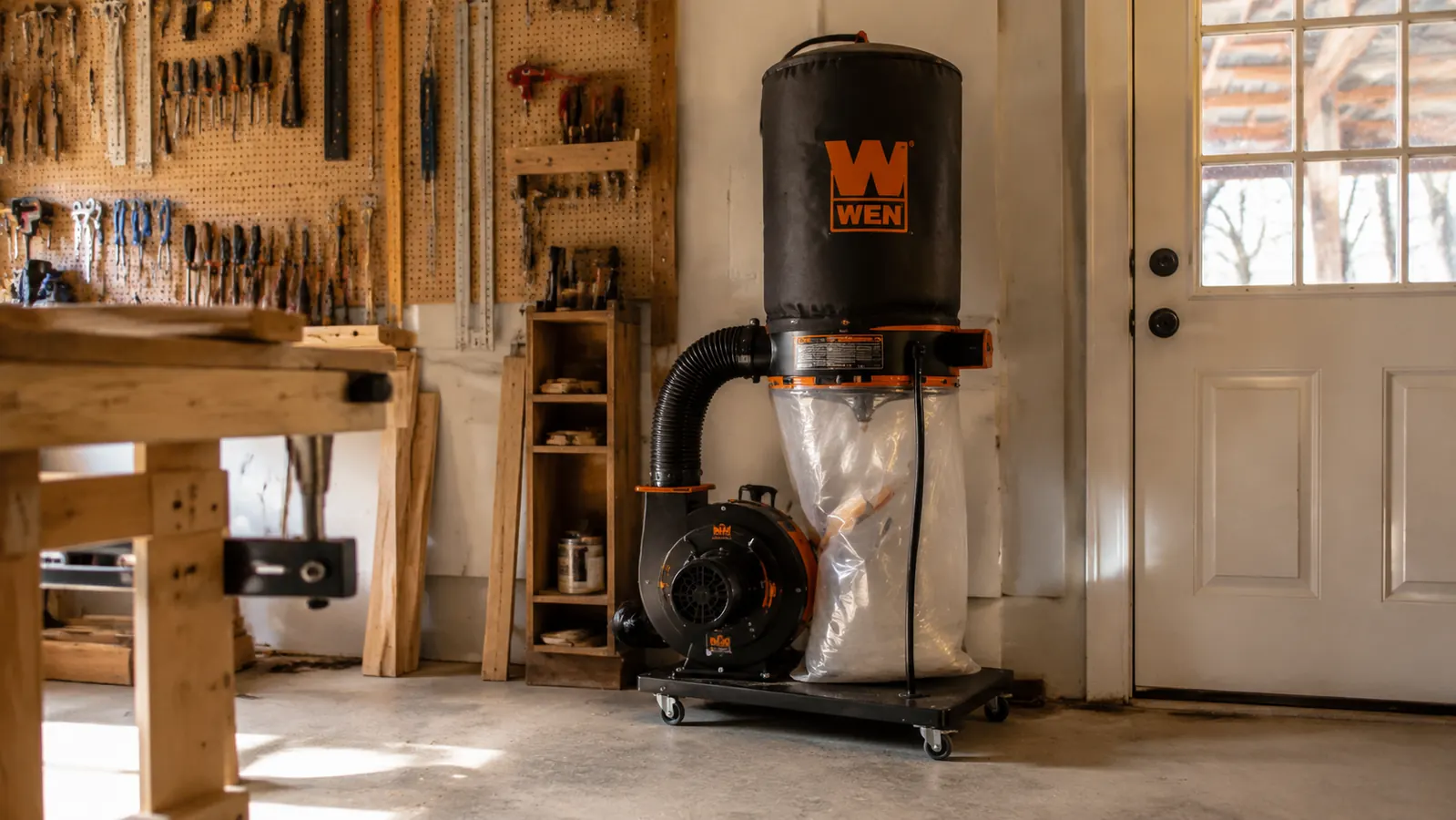
I spent a long time thinking dust collection was optional. Twenty-two years into woodworking, I had a shop vac in the corner, a broom I used too often, and a persistent cough every spring that I blamed on allergies. Then my doctor told me my lung function was down. She asked what I did for a hobby. I told her. She said: get a real dust collector or wear a respirator every single session. I went home and bought the WEN 5.7-Amp Dust Collector. That was 18 months ago.
I want to be straight with you up front: WEN is a budget brand. This machine has 4.1 stars on Amazon across 654 reviews, which is honest, not glowing. It is not a Oneida. It is not a Jet. It sits in a different category entirely. But here is what I can tell you after 18 months: it beats the heck out of nothing, and nothing was what most home woodworkers are running. If you're sweeping chips, if your finish coats show up with embedded dust, if your shop vac fills every third session, this machine will change things. I want to give you the real picture, not the catalog sheet.
The Quick Verdict
A legitimate entry-level dust collector for home shops. Honest limitations on filtration and hose fit, but a real improvement over no dust collection. Buy it if budget is the constraint; upgrade if you run a drum sander or heavy production schedule.
Amazon Check Today's Price →Done sweeping the same dust twice? The WEN gets you proper collection for under $130.
The WEN 5.7-Amp Dust Collector runs on a standard 120V outlet and connects to most shop tools via the included 4-inch hose. It has moved with me from one corner of my garage to another on its mobile base without complaint. Check today's price on Amazon before the next round of chips hits your floor.
Amazon Check Today's Price on Amazon →How I've Used It: 18 Months, Four Tools, One Garage
My shop is a single-car garage in Minnesota. Twelve by twenty-two feet. In that space I run a jobsite table saw, a router table I built myself, a random orbit sander, and a planer I borrowed from my brother-in-law and never gave back. That planer is the reason I needed more than a shop vac. One pass of rough-sawn white oak through that thing produces enough chips to bury a small dog. My shop vac was full in eight minutes.
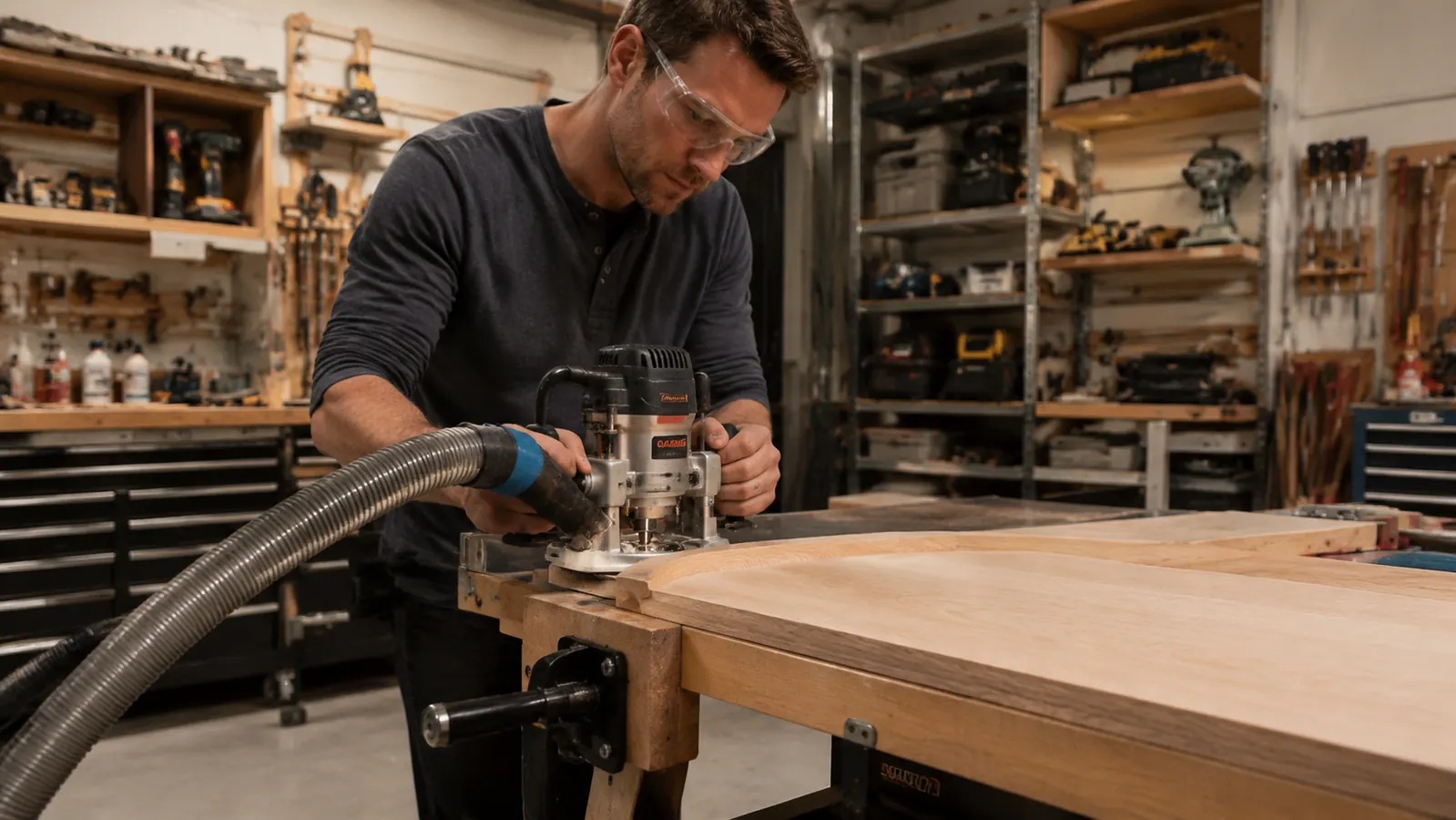
I've been running the WEN almost exclusively on the table saw and the planer. The router table gets the shop vac still, because the 4-inch hose doesn't fit the router table fence port without an adapter I built from a piece of PVC. The sander I mostly run outside in good weather. So this review reflects real daily use on the two highest-production tools in my shop, through a full winter of garage work, and that is how you should read it.
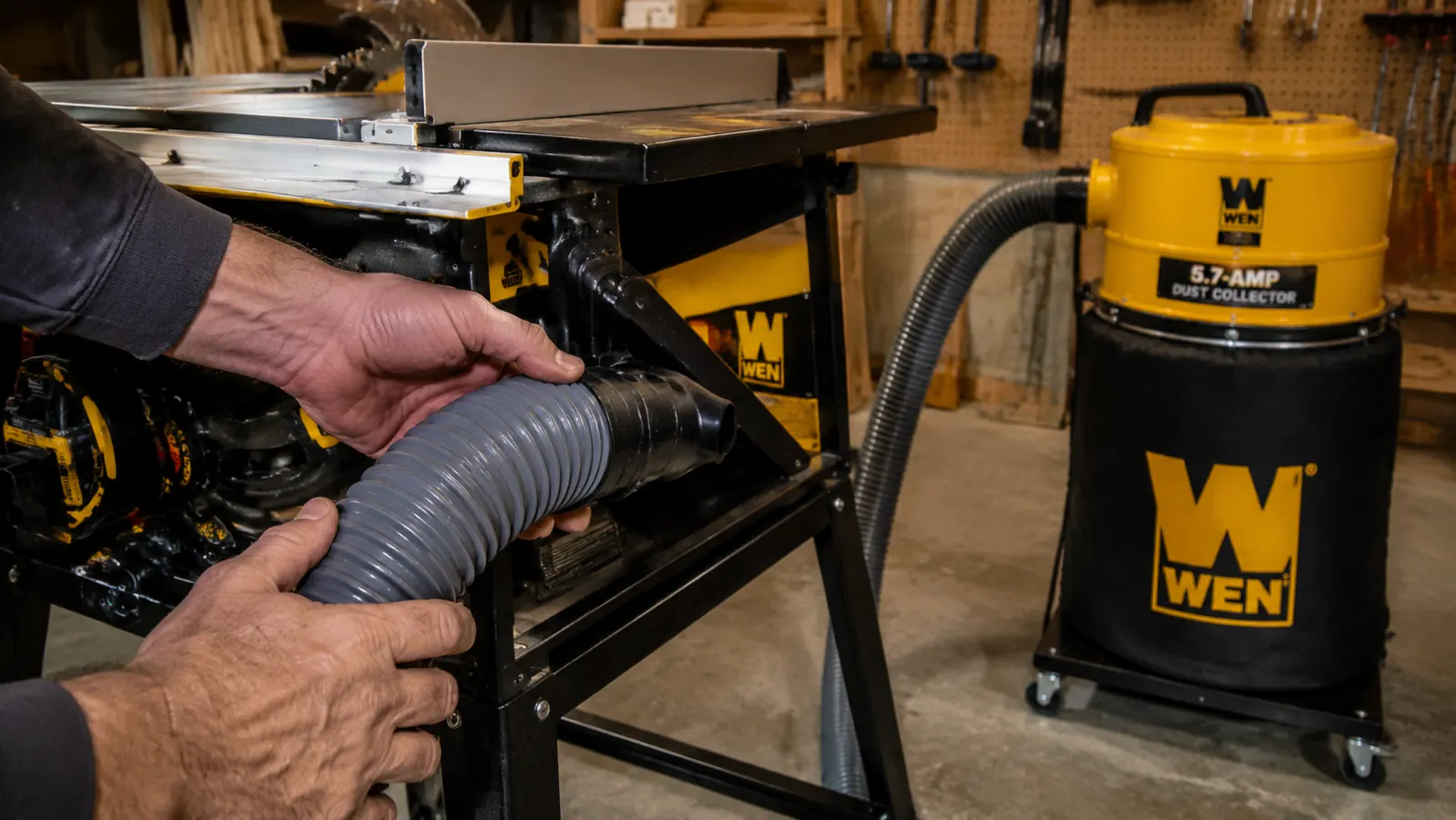
Setup took about 25 minutes out of the box. The mobile base went together without drama. The bag clamped on with a standard band clamp that felt slightly flimsy, but it has held. I rolled it into the corner next to the table saw, ran the 4-inch hose, and turned it on. The suction was noticeably stronger than my shop vac, the noise was about the same, and the first bag took three full sessions to fill. That was progress.
Motor, Airflow, and What 5.7 Amps Actually Gets You
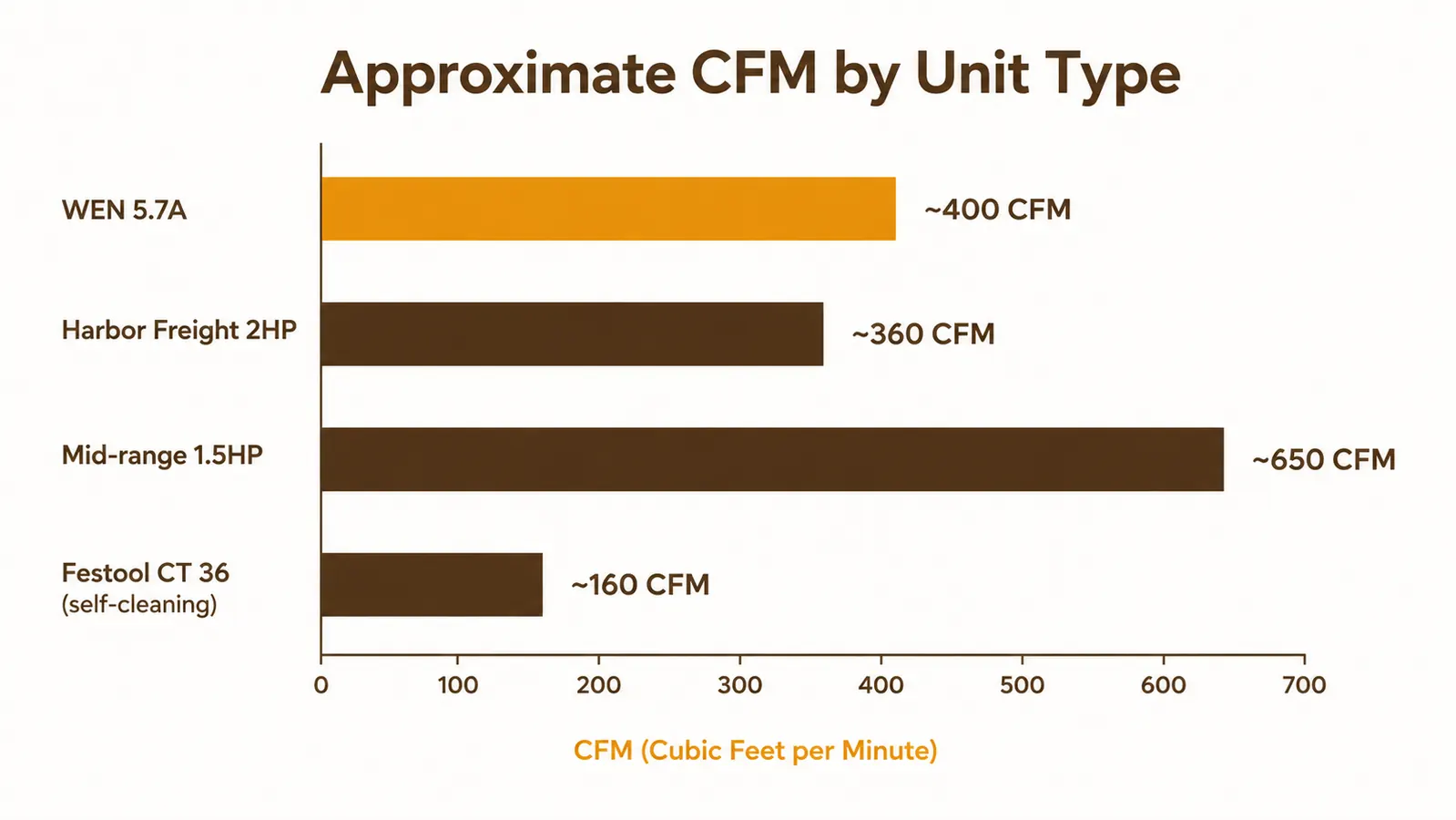
The WEN runs a 5.7-amp motor, which at 120V works out to roughly 680 watts. That drives around 400 CFM of airflow at the inlet, according to WEN's published specs. To put that in context: a shop vac in blower mode is typically 100 to 150 CFM. A serious two-stage collector from Oneida or Grizzly pushes 800 to 1,200 CFM. The WEN sits in the middle, closer to the bottom end than the top, but meaningfully above shop-vac territory.
In practice, on my DWE7485 table saw, the WEN catches most of the chips from rip cuts cleanly. Cross-cuts with a miter gauge still throw some dust into the air because there's no blade guard dust port on that saw, just an under-table port, and cross-cut turbulence escapes before the collector can grab it. The planer is where the WEN earns its keep. Most of the shavings go in the bag. Some fine dust still escapes and settles on flat surfaces in the shop, which is the limitation of the stock bag filtration at roughly 5 microns.
That 5-micron filtration is the honest weakness of this machine. Fine hardwood dust, the particles that cause the real lung damage, is in the 1 to 10 micron range. The WEN bag catches most visible chips and coarse dust, but some of the finest particles pass through. If you're running a lot of MDF, which is particularly nasty, you will want to either upgrade to a better filter bag or pair this collector with a ceiling-mounted ambient air filtration unit. I added a $45 box-fan HEPA filter to my shop after the first winter, and the combination works well.
The WEN caught most of the chips. Some fine dust still settled on flat surfaces. That is the honest limitation of a 5-micron bag, and you should know it going in.
The Bag: Capacity, Leakage, and What I Changed
The 12-gallon collection bag is the WEN's biggest annoyance in daily use. It is made from a woven fabric that feels adequate for the first six months. Then it develops micro-pinholes from abrasion at the band clamp, and you'll notice a ring of fine dust on the floor around the base of the machine. I replaced the bag at month seven. Replacement bags run about $15 to $20 and fit without issue.
Emptying the bag is a two-person job if you want to avoid wearing its contents. The band clamp at the bottom releases the bag, which then wants to invert itself and puff fine dust into the air. My solution after the first blunder was to use a heavy-duty contractor bag as a liner inside the collection bag. Slide it in at the start of each session, tie it off when it's getting full, pull the liner out with the dust inside it. Takes an extra 30 seconds and saves you a face full of hardwood chips.
Hose Fit and Connection Quirks
The WEN ships with one 4-inch flex hose that is about five feet long. It fits the table saw port and the planer port I use without issue. It does not fit the router table fence port I have, which is a 2.5-inch slip joint, and it does not fit the sander's dust shroud, which is 1.25 inches with a bag attached.
If you plan to run the WEN to multiple tools, budget another $20 for hose adapters. The 4-to-2.5-inch reducer is the most useful. You can find them at any big-box home center. WEN does not include any adapters in the box, which is a miss on their part. Most of their target customer is connecting to more than one tool, and a basic adapter kit would add maybe $3 to their production cost. This is not a dealbreaker, just a small frustration on unboxing day.
The hose included is a bit stiff in cold weather, which matters to me because my Minnesota garage in January is around 40 degrees Fahrenheit even with a space heater running. I replaced it with a 10-foot, 4-inch flex hose I found for $18, which is more flexible in the cold and long enough to reach the far end of my table saw extension wing. Small upgrade, noticeable improvement.
What I Liked
- Significantly better airflow than a shop vac, real improvement on table saw and planer duty
- Mobile base rolls easily on concrete, the locking casters actually hold
- Runs on a standard 120V outlet, no rewiring or special circuit needed
- Quiet enough to hold a conversation over it, less fatiguing than a shop vac
- Compact footprint for a dust collector, fits in a tight one-car garage corner
Where It Falls Short
- 5-micron bag filtration misses the finest hardwood dust particles, consider a HEPA ambient filter as a companion
- Bag develops pinhole leaks after 6 to 8 months of heavy use, budget for replacement
- No hose adapters included, you will need them for router tables and sanders
- 4.1-star rating is honest: this is a budget machine, not a precision tool
- Short hose at 5 feet, worth buying a 10-foot replacement for larger shops
Noise, Motor Longevity, and 18-Month Reliability
The WEN is rated at around 70 dB, which matches my shop measurement with a phone app. That is about the same as my shop vac and louder than a conversation but not loud enough to require ear protection on its own. When I run it at the same time as the table saw, I wear earmuffs regardless, so the collector's noise contribution is moot.
The motor has given me zero trouble in 18 months. It starts clean every time, including in cold weather, and has not thrown any odd smells or overheating issues. I run it in 45-minute sessions without break during winter projects, and it has never complained. I cannot speak to five-year reliability because I have not had it that long, but the build quality of the motor housing and impeller feel solid enough. The plastic parts of the lid assembly feel less robust. My shop neighbor cracked his lid piece dropping a router base on it. A new lid is about $30 from WEN's parts department, which suggests they support the machine.
Who This Is For
The WEN dust collector is the right tool for the home woodworker who is currently running no dust collection or a basic shop vac, who works in a single-car or double-car garage, and who runs one or two tools at a time. If that is you, this machine will make a real difference in your shop air quality, your floor cleanliness, and your finish quality. It is also the right first step for someone who plans to eventually build out a full duct system but wants to start collecting before dropping $600 on a two-stage unit. You can always move this machine upstream in a future system. If your shop is small and your tool count is modest, you may find the WEN does the job for years without ever needing an upgrade. For anyone considering the alternatives, my full breakdown is in the WEN vs Harbor Freight dust collector comparison, and for setting up your whole collection system, see my guide on how to set up dust collection in a home woodshop.
Who Should Skip It
If you run a drum sander, a wide-belt sander, or a 15-inch planer in your shop, the WEN will not keep up with chip volume and fine dust load. You need a two-stage collector with a 1.5 to 2 HP motor for that scale of production. If you are building furniture for sale and running your shop six or eight hours a day, the WEN is underspec for that duty cycle. Budget up to a Jet or Grizzly single-stage at minimum. And if MDF is a significant part of your work, the 5-micron bag is genuinely inadequate for the fine particles MDF produces. Pair it with a better filter or buy a machine with a 1-micron canister filter to start.
If your floor is cleaner than your lungs, the WEN is where the math starts to change.
At current pricing, the WEN 5.7-Amp Dust Collector is one of the lowest-cost ways to move from no dust collection to real dust collection. The mobile base, the 4-inch hose, and the 12-gallon bag are all included. My honest recommendation: buy it, add a HEPA ambient filter in your shop, and pick up a hose adapter for your smaller tools. That full setup will run you under $200 and make a measurable difference in how your shop air feels after an hour of work.
Amazon Check Today's Price on Amazon →