
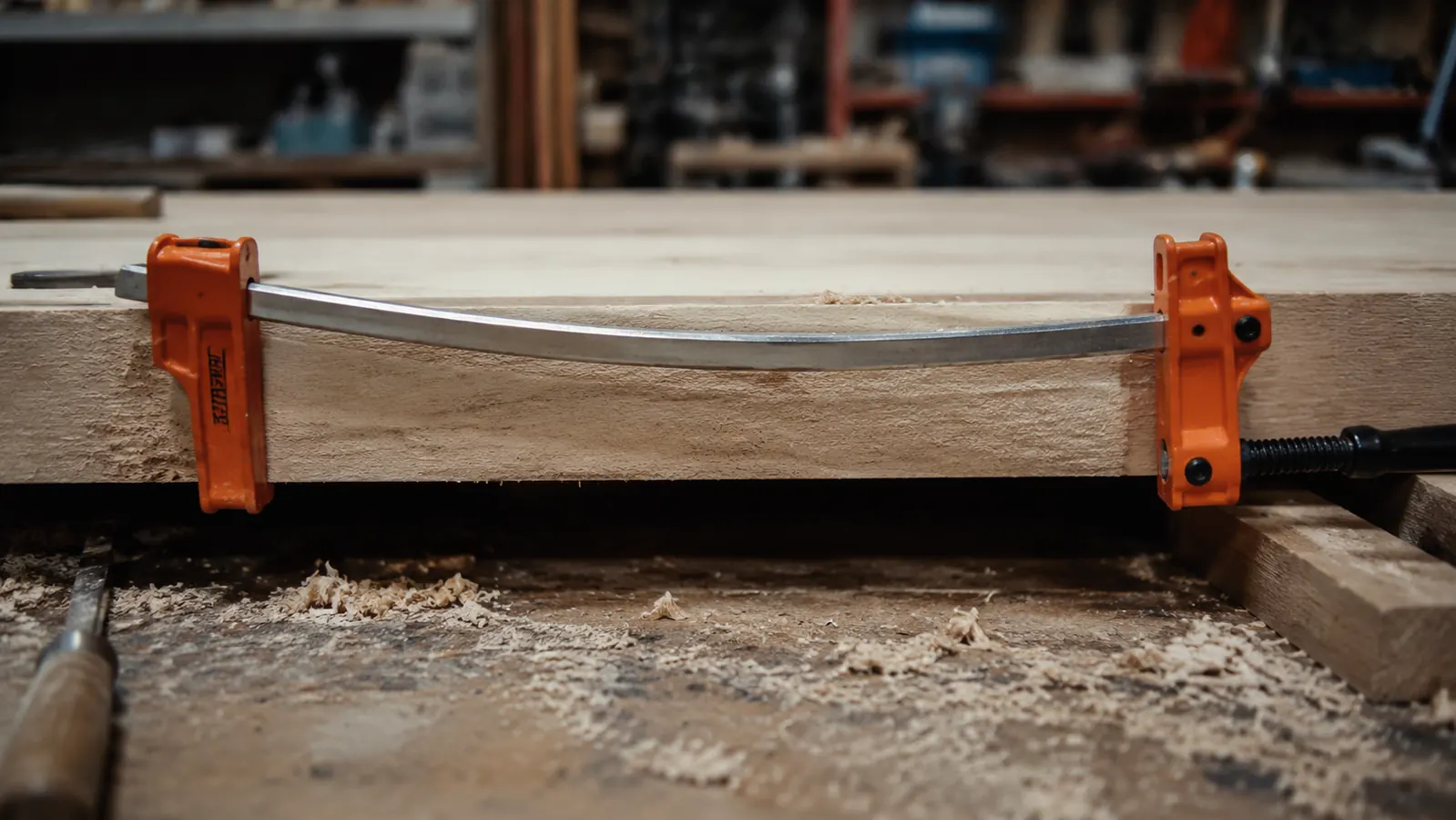
Let me tell you something the IRWIN Quick-Grip product listing will not tell you. The bar flexes. Not dramatically, not enough to wreck your project if you are using them correctly, but it flexes. I noticed it the first time I tried to use a pair of these on a 2-inch thick white oak rail, clamping a bridle joint while I waited for the glue to grab. The bar bowed maybe an eighth of an inch at the midpoint. The clamp held, but the joint had moved about a thirty-second off square and I had to break it apart and reset it. That is not a catastrophic failure. It is just the kind of thing that sends you to a Bessey instead.
I have owned my Quick-Grip set for a while now and I use it constantly. I am not writing this to talk you out of buying one. I am writing it because the gap between what a product listing says and what actually happens in a home garage shop matters, and most reviews of these clamps are written by people who used them on a pine 2-by-4 and called it a day. There are specific situations where Quick-Grips fail in ways nobody warns you about, and there is a real answer to the question of how many you actually need before you are just hoarding orange plastic.
The Quick Verdict
A solid one-handed clamp that earns its place in any home shop, but the bar flex and jaw racking under heavy load are real limitations you need to account for before you use these on your more demanding joinery. Buy the set. Know when to grab a Bessey instead.
Amazon Check Today's Price →If you are clamping face frames, drawer boxes, and small carcasses, this set will work hard for you.
The IRWIN Quick-Grip 8-piece set gives you eight clamps in a range of 6-inch reach sizes. One-handed application, quick release, spreader-capable. Understand the load limits and these earn their spot on the wall. Check today's price on Amazon.
Amazon Check Today's Price on Amazon →How I Have Been Testing These in My Shop
My garage shop in central Wisconsin is where I do mixed furniture and casework, mostly hardwoods: walnut, hard maple, white oak, and some cherry. I work alone on weekends. My projects over the past year have included a walnut side table with mortise-and-tenon apron joints, a cherry jewelry box with splined miters, a set of wall-hung cabinet boxes in oak plywood, and a small hall bench with a lift-top storage seat. That range of projects put the Quick-Grips through different load scenarios. I took notes on where they worked cleanly and where I swapped them out.
For the clamping force claims, I pressed the clamp jaw down onto a bathroom scale and recorded readings at a squeeze I could maintain for 30 seconds, which is roughly what you are doing mid-glue-up. I got between 120 and 155 pounds depending on which clamp in the set I used. The variation across the eight clamps surprised me a little. Some of them are noticeably weaker than others right out of the box, which suggests quality control is not perfectly consistent across a single production run.
The Bar Flex Problem: What It Is and When It Matters
The Quick-Grip bar is steel. It is not thin, stamped sheet metal. Under moderate load, say 80 to 100 pounds of clamping force applied to a joint with a narrow glue surface, the bar holds stiff. The issue shows up at the upper end of the clamp's rated force, especially when the load is applied across a wide span with the bar near full extension. Pull the moveable jaw out to 10 or 11 inches and squeeze as hard as you can on thick stock. You will see the bar arch upward slightly in the middle. That arch means the force is not being transmitted straight through the joint. It is being partially lost to the flex in the bar itself.
This is an engineering tradeoff, not a defect. The bar has to be light enough that the clamp is practical to operate with one hand. A bar stiff enough to eliminate flex at full extension would be heavier than you want to hold one-handed over a glue-up. IRWIN made a reasonable call for the product's intended use. The problem is when buyers assume the bar is rigid like a Bessey K-body bar, which is a very different piece of steel designed specifically to resist deflection under load. The Bessey bar is heavier, two-handed to apply, and costs more per clamp for a reason.
When does bar flex actually hurt you? When you are clamping a joint that needs to stay in a specific plane while the glue cures. Mortise-and-tenon joints, bridle joints, half-laps: these joints have some tolerance in them before glue is applied, and the bar flex can let the workpiece drift a few degrees off square during the clamp cycle. On a box corner with a tiny glue surface, it almost never matters. On a chair leg with a 3/4-inch tenon going into a 3/4-inch mortise in 8/4 stock, it can drift your leg angle in a way that is visible when the chair is done.
Jaw Racking Under Heavy Clamping: The Thing the Listings Never Mention
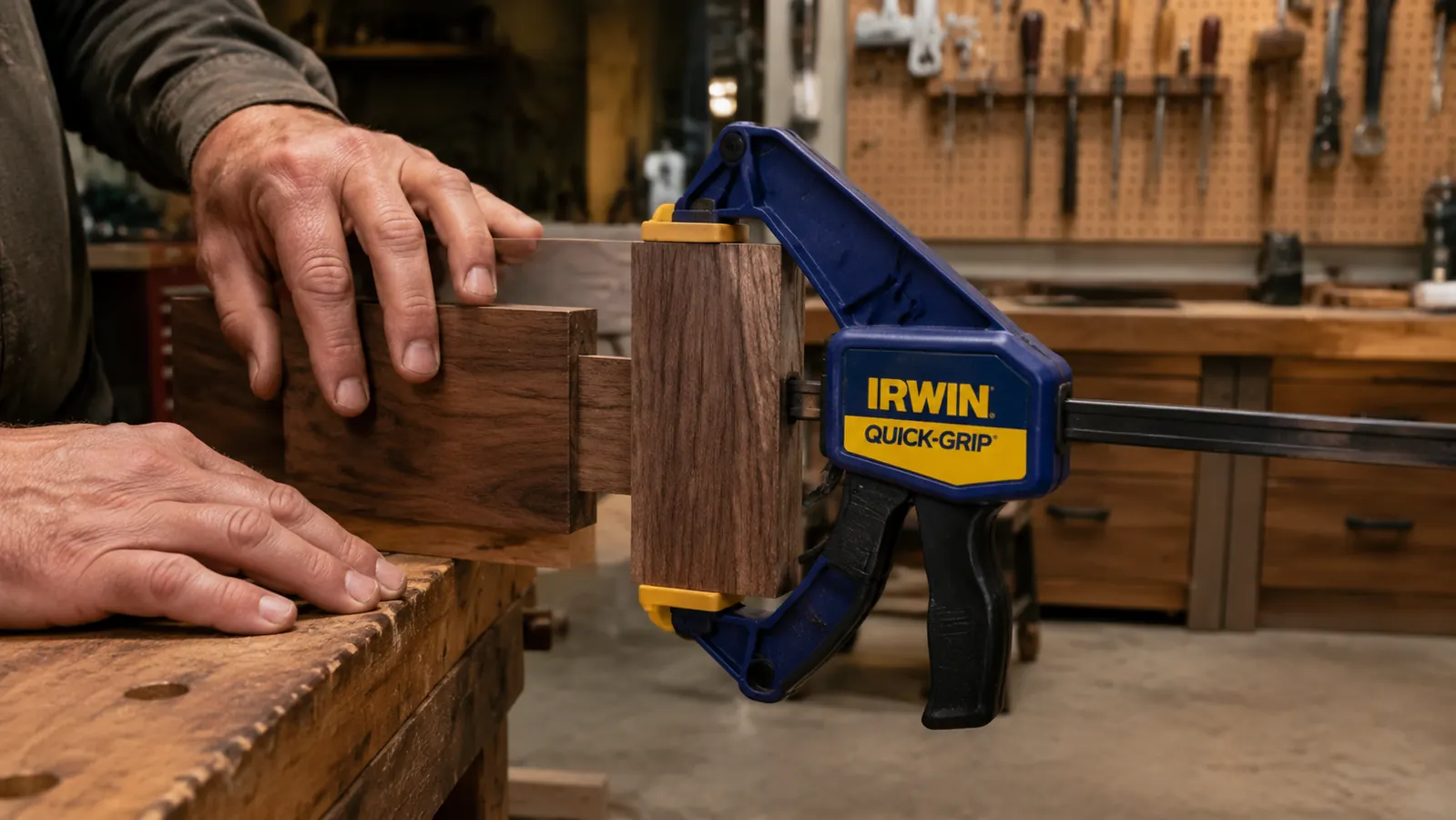
Jaw racking is what happens when the moveable jaw of the clamp rotates slightly around the bar under load instead of staying square to the workpiece. You see it as a slight tilt of the jaw face relative to the wood surface. On a smooth flat face, racking shows up as a crescent-shaped pressure mark from the pad edge instead of a full even contact patch. I first noticed it when I was using a Quick-Grip to hold a splined miter joint on the cherry jewelry box. I had the clamp set up across the corner and squeezed it down hard. When I pulled the clamp after cure, I had a slight ridge on the cherry face from the jaw edge biting in at an angle.
The mechanics of racking are straightforward. The moveable jaw rides on the bar in a channel. That channel has a small amount of angular play so the jaw can accommodate slight variations in workpiece thickness. Under heavy clamping force, the jaw rotates to its angular limit in the channel and stays there. The rubber pad is supposed to compensate by conforming to the surface, and on softwood or rough-sanded hardwood it usually does. On glassy-smooth jointed surfaces, the rubber cannot compress enough to keep the full pad in contact, and the edge of the jaw digs in.
The fix is simple: use a caul. A strip of 3/4-inch plywood or MDF between the jaw pad and your workpiece distributes the load across a wider area and eliminates the edge-dig problem entirely. Most experienced woodworkers do this as a habit with any bar clamp. The Quick-Grip's jaw racking just makes it a higher priority than it would be with a clamp that has a more precise jaw-to-bar fit. If you are going to use these on show faces, keep a stack of MDF caul strips at the bench.
The bar flexes at full extension and the jaws rack on smooth hardwood faces under heavy load. These are not flaws you should be surprised by. They are the direct result of engineering a one-handed clamp at a one-handed price point.
When You Outgrow Quick-Grips and Need Real Bessey K-Bodies
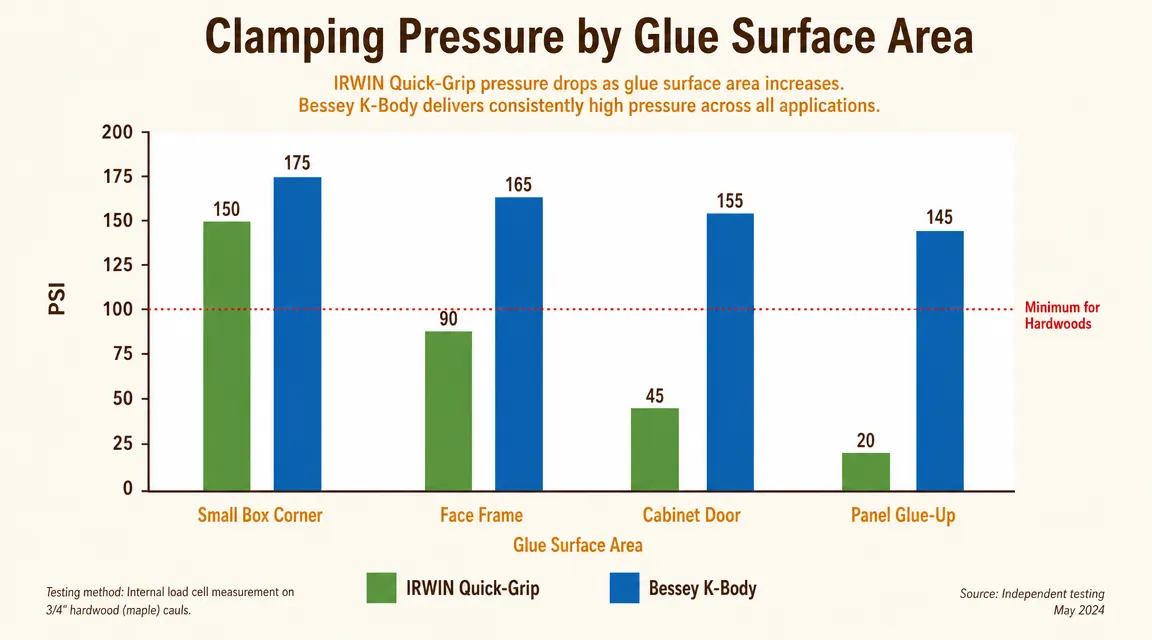
I want to be specific about this threshold because I see a lot of hobbyists holding off on buying Besseys because they think their Quick-Grips can handle the work. Sometimes they can. Sometimes they are leaving glue joints weaker than they realize, and the joint holds for a year or two and then opens at the first real stress. Here is my rule: when your glue surface area per joint exceeds about three square inches and the material is a hardwood, you need a rigid bar clamp. The Quick-Grip at 150 pounds of force on a 3 square inch surface is giving you 50 psi. That is the low end of adequate for hardwoods and it assumes you are actually achieving the rated force, which not all eight clamps in the set do consistently.
The specific project types where I default to Bessey K-bodies now: panel glue-ups of any width over 8 inches, chair joinery with 3/4-inch or larger tenons, wide cabinet door frames, and any joint where I need the parts to stay perfectly in plane during cure. The Bessey K-body bar does not flex at normal working loads. The jaw has a finer fit on the bar. The clamping force is higher and more consistent. I run a set of Bessey K-body 24-inch and 36-inch clamps for all of that work and I have not gone back to Quick-Grips for it. You can read more about how those two clamps stack up in my IRWIN versus Bessey comparison.
The price difference is real but it is not as large as you might think when you work it out per project. A pair of Bessey K-body 24-inch clamps runs around 55 to 65 dollars per pair depending on sales. For most panel glue-ups you need six to eight clamps, alternating top and bottom. That is three to four pairs, so call it 180 to 260 dollars for a full panel glue-up set. That feels like a lot until you consider that a failed tabletop glue-up costs you the board footage, the finish materials, and a full day of your Saturday. One saved panel glue-up covers the Bessey investment.
The How Many Do You Actually Need Reality Check
People overestimate how many clamps they need before they have done many glue-ups, and then they buy too many of one type and not enough of another. Here is the breakdown from my actual shop practice over the past few years of regular furniture building.
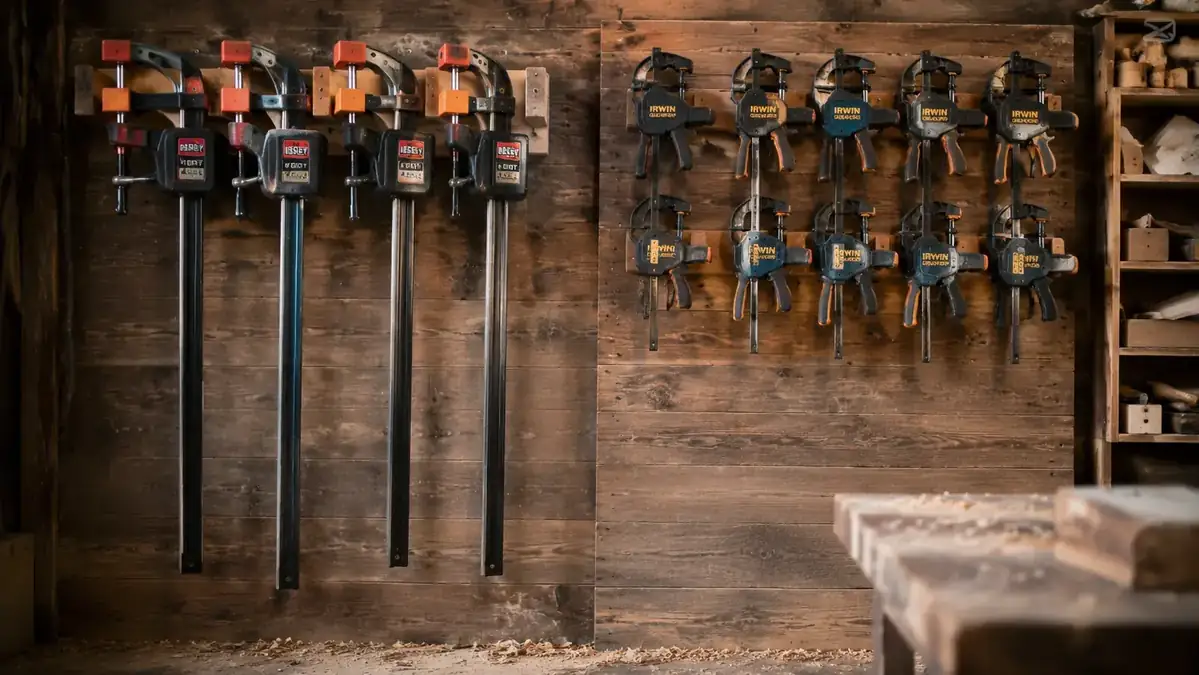
For one-handed quick-grip style clamps, eight is the right number for a typical hobbyist home shop. You use four to six on most assembly jobs: two to hold a cabinet carcass square while you check it with a square and a diagonal measurement, two to hold a face frame in position while you drill pocket screw holes, one or two as stop blocks or hold-downs at the router table. You rarely need more than six in any single operation. The last two in the set are your insurance clamps for larger setups. I have never needed more than eight in a single operation in my shop, and I have done some reasonably complex multi-part assemblies.
The mistake I see is guys buying a second set of eight Quick-Grips instead of using that 40 dollars toward their first pair of Besseys. If you already own eight Quick-Grips and you are doing any kind of panel glue-up or mortise-and-tenon work, the next purchase should be a starter pair of Bessey K-bodies. You can also look at why these clamps earn their place even with their limits if you are still making up your mind on the set. But doubling your Quick-Grip count is rarely the right move. You hit diminishing returns fast.
The other clamp category worth budgeting for is pipe clamps with 3/4-inch pipe. Pipe clamps are the hobbyist's alternative to long Besseys for wide panel glue-ups. A Pony Jorgensen 50 pipe clamp head costs about 12 dollars and works with any length of 3/4-inch black pipe you can get cut at the hardware store. For deep-reach clamping on a 30-inch dining tabletop, two pipe clamps give you more force and more reach than anything in the Quick-Grip product line, at a fraction of the cost of long Bessey bars.
What I Liked
- One-handed application genuinely reduces setup stress during a timed glue-up with open glue
- Quick-release lever is fast and stays smooth with light use
- Eight clamps at one price covers most assembly operations for a home shop in one purchase
- Spreader function works well on drawer boxes and carcass assembly, fast to set up
- Adequate for face frames, small carcass boxes, picture frames, and thin-stock joinery
- Light enough to apply and reposition without putting the workpiece down
Where It Falls Short
- Bar flexes visibly at full extension under heavy load, can drift a joint out of plane during cure
- Jaws rack slightly on smooth hardwood faces under maximum clamping force, use cauls to compensate
- Clamping force varies noticeably across clamps in the same set, not all eight reach the rated 150 pounds
- 6-inch throat depth limits usefulness on panels or carcasses wider than about 5 inches
- Not appropriate for mortise-and-tenon or heavy joinery that needs a rigid bar and consistent force
- Buying a second set of eight is rarely the right call; that money should go toward Bessey K-bodies
Where They Work Exceptionally Well
I do not want this whole review to read like a caution label. There is a wide range of shop work where the Quick-Grip is simply the right tool and performs without any of the issues I have described above. Picture frame glue-ups. Small box corners. Face frame assembly with pocket screws. Hold-downs on the drill press table. Stop blocks clamped to a fence. Temporary workholding while you check something for square before committing to fasteners. Edge-banding holddowns. Anything where you need a clamp for 90 seconds while you reach for the drill.
In the hall bench I built earlier this year, I used Quick-Grips exclusively for the carcass assembly while I drove the screws, then swapped them out and used Besseys for the final glue cycle. That combination workflow is the natural way to use these. Quick-Grips for setup and positioning, proper bar clamps for the cure. If that is how you approach your glue-ups, you will wonder how you managed without them.

Who This Is For
Buy the IRWIN Quick-Grip set if you work alone and do mixed furniture and casework where assembly positioning is as much of a challenge as raw clamping pressure. If you are building smaller-scale work in softwoods or lighter hardwoods, poplar, alder, soft maple, the 150-pound rating is genuinely adequate for most of what you will do. If you want a first clamp set that covers a lot of ground without a big investment, the eight-piece Quick-Grip set is a reasonable starting point, particularly if you understand that panel glue-ups and heavy mortise-and-tenon work will eventually require a separate bar clamp purchase.
Who Should Skip It
If your primary work is wide panel glue-ups and heavy joinery in 8/4 hardwood, and you are hoping to avoid buying Besseys by using Quick-Grips instead, save yourself the frustration and go straight to the K-bodies. The Quick-Grips will let you down in exactly the moments when you need the most from a clamp: the end of a long glue-up, high-force joints in thick stock, work where a half-degree of jaw racking shows up in the finished piece. The 40 dollars you spend on the Quick-Grip set is better spent as part of the budget for your first two Besseys if serious joinery is your main work.
Eight clamps for assembly, positioning, and light glue-ups: they earn the 40 dollars.
If you go in knowing the bar flex limits and the jaw racking on smooth faces, the IRWIN Quick-Grip set is a genuinely useful addition to any home shop clamp wall. Check today's price on Amazon and see if a discount is running.
Amazon Check Today's Price on Amazon →