
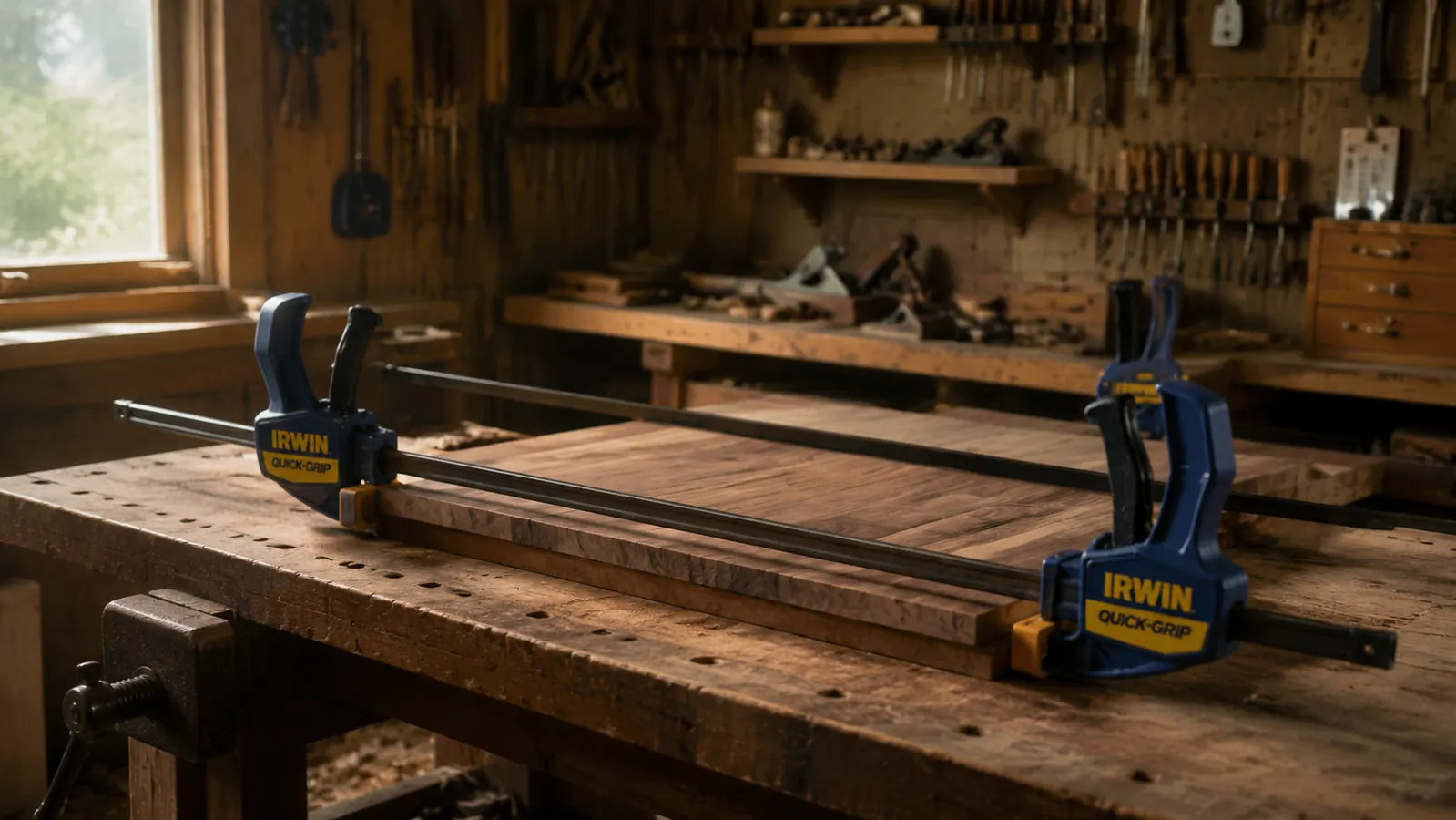
Three years ago I got tired of running out of hands during glue-ups. I had a good set of Bessey K-bodies for panel work and a few Jorgensen bar clamps that had been on the wall since my father-in-law gave them to me, but every time I was doing a drawer carcass or a face frame by myself, I kept needing one more clamp than I had free hands to place it. That is when I picked up the IRWIN Quick-Grip 8-piece set, mostly as a convenience purchase. Three years and a couple hundred glue-ups later, they have earned a permanent spot on my clamp wall.
I want to be straight with you before we go further: these are not a replacement for real bar clamps on a serious panel glue-up. If you are laminating a 30-inch wide tabletop from six boards of 8/4 walnut, you want clamping force measured in hundreds of pounds per square inch and a rigid bar that will not flex. The IRWIN Quick-Grip is not that tool. But if you understand what it is built for, you will use it constantly. I reach for mine probably four times a week in my garage shop.
The Quick Verdict
A genuinely useful one-handed clamp that holds up to three years of regular shop abuse. Modest clamping force is the real limit, but for 90 percent of what a hobbyist woodworker does on a given Saturday, the Quick-Grip is the right tool for the job.
Amazon Check Today's Price →If you have ever run out of hands mid-glue-up, this is the fix.
The IRWIN Quick-Grip 8-piece set covers 6-inch and larger reach situations. One-handed squeeze, no ratcheting, quick release. Check today's price on Amazon before the set goes up.
Amazon Check Today's Price on Amazon →How I Have Used These Over Three Years
My shop is a one-car garage in suburban Minnesota. I have about 16 feet of working depth and a Unisaw that takes up too much of it. I work mostly in hardwoods, mostly furniture: chairs, boxes, a couple of shelving units, a blanket chest, a hall table last fall. I build alone. No helper to hold a clamp while I position the next one.
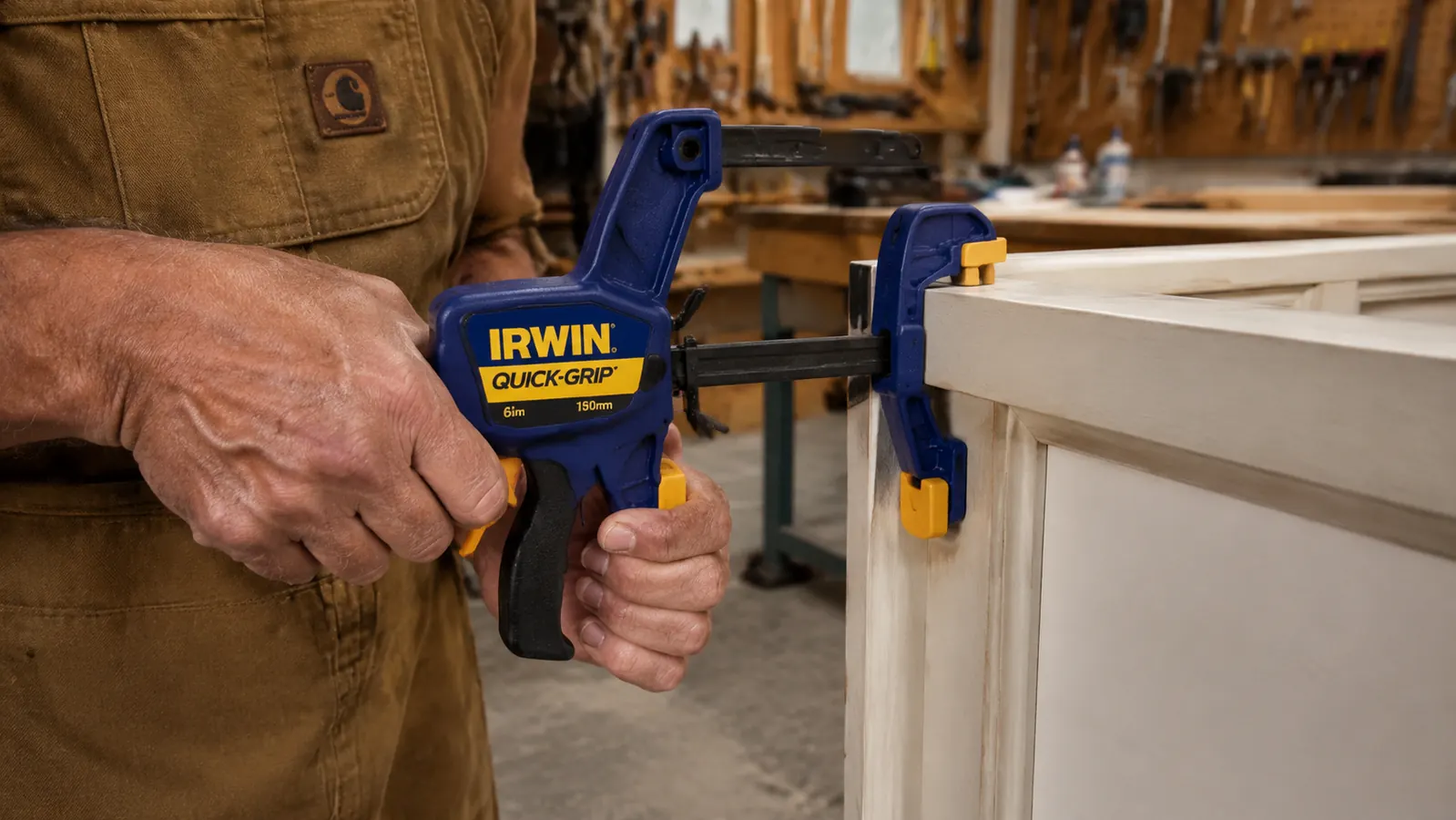
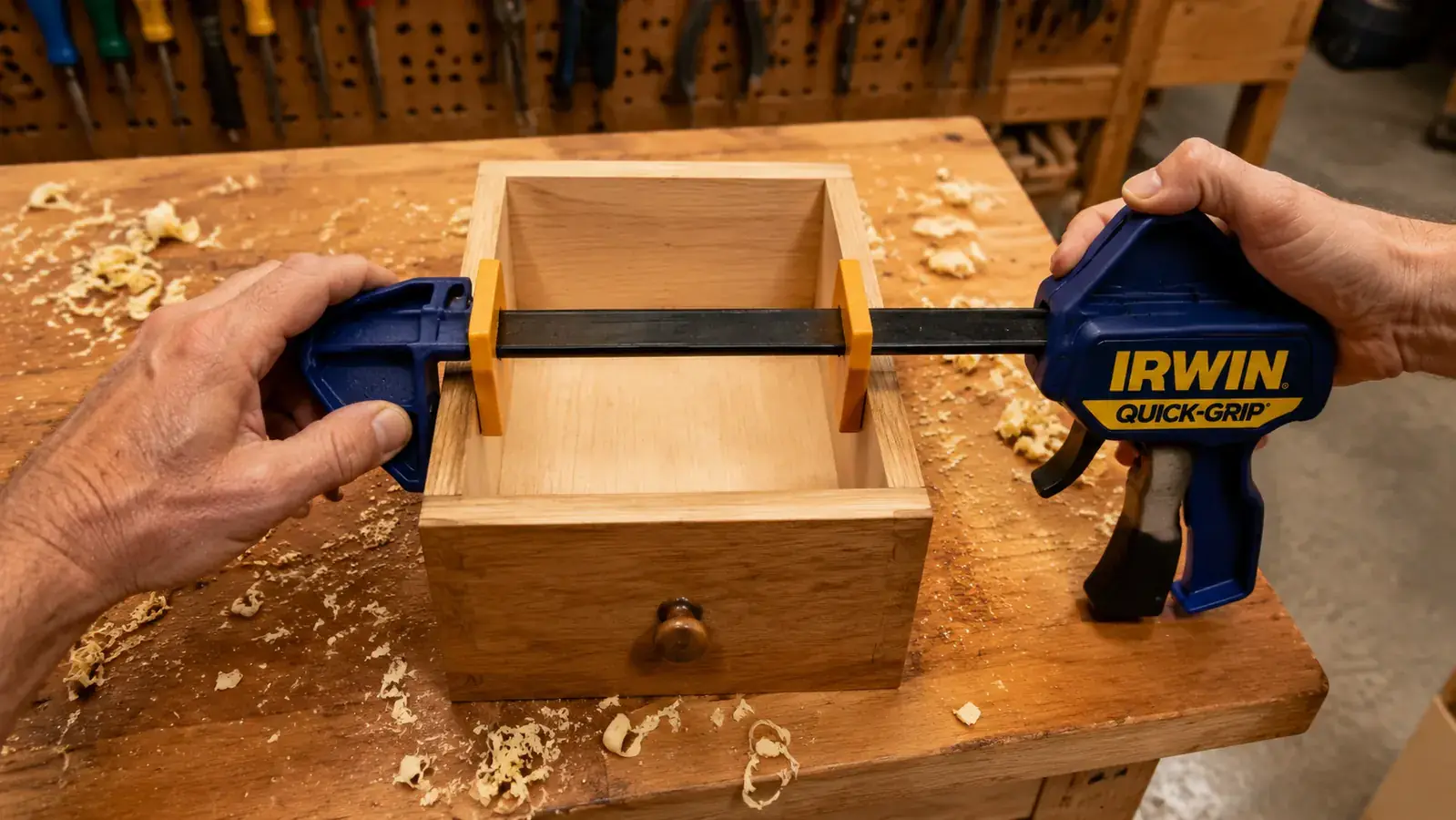
The Quick-Grips entered my workflow as assembly clamps, not glue clamps. I started using them to hold parts in position while I drove pocket screws or checked a joint for square before applying Titebond. That use case alone paid for the set inside the first month. From there I started using them on thinner stock and smaller face frames, where their 150-pound clamping force is plenty, and I discovered the spreader function, which I use constantly on drawer boxes and small carcasses. You can reverse the jaws on these in about two seconds and use them to push parts apart. That trick has saved several of my drawer carcasses from getting racked.
Over the three years I have used them on walnut, hard maple, white oak, pine, poplar, and MDF. I have used them in temperatures ranging from about 35 degrees Fahrenheit in the unheated garage in November to about 90 in July. The plastic parts have not cracked and the spring mechanism has not weakened noticeably. One of the eight clamps in my original set developed a sticky trigger last spring. I hit it with a little dry PTFE lubricant and it sorted itself out.
Clamping Force: What the Number Actually Means in the Shop
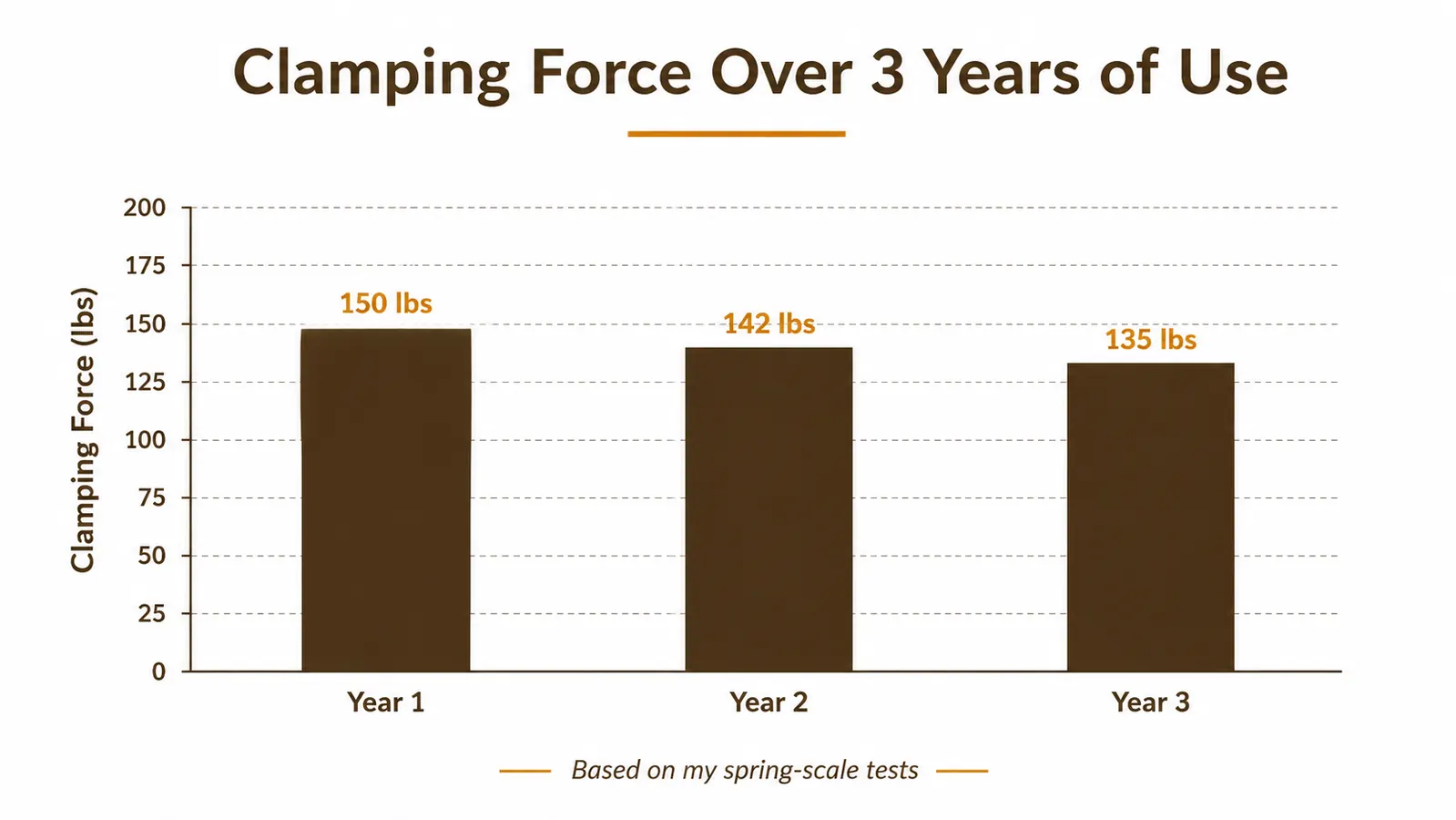
IRWIN rates these at 150 pounds of clamping force. I tested that claim informally with a bathroom scale in my first year, squeezing the clamp jaw onto the scale platform. I got readings between 130 and 160 pounds depending on the clamp and how hard I squeezed. Last spring, three years in, I ran the same test and got readings between 125 and 145 pounds. So there is a modest decline, but not a cliff. For context, a Titebond glue joint needs somewhere between 100 and 150 psi of clamping pressure for hardwoods, and considerably less for softwoods. Whether you actually achieve that pressure depends on your glue surface area, not just your peak clamp force.
What this means practically: on pieces with large glue surface area, like a wide cabinet door frame or a panel with many joints, these clamps do not develop enough pressure to do the heavy lifting. A 6-inch Quick-Grip bearing down on a joint with 8 square inches of glue surface is putting about 18 psi on that joint. That is below the recommended range for hardwoods. On a narrow face frame stile or a small box corner, where the glue surface is under 2 square inches, the same clamp is applying well over 60 psi. Know your glue area and use the right clamp for the job.
I built a simple crosscut sled for my table saw last winter, and I used Quick-Grips exclusively to hold the fence and the backstop while the glue set. Worked fine. The joints are still solid. But when I glued up the top for a hall table out of three 2-by-10 pine boards, I went to my Besseys. That is the right way to think about these.
I reach for the Quick-Grip about four times a week. It is not the strongest clamp on my wall, but it might be the most-used one.
Build Quality After Three Years of Regular Use
The orange rubber pads have held up well. I have not had any splitting or delamination from the pad surface. The pads do tend to pick up finish residue and dried glue over time. I clean them occasionally with a putty knife and a damp rag. The pads are also reversible on most sizes in this set, which extends their life a bit.
The bar itself is steel, not aluminum, and I have not seen any bending or deformation even from clamping across a dovetail box corner where all the force is concentrated on a small area. The trigger mechanism on seven of the eight clamps is still smooth. The one that got sticky, I mentioned above. That is a pretty good durability record for a tool I bought for around 40 dollars for eight of them. A comparable set of Bessey bar clamps would cost three to four times that.
The quick-release lever at the back has stayed crisp. You squeeze it with your thumb and the jaw slides free. No sticking, no fumbling. When you have glue in the open and ten minutes to get everything clamped before it starts to skin over, that matters. I have used screw clamps that required two full rotations of the handle to release. In a timed glue-up, that is two rotations too many.
The Spreader Function Nobody Talks About Enough
Flip the moveable jaw 180 degrees and the Quick-Grip becomes a spreader clamp. This takes about three seconds and requires no tools. I use this constantly when fitting drawer boxes into a carcass, when spreading a bent panel back to flat for re-gluing, and when I need to hold two parts apart while a joint cures. Most woodworkers who buy these for clamping never discover they own a spreader too, and that is a shame because the spreader function is one of the better features on this tool.
Last fall I built a small wall-mounted cabinet with inset doors. Getting the door gap even on all four sides required spreading the hinge-side stile out about 3/32 of an inch while I held the door in position. I put a Quick-Grip in spreader mode on the lower hinge stile and it held the gap open long enough for me to get the hinge screws seated. That kind of operation is exactly what this clamp was designed for and it handled it without complaint.
Where the Quick-Grip Runs Into Trouble
I want to be honest about the limitations because most reviews of these are written by people who used them twice and gave them five stars. Three years of real use turns up some genuine annoyances.
The jaw slippage issue is real on very smooth surfaces. If you are clamping two freshly jointed and planed faces of hard maple, the rubber pads can skate sideways as you apply pressure, especially on the first squeeze. This usually self-corrects as the pads bite in, but it has knocked a joint out of alignment on me twice. My fix is to rough up the clamping area lightly with 80-grit if the surface is going to be covered by a dado or a rabbet, or to use a caul between the pad and the workpiece if I need to protect the face. If you want more detail on how I set up cauls and clamp placement for panel glue-ups, I wrote that out in my panel glue-up guide.
The 6-inch throat depth means you are limited on wide stock. Most of my carcass work falls within that reach, but for a wide panel or a large cabinet door, the bar does not reach the center. You need bar clamps or pipe clamps for that work. The Quick-Grip also does not have the rigidity to resist racking on a wide joint under pressure. If you are gluing up a mortise-and-tenon joint that has any play in it, you want a rigid bar clamp that will hold the parts in plane. The Quick-Grip bar flexes slightly under load, which can let a joint drift.
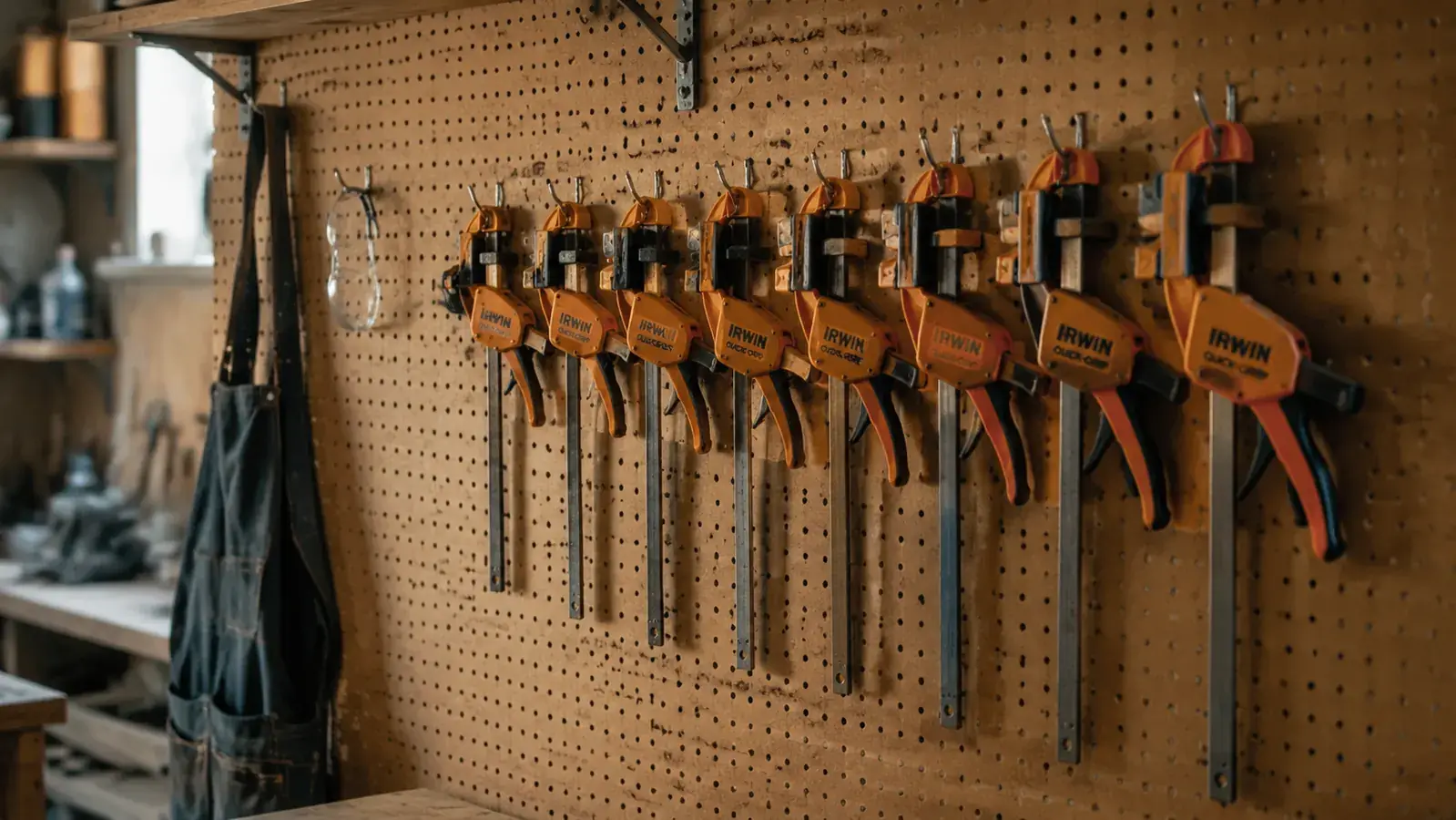
I also noticed that at maximum extension, the sliding bar develops a little play in the channel. It is not enough to affect function, but it is a sign that the tolerances at the back of the bar track loosen up with use. If I were a professional cabinetmaker using these eight hours a day, I would probably replace a set every two years. As a weekend hobbyist, mine are still serviceable at year three.
What I Liked
- Genuinely one-handed operation, no awkward two-hand setup under time pressure
- Quick-release lever works smoothly after three years, no sticking
- Spreader function is useful and fast to set up, takes about 3 seconds to flip
- Steel bar shows no bending or deformation after heavy regular use
- Rubber pads have held up without cracking or splitting
- Eight clamps at this price point gives you the quantity you actually need for furniture glue-ups
- 150-pound rated force is adequate for face frames, small carcasses, drawer boxes, and thin stock
Where It Falls Short
- Jaw can skate on very smooth freshly jointed surfaces, use a caul on precise work
- 6-inch throat depth limits reach on wide panels and large cabinet doors
- Bar flexibility under load is not suitable for mortise-and-tenon joints with any play
- One of my eight clamps developed a sticky trigger at year three, required light lubrication
- Not a substitute for bar clamps or pipe clamps on serious panel glue-ups
IRWIN vs Bessey: When to Use Each
I get this question a lot from guys setting up their first real shop. They want to know if they should buy the IRWIN set or spend the money on Besseys. The honest answer is that they are different tools solving different problems, and the best-equipped shop has both. I cover this in depth in my IRWIN vs Bessey comparison, but the short version is this: if you are starting out and have to choose one, buy the Besseys for panel glue-ups and buy the IRWIN set when you discover you keep running out of clamps during assembly. The Quick-Grips are a complement to a good bar clamp collection, not a replacement.
That said, I know hobbyists who work in pine and poplar and do mostly lighter furniture who use Quick-Grips for everything and do fine. If your glue-ups are smaller-scale and you are working with softwoods, the 150-pound force rating is genuinely adequate for most joints. The line for me is wide hardwood panels under real stress. That is where I reach for the Besseys every time.
Who This Is For
These clamps belong in your shop if you work alone and do mixed furniture and casework. They are also the right call if your primary glue-ups are face frames, drawer boxes, small carcasses, jewelry boxes, picture frames, or any joint with a modest glue surface area. If you are also doing a lot of jig-building, stop-block setups, and temporary workholding at the bench, the Quick-Grip will handle all of that better than anything else in its price range. The one-handed operation stops being a novelty fast and becomes a real efficiency gain when you are working against an open glue window.
I also think these are a good first clamp purchase for someone just setting up a shop, specifically as a supplement to whatever bar clamps they start with. Buying eight Quick-Grips gives you the numbers you need for an assembly job without breaking the budget, and the learning curve is about thirty seconds.
Who Should Skip It
If you are building chairs or tables that use heavy mortise-and-tenon joinery and your glue-ups need north of 200 pounds of clamping force, these are the wrong tool. Spend the money on Besseys, Jorgensens, or pipe clamps with 3/4-inch pipe. You will not regret it. Similarly, if you are doing wide panel glue-ups as your main work, maybe cutting boards, tabletops, or cabinet sides from solid stock, the Quick-Grip's 6-inch throat depth will leave you frustrated within the first project. Get proper bar clamps and build your quick-grip collection later.
Also worth noting: if you buy cheap clamps because you think clamping pressure does not matter, you will get joints that look good and fail in a year. I have opened apart old furniture with failed glue joints that looked fine when they were built. Adequate clamping pressure during the cure is not optional for a lasting joint. Know your requirements and buy the tool that meets them.
Three years in, I would buy this set again without hesitation.
The IRWIN Quick-Grip 8-piece set has lived on my clamp wall for three years. For assembly work, face frames, drawer boxes, spreader duty, and small carcass glue-ups, nothing at this price point competes. Check today's price and see if it has a coupon running.
Amazon Check Today's Price on Amazon →