
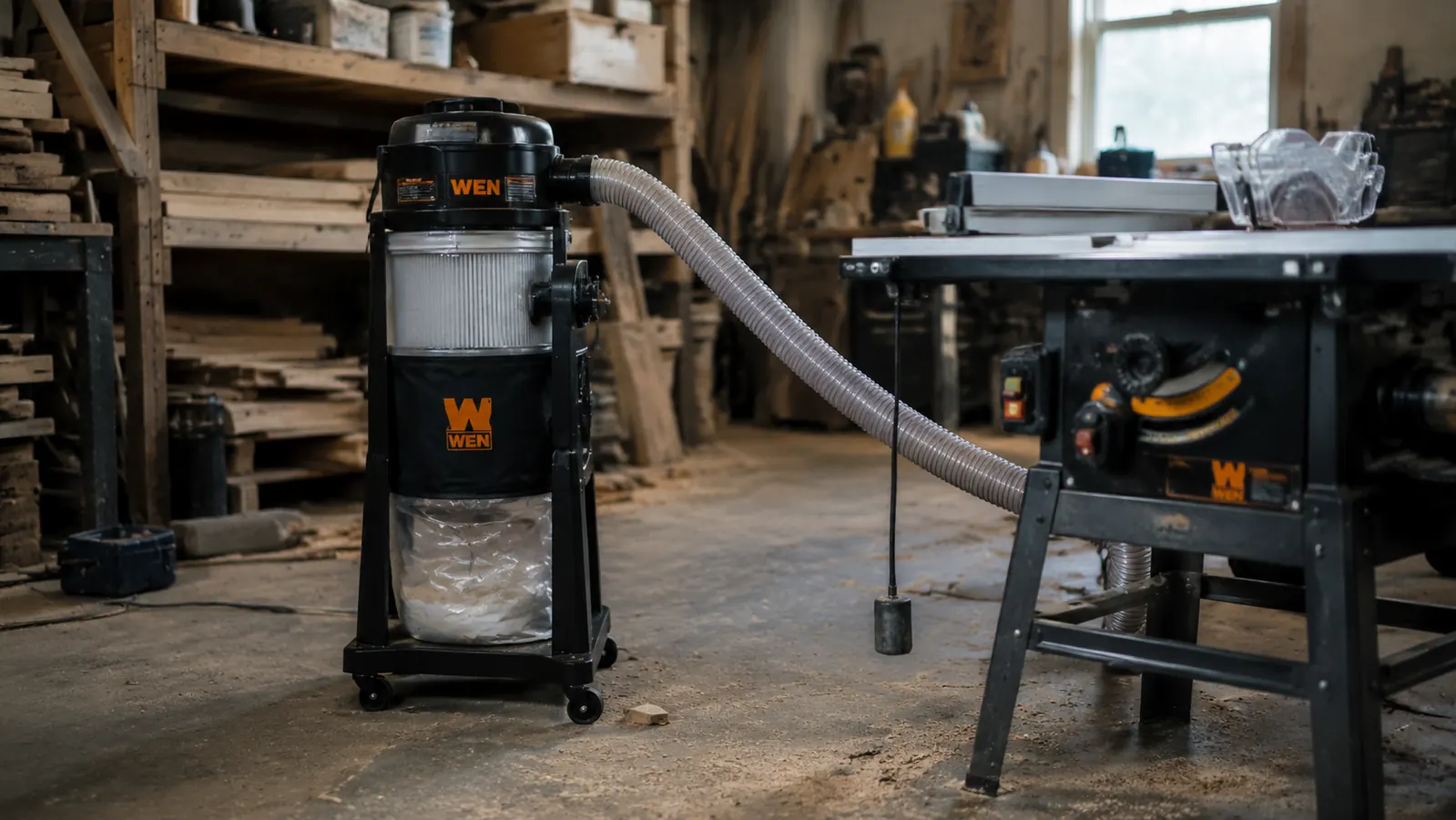
I've been woodworking in my garage for 25 years, and I can tell you the one thing that separates a guy who's been doing this a long time from someone who just started: the veteran has already made the cheap-tool mistake at least twice. I bought the WEN 5.7-Amp Dust Collector (ASIN B09Q7F9NC8) after watching the price sit under $130 and thinking, how bad can it be? The answer is more nuanced than the Amazon listing lets on, and I want to walk you through the parts nobody mentions in the five-star reviews.
This is not the long-term wear review. That's a separate article where I cover 18 months of real use. You can read that one here. This review is the one I wish I'd read before I ordered. The bag situation. The noise. The difference between what the spec sheet implies and what actually happens at the end of a 4-inch hose on a Saturday afternoon.
The Quick Verdict
A real step up from a shop vac for a single large tool, but fine dust passes through the bag, the noise is rough in an attached garage, and anyone running two tools or caring about sub-micron filtration will hit its ceiling fast.
Amazon Check Today's Price →Know what you're getting into before you order
If you've read this far and still think the WEN is right for your shop, check the current price on Amazon. It fluctuates, and sometimes it's genuinely the right call for the budget and the setup.
Amazon Check Today's Price on Amazon →How I've Used It (The Context Matters)
My shop is a two-car garage, roughly 480 square feet, with a DeWalt jobsite table saw, a 6-inch jointer, a 13-inch lunchbox planer, a router table, and a random orbit sander. The WEN runs off a 20-amp circuit on the back wall. I hooked it up with the included 4-inch hose going directly to a single tool at a time, since that's how single-stage collectors are designed to work. I didn't pair it with a cyclone separator or a thien baffle mod, which some people do to extend filter life. I wanted to test it as most buyers will actually use it.
The WEN has a 5.7-amp motor and a 12-gallon lower collection bag. The upper bag is the filter bag. Air moves up through the lower collection bag, through the separator cone, and the upper bag catches fine material before the air exits. On paper, that's a sensible enough design for a single-stage collector. The problem, which I'll get to in a minute, is in the execution of the upper bag.
I ran it at the table saw while ripping white oak, at the router table cutting 3/8-inch roundovers, and at the sander finishing cherry tabletops. Those three contexts produce very different dust profiles, and the WEN handles them very differently.
The Bag Situation: This Is the One You Need to Know About
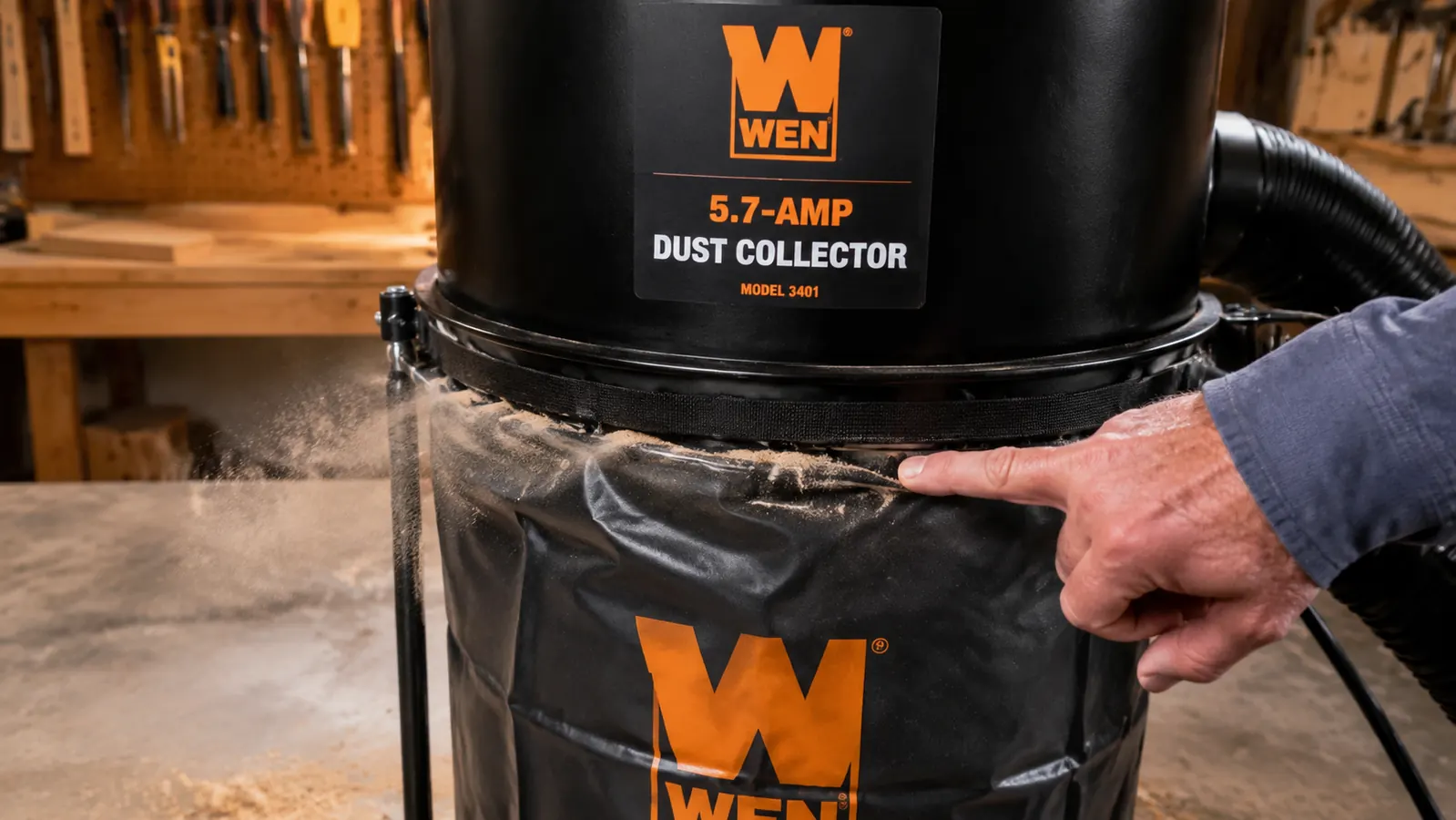
The lower collection bag does its job. Shavings, chips, and larger particles drop into it and stay there. That's not where the problem is. The problem is the upper filter bag, and what it does with the fine stuff.
Stand behind the WEN while it's running with the lights off and a flashlight aimed at the exhaust side. You'll see a haze. It's fine dust, the stuff under 10 microns that you can't see in normal shop lighting, passing straight through the upper bag material and exhausting back into your shop air. The bag is a woven fabric, not a felt filter, and not a canister with real micron-level filtration. WEN's own literature on this unit doesn't specify a filtration rating in microns. That's not an accident.
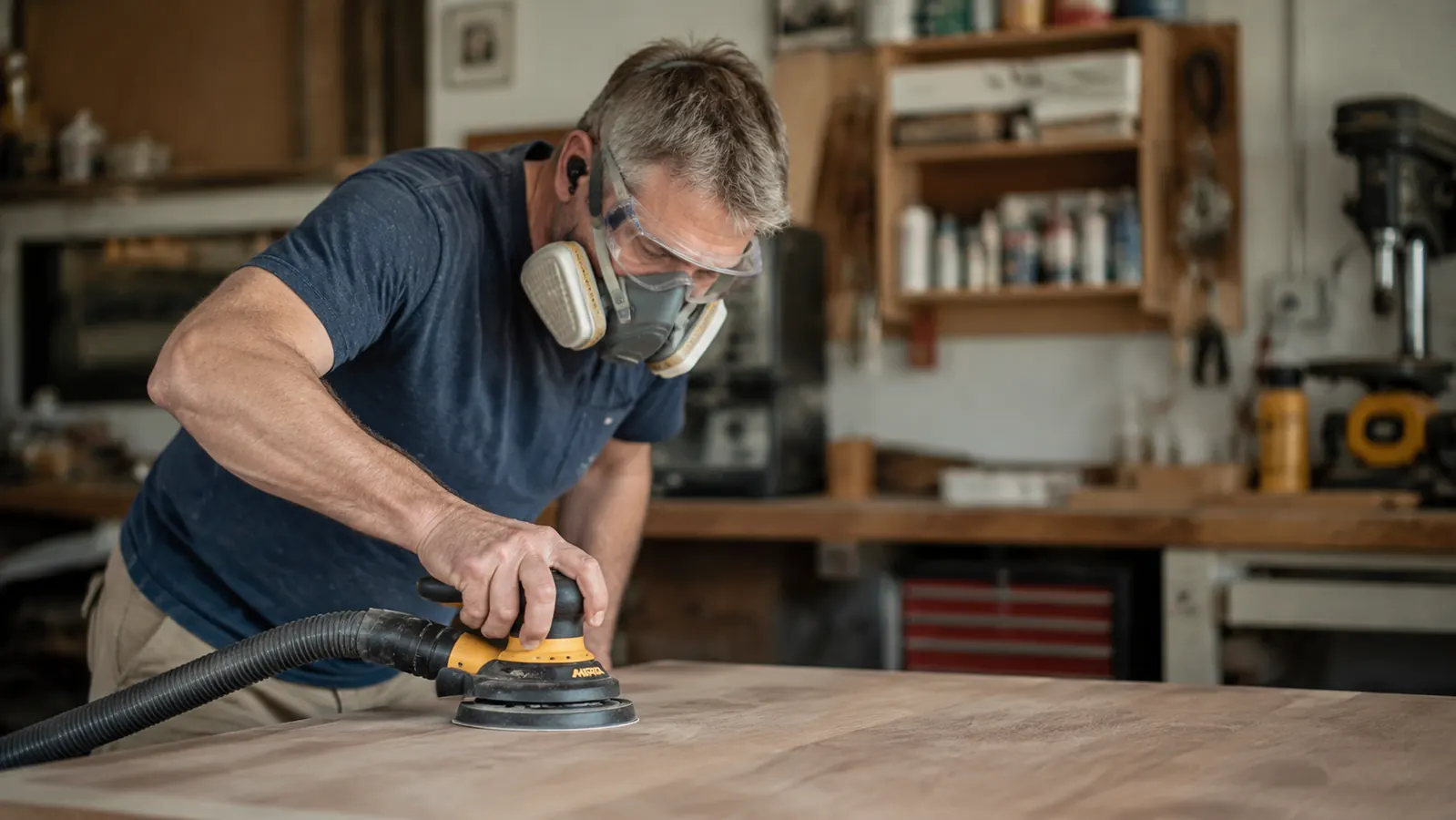
At the table saw ripping oak, the chips are big enough that most of what the collector captures stays captured. But at the sander running 120-grit on cherry, a meaningful fraction of what the sander kicks up is fine enough to pass through. You're not going to feel it immediately. But over time, in a shop without good air exchange, it adds up. If you're in an attached garage with a door to your house, that fine dust is migrating. If you have any respiratory sensitivities, this matters a lot.
Stand behind the WEN with a flashlight and the lights off. You'll see a fine dust haze exhausting from the upper bag. That's the honest story about single-stage bag filtration.
The Noise: Louder Than You're Picturing
The WEN specs list the motor at 5.7 amps. What they don't list is a decibel rating. I measured mine with a decibel meter app at about 73 dB at 10 feet, which is in the range of a loud conversation or a busy restaurant. That doesn't sound terrible until you add it to the 95 dB of the table saw running simultaneously. At that point, you have two sources of sustained loud noise in a reflective concrete-and-drywall box.
If your shop is a detached garage, the noise is an annoyance. If your shop is attached to the house with shared walls, your household will have opinions. My wife works from home three days a week and she notices. If you're in a basement shop with the ceiling between you and a living space, the motor vibration travels through the floor joists. It's not a dealbreaker, but I'd rather you know going in than be surprised after setup.
The noise comes from two sources: the motor itself and the air moving through the hose and bag at velocity. At full suction with a 4-inch hose connected, the airflow sound is a constant deep rush. Reducing the hose diameter with an adapter adapter to a 2.5-inch tool port actually increases the pitch and the perceived noise because you're forcing the same CFM through a smaller opening. Neither option is quiet.
Real-World Suction vs. What a Cyclone Does
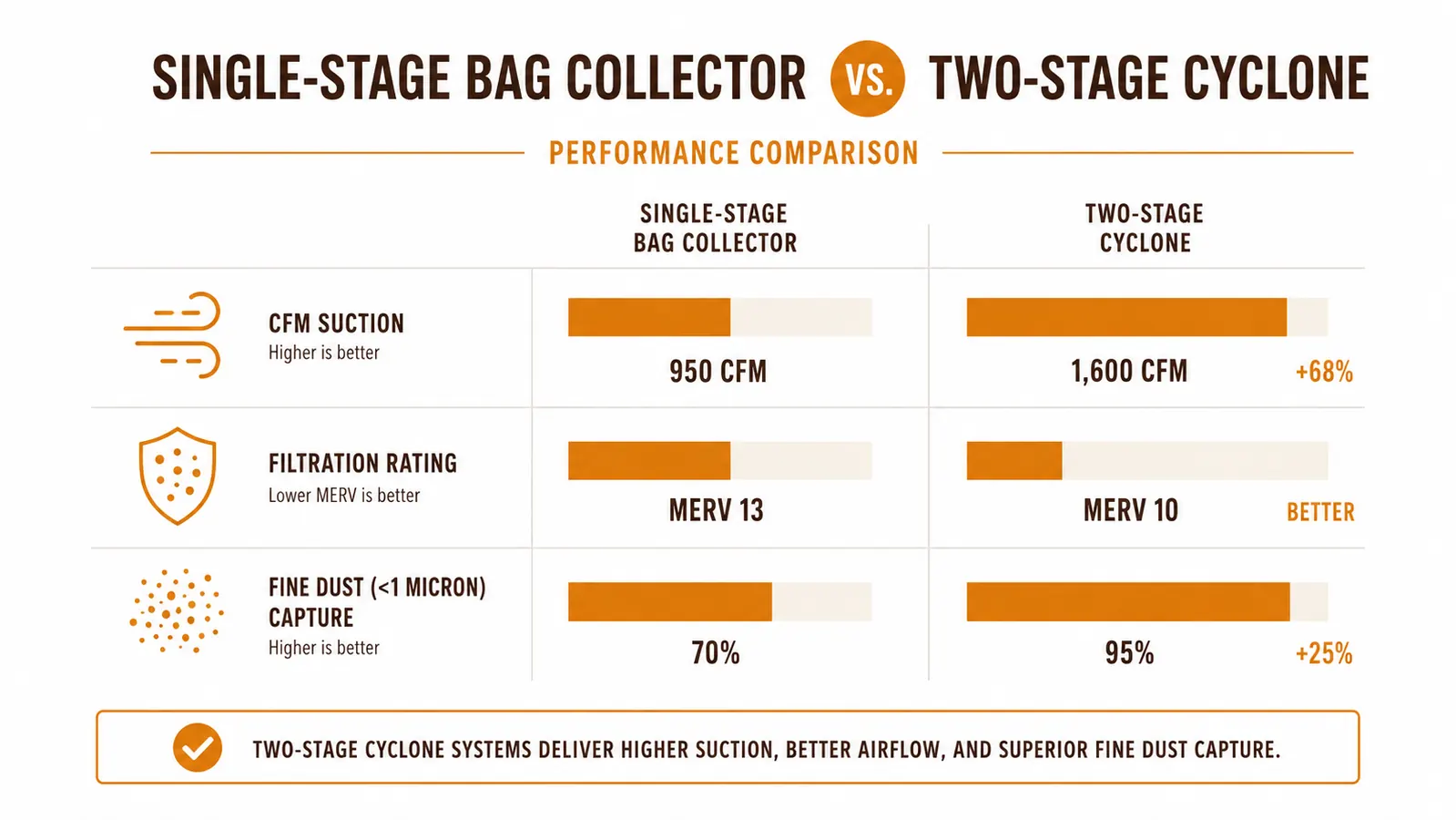
The WEN is rated at 650 CFM. In practice, with a 10-foot hose run and adapters, you're probably pulling somewhere in the 400-450 CFM range at the tool connection. That's enough to capture most of the large chips at a table saw or router table, especially if the port is close to the blade. It is not enough to keep a 13-inch planer or a 15-amp router running at depth from putting material on the floor.
A two-stage cyclone, even a budget one like the Oneida Dust Deputy or a Chinese-manufactured cyclone lid sitting on a 5-gallon bucket, works fundamentally differently. In a cyclone, the dirty air spins in a cone and centrifugal force drops the chips and heavy particles into the collection bin before the air ever reaches the filter. The filter only sees the lightest dust fraction, so it stays clean longer and flows better over time. A single-stage collector like the WEN has no pre-separation, so everything hits the bag from the first chip to the last. As the bag loads up, suction drops. You'll feel it.
By mid-session on a heavy ripping day, I noticed a clear drop in chip pickup at the saw. The bag wasn't full, but it was loaded enough that airflow through the fabric was restricted. Shaking the bag helps temporarily. Emptying it helps more. If you're doing marathon sessions with the planer, plan to stop and empty the bag more often than you'd expect.
The Hose Fit Problem Nobody Talks About
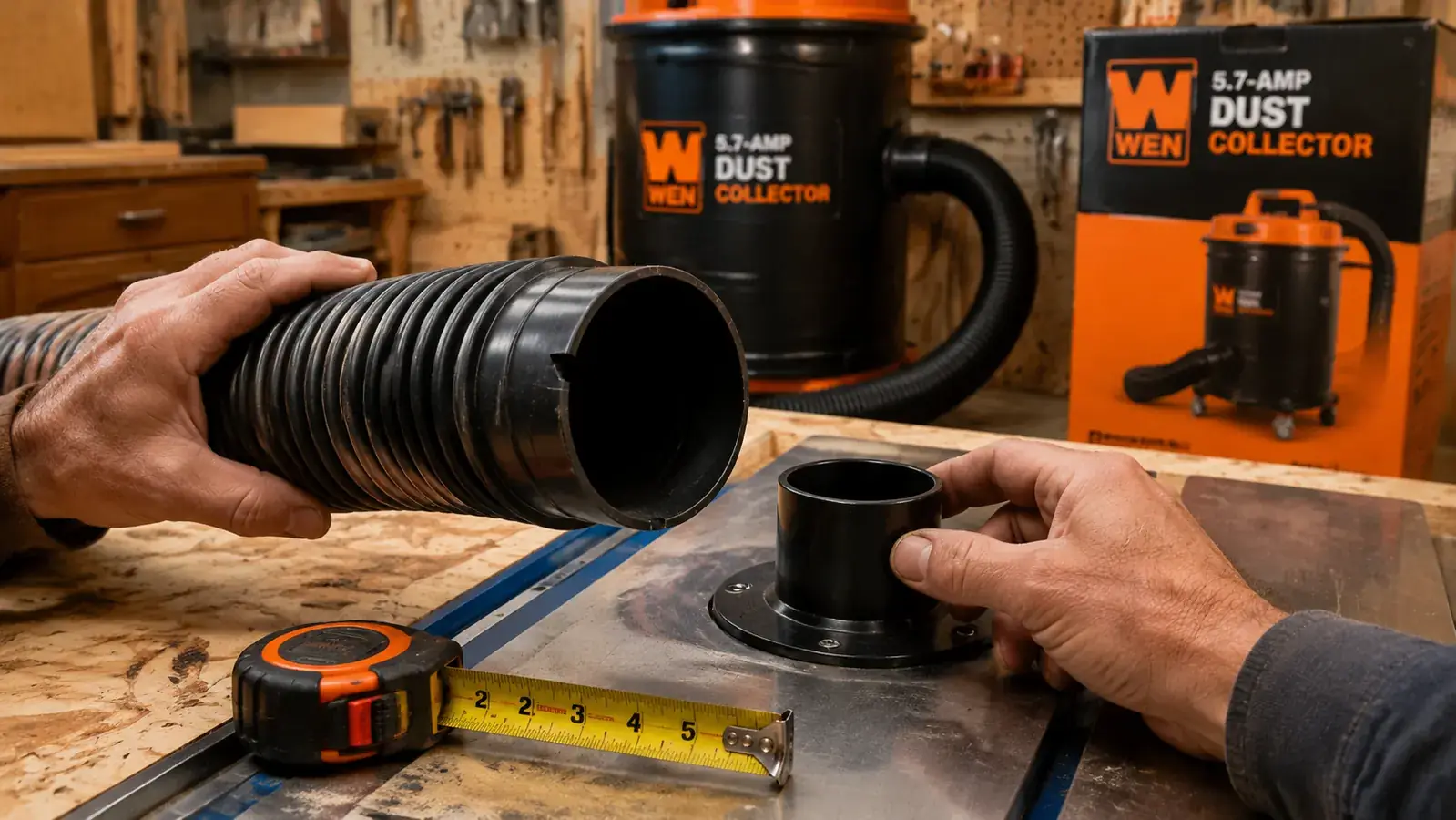
The WEN comes with a 4-inch diameter hose, which is the right diameter for a real dust collection system. Most portable power tools, including the majority of sanders, routers, and smaller tools in a home shop, have 1.5-inch, 2-inch, or 2.5-inch dust ports. The WEN does not include a full adapter set. You get the 4-inch hose and that's largely it.
To connect the WEN to a sander or router, you need a 4-inch to 2.5-inch reducer at a minimum. Some tools use 1.5-inch ports, which requires another step down. You're buying adapters. The adapters are cheap, but this is the kind of thing that should be on the product page in plain language. I've seen guys set this collector up and then stand there holding a 4-inch hose up to a 2.5-inch sander port and wonder why the suction feels weak. The answer is your seal is terrible. Get the right adapters before you turn it on for the first time.
The hose itself is a standard 4-inch flexible hose. It's workable. The connections at both the machine end and the tool end are friction fit, not cam-lock. They hold fine under normal use but will pop loose if you're moving around the shop and the hose gets pulled at an angle. I added a wrap of HVAC foil tape at the machine connection and that solved the problem.
What I Liked
- Real improvement over a shop vac for large chip volume at the table saw, jointer, and planer
- 12-gallon lower bag holds a lot before you need to empty it, so fewer interruptions on a normal session
- Mobile base with wheels makes repositioning between tools practical in a one-car or two-car garage shop
- Price is the lowest entry point for a dedicated dust collector with real CFM numbers
- Standard 4-inch port means it fits into any real DC hose and duct system you might build later
Where It Falls Short
- Upper filter bag is fabric, not felt or canister filtration; fine dust under 10 microns passes through and exhausts into shop air
- Suction drops noticeably as the bag loads up during heavy sessions; you'll stop to empty more than you'd like
- No adapter set included for the 2.5-inch and 1.5-inch ports that most portable tools actually have
- Noise at 73 dB (measured at 10 feet) is rough in an attached garage or basement shop
- A single-stage design means no pre-separation; fine and coarse dust mix in the bag, accelerating filter loading
Who This Is For
The WEN makes sense in a specific scenario: you have a detached garage shop, you run one large tool at a time (table saw, miter saw, or jointer), you generate mostly large chips rather than fine sanding dust, and you don't have sensitivities to wood dust. In that setup, the WEN is a genuine step up from a shop vac. It moves more air, holds more debris, and gets it out of the immediate cutting zone without costing you $300.
It's also a reasonable starter unit if you plan to upgrade the filtration. Some owners add an aftermarket canister filter to replace the upper bag, which brings the filtration much closer to real fine-dust territory. That mod costs another $30-50, which still puts you under $180 total for a usable single-stage system. If you're a tinkerer who's comfortable making that modification, the WEN is a solid base. If you want it to work correctly out of the box, go in with lower expectations.
Who Should Skip It
Skip the WEN if you do a lot of finish sanding and care about fine dust in your shop air. Random orbit sanders and finish sanders generate the finest dust of any tool in the shop, and that's exactly the particle size the WEN bag handles worst. If you're sanding cherry, walnut, or any exotic hardwood, some of those species produce fine dust with real health implications over cumulative exposure. The WEN's bag filtration is not the right tool for that job. Either pair it with a canister filter replacement or use a sander with a vacuum hose to a real HEPA shop vac instead.
Skip it if your shop is in an attached garage with shared walls or above a finished basement. The noise and the fine dust exhaust are both problems in those setups. Your house will have both the sound and the particulates from the WEN's exhaust in areas you don't want them.
Skip it if you run two or more tools in the same session and expect to keep them both clean. The WEN is a single-port, single-stage machine. You can add a blast gate and split the hose to two tools, but you'll lose meaningful suction at both ports. That's not a WEN problem specifically, it's a physics problem, but the WEN's already-modest CFM makes it feel worse than it would on a higher-powered unit.
And skip it if you've already outgrown a shop vac and think this is going to feel like a quantum leap. It's a meaningful improvement, not a transformation. The guys who get the most out of the WEN are the ones who understood what they were buying: a budget single-stage collector with a fabric bag, not a cyclone dust management system. If you're expecting the latter, save up and buy a unit that actually delivers it.
The Bottom Line Before You Click Buy
The WEN 5.7-Amp dust collector is a real dust collector. It's not a toy, and it's not a rebadged shop vac. For large chips at a table saw or miter saw, it does its job. For a single-tool shop in a detached garage where your lungs and your neighbors aren't a daily concern, it earns its price. But the bag passes fine dust, the noise is significant, the hose adapters aren't included, and it is not comparable to even a budget cyclone setup for filtration quality.
If you've read this and still want to go ahead, you know what you're dealing with. That's all I ask. And if you want more context on what it's like to run this unit through an entire woodworking season, the 18-month review covers that. For a broader look at why dust collection matters for finish quality, not just health, take a look at this piece on what dust collection actually does for your work.
If the WEN fits your shop, here's where to check current pricing
It's the lowest-priced dedicated dust collector that moves real CFM. For a single large tool in a detached garage, it does the job. Just add the adapter kit before your first session.
Amazon Check Today's Price on Amazon →