
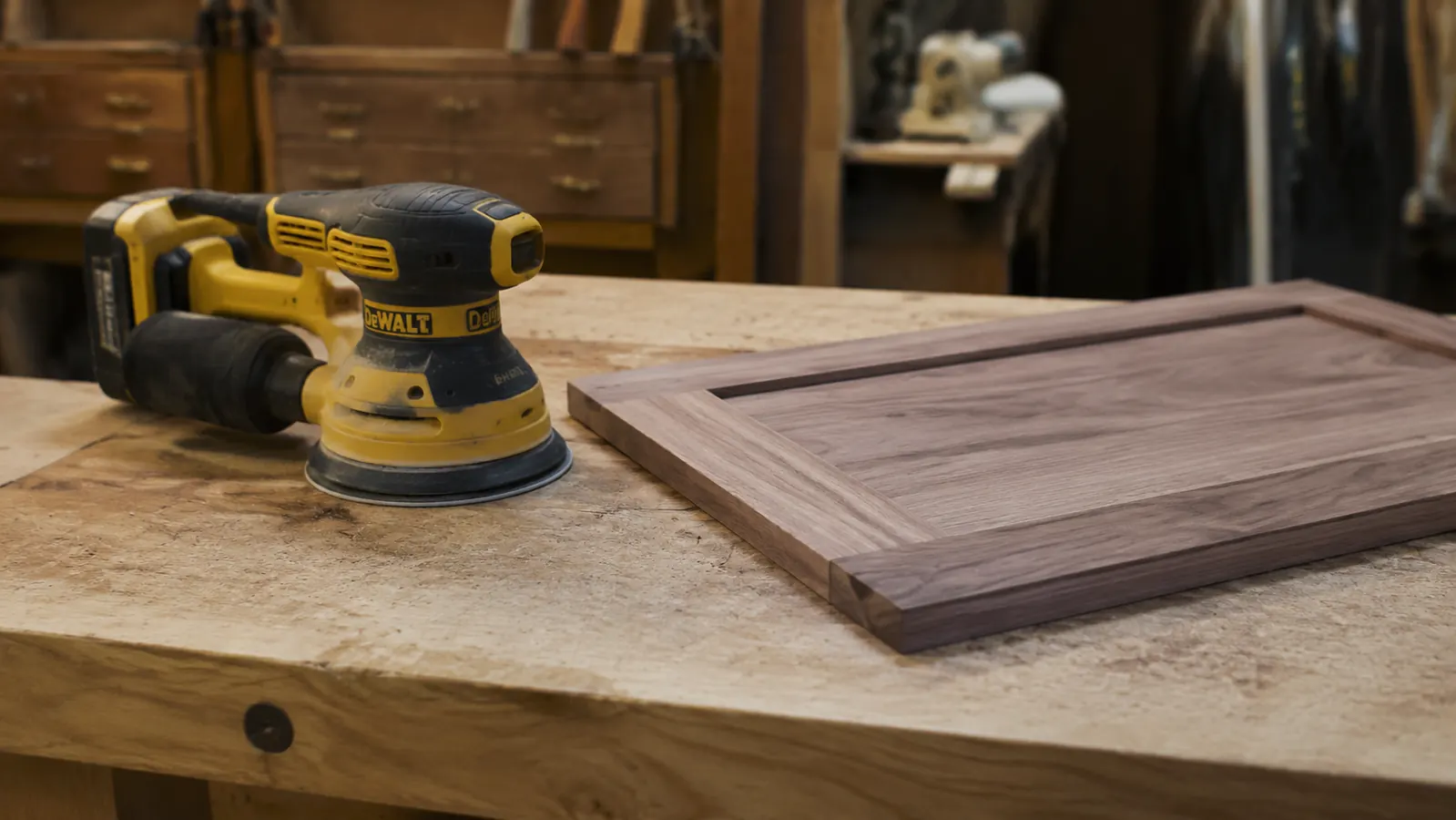
Let me tell you exactly who this review is for. You've already read three articles about the DCW210B that said it was great, it sands smooth, it's cordless and convenient, four-point-eight stars, buy it. And you're sitting there thinking: okay but I'm about to put a clear finish on a walnut dining table I spent forty hours building, and I need to know the truth. That's who I'm writing this for.
I've run the DeWalt DCW210B alongside a Festool ETS 125 EQ and a Mirka DEROS over the course of about a year and a half. I didn't set out to compare them head-on, but after a while you can't ignore what you're seeing on the wood surface and what's settling on your shop floor. So here's what I know.
The Quick Verdict
A genuinely capable cordless sander for general shop work, but the dust bag is nearly useless for furniture finishing, pad life is shorter than it should be, and the "tool only" listing is a trap if you're not already in the DeWalt ecosystem.
Amazon Check Today's Price →Still want it? Make sure you're buying the right version.
The DCW210B is sold tool-only. If you don't already own a DeWalt 20V battery and charger, the price goes up considerably. Check current pricing and bundle options before you click add to cart.
Amazon Check Today's Price on Amazon →How I've Used This Sander
My shop is a two-car garage in northern Wisconsin. I build furniture, mostly case pieces and tables. Over the past year and a half I've run the DCW210B on red oak, hard maple, walnut, cherry, and white pine. I've used it for rough stock removal at 60-grit, progressive finish sanding through 80-120-180, and final pre-finish passes at 220. The sander has lived on my bench next to a Festool ETS 125 EQ and, for the last eight months, a Mirka DEROS 5650CV that I picked up used from a finish carpenter in my woodworking club.
I kept notes because I kept having conversations with other guys in my woodworking group who were considering the DCW210B as their first quality sander. I wanted to be able to tell them something more useful than "it's pretty good." What I learned is that the DCW210B is a solid tool with specific weaknesses that matter a lot if finish quality is your standard, and barely at all if you're sanding shop fixtures or painted pieces. Those are two different tools in practice, even if the spec sheets look the same.
The Dust Collection Problem Nobody Wants to Talk About
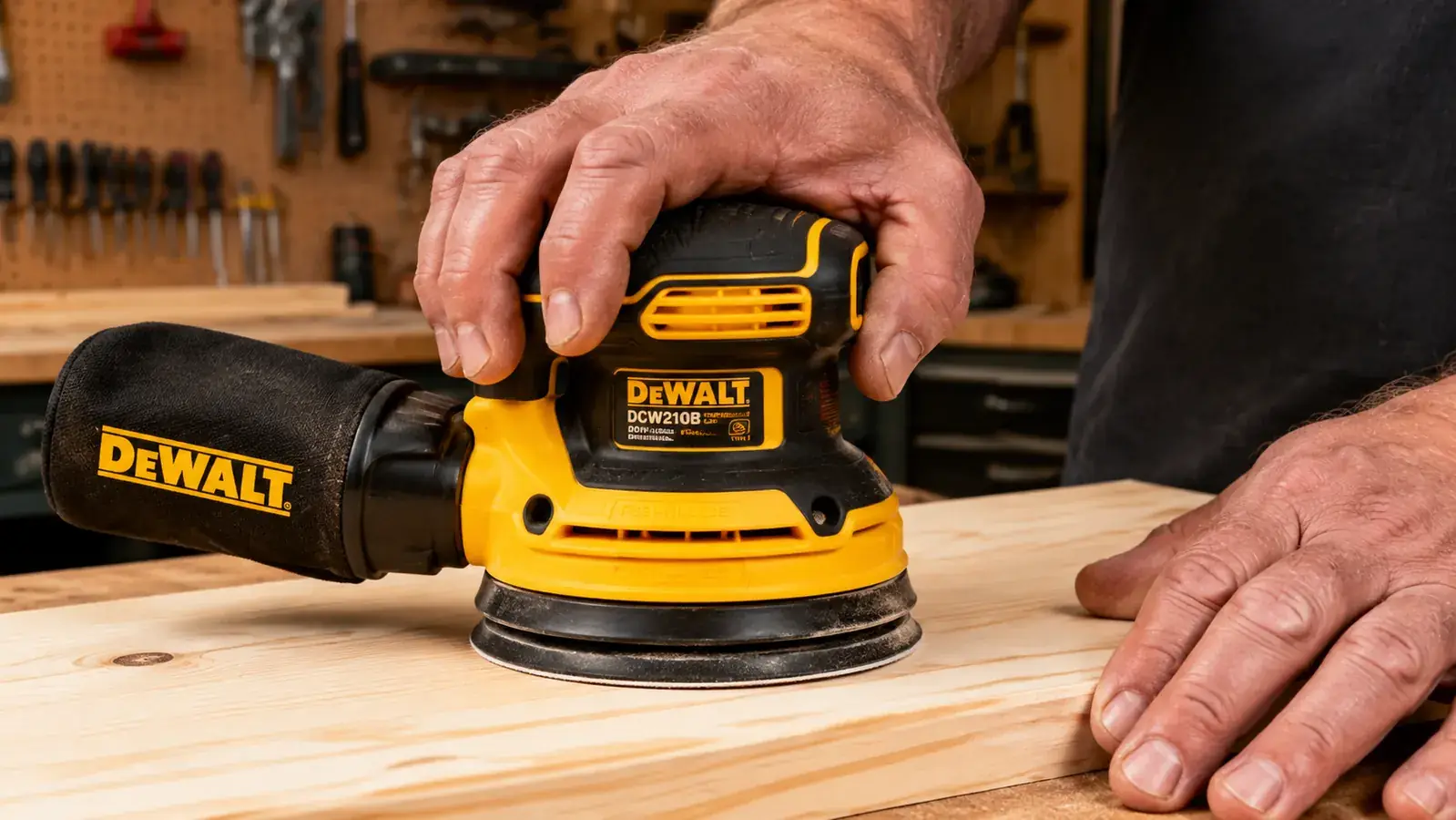
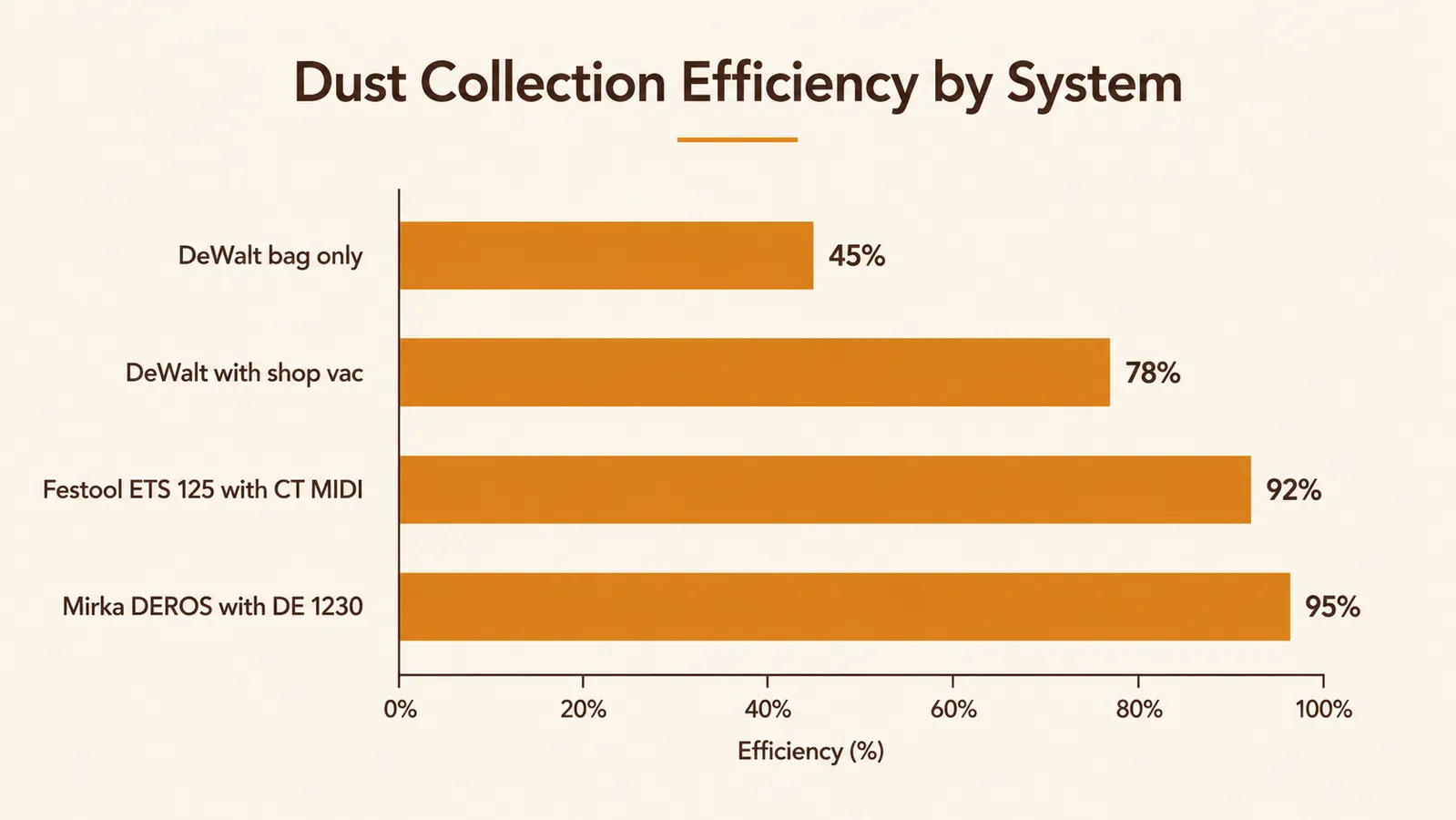
The included dust bag on the DCW210B captures maybe 40 to 45 percent of the fine dust you generate, in my experience. The bag itself isn't the main culprit. The problem is that random orbit sanders create a lot of fine particulate that hangs in the air before it ever reaches the bag port, and the bag's filtration just isn't dense enough to stop the really fine stuff from blowing back through. After twenty minutes of sanding maple at 120-grit, I had a visible cloud of fine dust in my shop even with a ceiling fan running.
Connecting the DCW210B to a shop vac with a fine-filter bag gets you to about 75 to 80 percent capture, which is usable. You need an adapter because the DCW210B's dust port is a proprietary size that doesn't accept standard 1-1/4 inch or 2-1/2 inch hose fittings directly. DeWalt sells the adapter, but it's not included. That's a separate purchase. Keep that in mind when you're building your budget.
Compare that to the Festool ETS 125 connected to a CT MIDI extractor. That system captures around 92 percent of fine dust at the source, which is enough that you can sand in a finished space without covering everything. The Mirka DEROS with their DE 1230 mobile dust extractor is in the same league. The difference isn't cosmetic. It directly affects your finish, because dust that settles on your workpiece while you're sanding shows up as contamination under your first coat of oil or lacquer.
If dust collection matters to your finishing process (and it should), budget for a shop vac with fine filtration and an adapter when you buy the DCW210B. Or understand that you're looking at a fundamentally different class of dust management if you go Festool or Mirka.
Hook-and-Loop Pad Wear: Faster Than You'd Expect
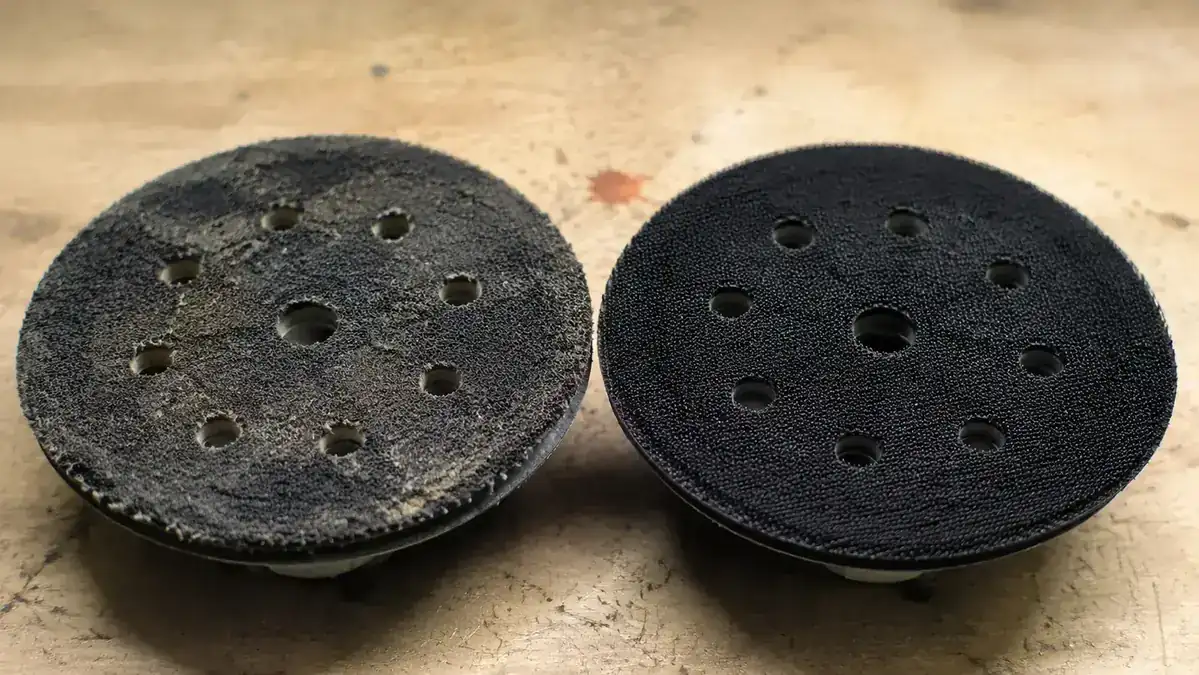
The pad on the DCW210B is a standard 5-inch hook-and-loop, and it will wear out. That's normal. What surprised me was how quickly the hooks flattened when I was doing heavy stock removal at 60 or 80-grit on rough-sawn lumber. The abrasive side of the paper rubs back against the pad surface with each orbit, and over time the hooks lose their grip. You start to see discs spinning or shifting mid-stroke, which causes exactly the kind of random scratches you're trying to avoid.
I replaced my first pad after about six months of regular use that included a lot of rough sanding. That's not terrible, but a replacement pad runs around twelve to fifteen dollars. If you're doing production-level rough sanding, build that cost in. The Mirka DEROS pads tend to last longer in my observation, partly because Mirka engineers their pads and abrasives as a matched system, and partly because the DEROS's random orbit action is gentler on the pad surface under load.
Disc Loading and Grit Progression: A Real-World Problem
One thing I haven't seen mentioned anywhere is how the DCW210B performs specifically in the 80-grit phase on resinous woods. Sanding pine or cherry at 80-grit with the DCW210B causes the disc to load with pitch and sap residue noticeably faster than either the Festool or Mirka, and I think it comes down to airflow through the pad. The DeWalt's eight dust holes just don't move enough air across the disc surface to clear swarf before it starts bonding. On a Mirka Abranet disc, the mesh structure lets air pass through the full face and carries the debris away continuously.
Practical result: on a thirty-inch cherry dining table top at 80-grit, I was swapping discs every eight to ten minutes with the DCW210B to avoid burning the surface. With the Mirka setup on the same species, I got through a full grit step on the same panel with one disc. That's a real consumable cost difference over time, and it's worth factoring in alongside the tool price if you work with cherry, pine, or teak regularly.
After twenty minutes of sanding maple at 120-grit, I had a visible cloud of fine dust even with the ceiling fan running. The included bag captures maybe 40 percent. That's the number nobody puts in a review.
Battery Runtime on Rough Sanding: The Honest Numbers
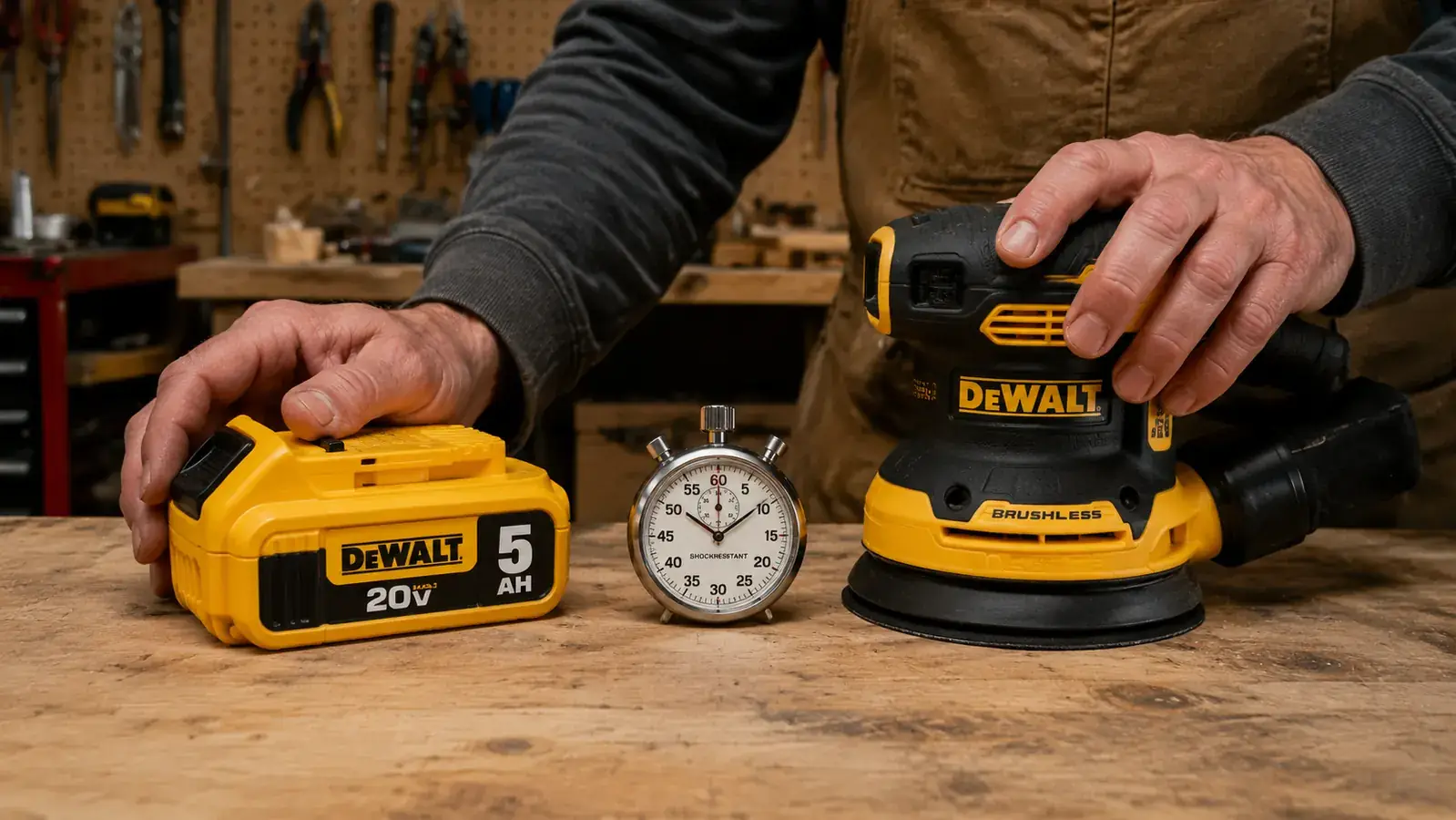
DeWalt advertises the DCW210B as compatible with the full 20V MAX lineup, and I ran my testing with their 5Ah pack, which is the battery most people reach for when they want maximum runtime. On finish sanding at 180 or 220-grit with light pressure, I consistently got 45 to 55 minutes of runtime on a single charge. That's fine for most shop sessions.
Heavy stock removal changes the picture. When I was using the sander at 60-grit with firm pressure on rough-sawn white oak, runtime dropped to 22 to 28 minutes on the same 5Ah pack. The motor draws significantly more current when it's working hard against resistance, and the battery responds accordingly. That's not a flaw in the DCW210B specifically, it's just physics. But it's worth knowing if you're planning to use this sander for rough stock preparation before switching to finer grits. You'll be swapping batteries mid-session or pausing to charge.
For pure finish sanding, cordless is fine. For a full workflow from rough to finish on a large workpiece, corded or compressed-air tools have a clear practical advantage. The Mirka DEROS runs on 120V and never asks you whether the battery is charged.
The Tool-Only Trap
The DCW210B is listed as "tool only" at its standard price, meaning no battery and no charger included. If you're already deep in the DeWalt 20V MAX ecosystem and you have batteries on the shelf, this is fine. The tool will use the battery from your drill or your circular saw without any compatibility issues.
If you're new to DeWalt, or if you're buying this as your first DeWalt 20V tool, the effective cost includes a battery and charger. A 5Ah battery runs around forty to fifty-five dollars depending on where you buy it. A charger adds another twenty-five to thirty-five dollars. Suddenly the entry cost looks different than the tool-only price suggests. Check what's available as a kit before assuming the tool-only listing is the better deal. Sometimes the kit is only fifteen or twenty dollars more than the bare tool.
This isn't a complaint unique to DeWalt. Every cordless tool brand does this. But it catches people who are buying their first tool in a new platform, and I've watched it happen to guys in my woodworking group who were surprised at checkout.
When a Mirka or Festool Changes Your Life and the DCW210B Doesn't Cut It
I want to be direct here because I've seen a lot of advice online that treats the Mirka DEROS and Festool ETS as tools for snobs. They're not. They solve specific problems that the DCW210B genuinely cannot, and those problems matter if you're building furniture for people's homes or doing a lot of production finishing.
The Mirka DEROS 5650CV is a net-sanding system. Instead of solid discs with dust holes punched through them, Mirka's Abranet discs are a woven mesh that allows dust to pass through the entire disc surface, not just the holes. Combine that with Mirka's dust extractor and you're capturing 95-plus percent of the dust at the source. If you've ever laid down a coat of oil on a cherry panel and found fine dust embedded in the finish even after wiping down, you'll understand why that number matters. Mirka's system fixes that problem structurally, not just partially.
The Festool ETS 125 EQ is a similar story on the dust side, and adds a level of vibration damping that lets you sand for longer without hand fatigue. If you're doing a full day in the shop, the difference between the DCW210B's vibration and the Festool's vibration is noticeable by hour three.
The honest answer on when to step up: if you're building one or two projects a year in your garage and putting a natural oil finish on them, the DCW210B is completely adequate with a shop vac attached. If you're building furniture regularly, finishing in a space where dust contamination affects your results, or if your hands hurt after long sanding sessions, the Mirka or Festool investment pays for itself in time, finish quality, and comfort faster than you might think.
See also: my two-year long-term review of the DCW210B where I track how the tool held up over dozens of projects, and my breakdown of why every home woodworker needs a random orbit sander before they buy anything else.
What I Liked
- Genuinely good orbital action that minimizes swirl marks at 180-grit and above when the pad is in good condition
- Compatible with the full DeWalt 20V MAX battery platform, so useful if you're already invested in the ecosystem
- Variable speed dial gives real control from 8,000 to 12,000 OPM for matching speed to material hardness
- Solid build quality for the price point; the rubber over-mold grip is comfortable for short to medium sessions
- Lighter than most corded sanders at 2.6 lbs without battery, which matters on vertical or overhead sanding
Where It Falls Short
- Included dust bag is inadequate for fine furniture finishing; captures roughly 40-45% of fine airborne dust
- Requires a separate adapter to connect to a shop vac, and that adapter is not included in the box
- Battery runtime drops to 22-28 minutes under load on rough sanding even with a 5Ah pack
- Hook-and-loop pad wears faster than expected under heavy stock removal, especially at 60 and 80-grit
- Disc loading on resinous woods is noticeably worse than Mirka's Abranet net-sanding system
- "Tool only" listing means full kit cost is significantly higher for anyone new to the DeWalt 20V platform
Who This Is For
The DCW210B is the right call if you're a DeWalt 20V household who wants a capable cordless sander for general shop work and you're not doing production-level fine finishing. It's also a reasonable entry point if you're new to random orbit sanders and you want to understand the workflow before investing in a Mirka or Festool system. The tool itself sands well. The limitations are in the accessories and the ecosystem around it, not in the orbital mechanism itself.
Who Should Skip It
Skip the DCW210B if you're building furniture that will receive multiple coats of finish and dust contamination is a real concern in your space. Skip it if you sand for hours at a stretch and hand fatigue is a problem. Skip it if you don't own DeWalt 20V batteries and would be buying the platform from scratch just for this tool. Skip it if you regularly work with pine, cherry, or other resinous or gummy species and disc loading is eating your abrasive budget. In any of those cases, a corded Bosch ROS20VSK, a used Festool ETS 125, or a Mirka DEROS on compressed air will serve you better. The Mirka DEROS in particular is available used for reasonable prices on woodworking forums, and the air version removes battery life from the equation entirely.
Already in the DeWalt 20V family? The DCW210B earns its place on the shelf.
If you have the batteries and you need a capable cordless sander for general shop work, the DCW210B delivers. Just pair it with a fine-filter shop vac and budget for pad replacements. Check current pricing and available kit configurations before you buy.
Amazon Check Today's Price on Amazon →