
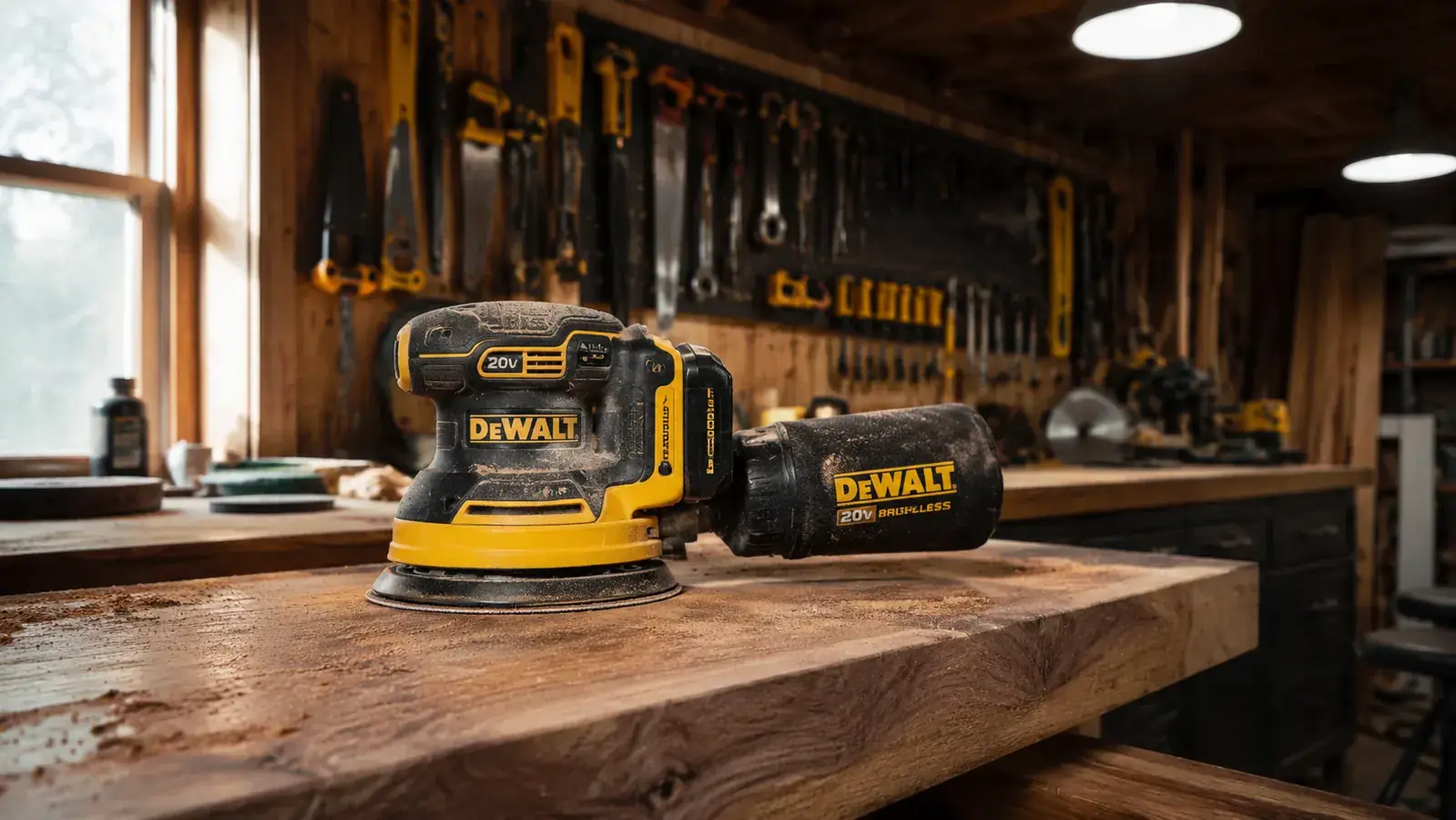
If you are shopping for a random orbit sander and you already own DeWalt 20V batteries, this comparison is going to end pretty quickly. But if you are starting from scratch or you are a Bosch loyalist who wants a real reason to consider cordless, keep reading, because the Bosch ROS20VSK makes a legitimate argument. The short answer is this: the DeWalt DCW210B wins for most home woodworkers, specifically anyone already running the DeWalt 20V MAX platform. The Bosch wins on price and collects dust a touch more efficiently, but it trails in every other category that matters for a garage shop.
I have run both sanders on the same workpieces, soft maple, hard oak, veneered plywood, and pine shelving boards. Neither one is a disappointment. But they have genuinely different personalities, and if you pick the wrong one for your situation, you will be annoyed in ways that are hard to put your finger on until I name them for you.
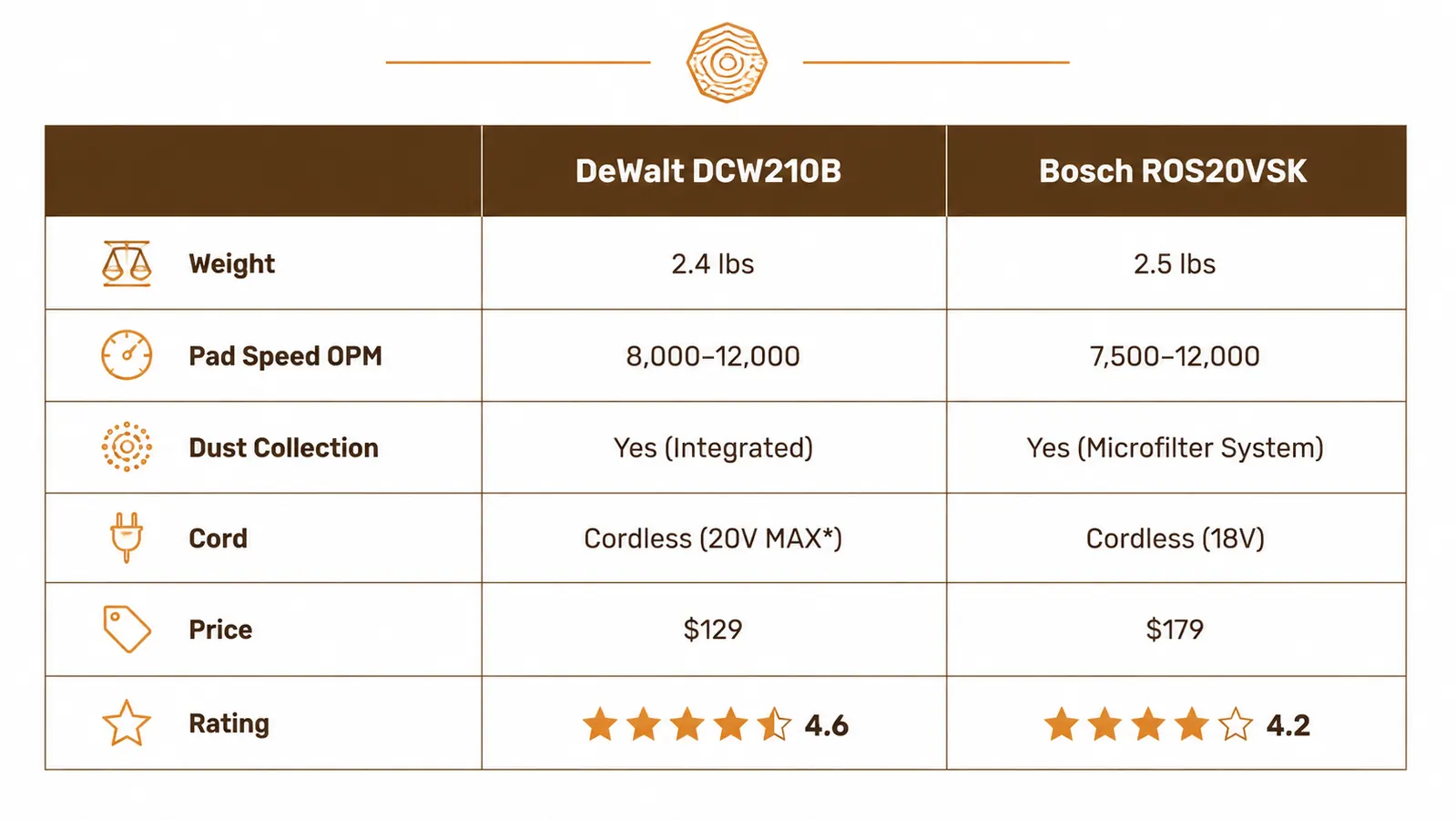
| Spec | DeWalt DCW210B (Left) | Bosch ROS20VSK (Right) |
|---|---|---|
| Power source | 20V MAX battery (tool only) | Corded, 2.5 amp |
| Pad speed | 8,000-12,000 OPM variable | 7,500-12,000 OPM variable |
| Pad size | 5 in. hook-and-loop | 5 in. hook-and-loop |
| Weight (tool only) | 3.0 lbs with battery | 2.6 lbs |
| Dust collection | Integrated bag + port | Integrated bag + port |
| Cord | None | 10 ft. |
| Brushless motor | Yes | No |
| Vibration control | Counterbalance mechanism | Standard |
| Amazon rating | 4.8 / 5 (13,599 reviews) | 4.7 / 5 |
| Current price | Check today's price | Lower out of pocket |
Already on DeWalt 20V? The DCW210B is the obvious answer.
With 13,599 Amazon ratings averaging 4.8 stars, the DeWalt DCW210B is the most-reviewed cordless sander at this price point. Check current availability below.
Amazon Check Today's Price on Amazon →Where the DeWalt DCW210B Wins
The biggest win is freedom of movement. When I am sanding a tabletop that hangs off the bench, or working on a cabinet door I have clamped to the side of a sawhorse, a cord is genuinely annoying. You drag it over the workpiece, you knock it against fresh finish, you spend mental energy managing it. With the DCW210B, there is nothing to manage. You grab it, you sand, you set it down. That sounds small until you have done it both ways on the same project.
The brushless motor is the second big advantage, and it compounds over time. Brushless motors run cooler, last longer before service, and extract more work from each battery charge. DeWalt rates the DCW210B at 8,000 to 12,000 orbits per minute with full variable speed. In practice, I run it at about 10,000 OPM for most hardwood work, knock it down to 8,000 for veneer and paint finishes. The motor never bogs under pressure the way a brushed motor will when you lean in. On a five-amp-hour battery, I get about 45 minutes of actual sanding time before the charge indicator drops to one bar. That covers most sessions in my shop.
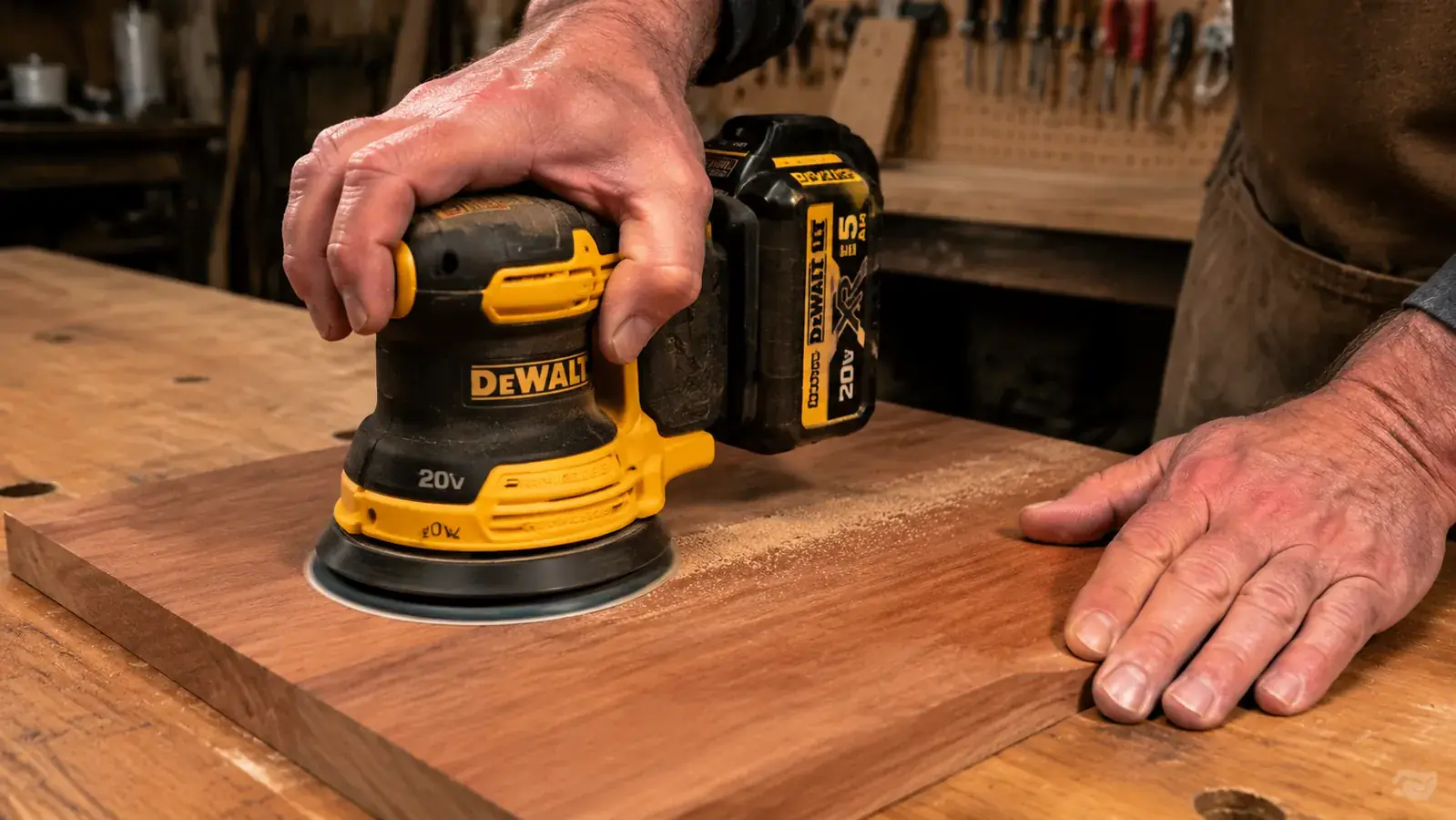
Vibration at the handle is noticeably lower on the DeWalt compared to the Bosch. DeWalt uses a counterweight mechanism in the pad assembly to cancel some of the orbital vibration before it reaches your hand. After 30 minutes on a big tabletop, my hand feels less fatigued than with the Bosch. If you do longer sessions or you have any wrist issues, that difference matters. The DeWalt's rubber over-mold grip is also thicker and more comfortable, which contributes.
Where the Bosch ROS20VSK Wins
The Bosch ROS20VSK ships as a kit in a carrying case with a dust bag, a vacuum adapter, and a collection of sanding sheets. If you are starting from zero and need to be sanding this weekend without ordering anything else, the Bosch out-of-box experience is better. The DeWalt is sold tool-only, so you need a 20V battery and charger separately. If you already own them, the math flips. If you do not, add roughly $60 to $100 to the DeWalt's price.
Dust collection is the other area where the Bosch has a real, if modest, advantage. The Bosch's dust bag seals tighter and captures a slightly higher percentage of sanding dust on average. Both sanders have a standard 1/4-in. vacuum port adapter, but the Bosch's internal ducting through the pad is a little more efficient at pulling dust away from the surface. It is not a dramatic difference, and once you hook either sander to a shop vacuum via the port, the gap closes almost entirely. But if you are relying purely on the bag, the Bosch keeps the bench cleaner. For a garage shop where dust control matters for both health and finish quality, that is worth knowing.
Both sanders produce a finish you would be proud to put stain on. The question is whether you want a cord in your hand while you do it.
Finish Quality: Does Cordless Match Corded?
This is the real question for anyone who cares about furniture-grade surfaces, and I tested it carefully. I sanded matching boards of hard maple to 150 grit on both machines, then applied a wipe-on oil finish and held the panels up to a raking light to check for swirl marks. Both panels looked identical. The orbital pattern on the DeWalt is 3/32-in. diameter, which is standard for random orbit sanders in this class and produces the same swirl-free surface. There is no finishing penalty for going cordless.
Where this matters practically: some woodworkers assume cordless tools have to compromise somewhere to deliver on battery life, and that the compromise shows up in finish quality. That used to be true a generation ago with brushed-motor cordless tools. The DCW210B's brushless motor and variable-speed electronics eliminate that tradeoff. You get the same surface quality as a comparable corded sander, with less vibration and no cord to manage.
Pad, Hook-and-Loop, and Sanding Sheet Compatibility
Both sanders use a standard 5-in. 8-hole hook-and-loop pad. That means you can use the same sanding discs on either machine, and the selection is identical at any hardware store or online. DeWalt pads use the same interface as most other 5-in. hook-and-loop sanders, so if you wear out the pad you can replace it with a generic at a fraction of the OEM cost. The Bosch pad is also standard and interchangeable.
One practical note on the hook-and-loop backing: after extended use on rough grits like 60 or 80, the hook fibers on both pads start to wear and sanding sheets begin to throw off during use. I replace the pad on any random orbit sander roughly every 12 to 18 months of regular shop use. At roughly $8 to $12 for a replacement pad, this is a maintenance item, not a defect. Neither brand has an advantage here.

Runtime, Battery System, and Real-World Cost
If you are already running a DeWalt 20V MAX kit in your shop, the DCW210B is effectively free to power. You have the batteries. You have the charger. You buy the tool and you are done. That changes the economics dramatically. A tool-only sander at under $100 with 20V batteries you already own beats a corded kit at a lower sticker price when you factor in the convenience and the battery ecosystem you have already paid into.
If you have no DeWalt batteries and no plans to buy into the platform, the Bosch ROS20VSK is the rational buy. It costs less out of pocket, it works the moment you plug it in, and it delivers a finish that matches the DeWalt. The only thing it cannot do is go cordless.
Runtime deserves a specific number. With a DeWalt DCBP034 2Ah compact battery, I get about 25 minutes of continuous sanding. With a 5Ah battery, closer to 50 minutes. For most shop sessions, where you sand a panel, change paper, sand another piece, and take a break in between, a single 5Ah battery covers a full afternoon. Sanding is not a high-draw application like cutting or routing, so the DCW210B is friendlier to battery life than the DCW600B router or any saw in the lineup.
Who Should Buy Which
Buy the DeWalt DCW210B if you already own one or more DeWalt 20V MAX batteries. The cordless convenience is real, the brushless motor is a genuine long-term advantage, and the finish quality matches anything in this class. At 4.8 stars across nearly 14,000 Amazon reviews, it is the most validated random orbit sander at this price point. Read my full long-term review of the DCW210B for two years of detail, or check the honest review for what the listing does not tell you.
Buy the Bosch ROS20VSK if you are not in the DeWalt ecosystem, you want a corded kit that is ready to run out of the box, or you are buying a second sander for a helper who does not have their own batteries. The Bosch's dust collection is marginally better bag-on-bag, and the corded reliability means no mid-session charge interruptions. It is not the better tool overall, but it is the better tool for a specific situation.
The DCW210B is the stronger tool for anyone in the DeWalt ecosystem.
Over 13,000 reviews, a brushless motor, variable speed from 8,000 to 12,000 OPM, and no cord to manage. Check current pricing and availability on Amazon before stock shifts.
Amazon Check Today's Price on Amazon →