
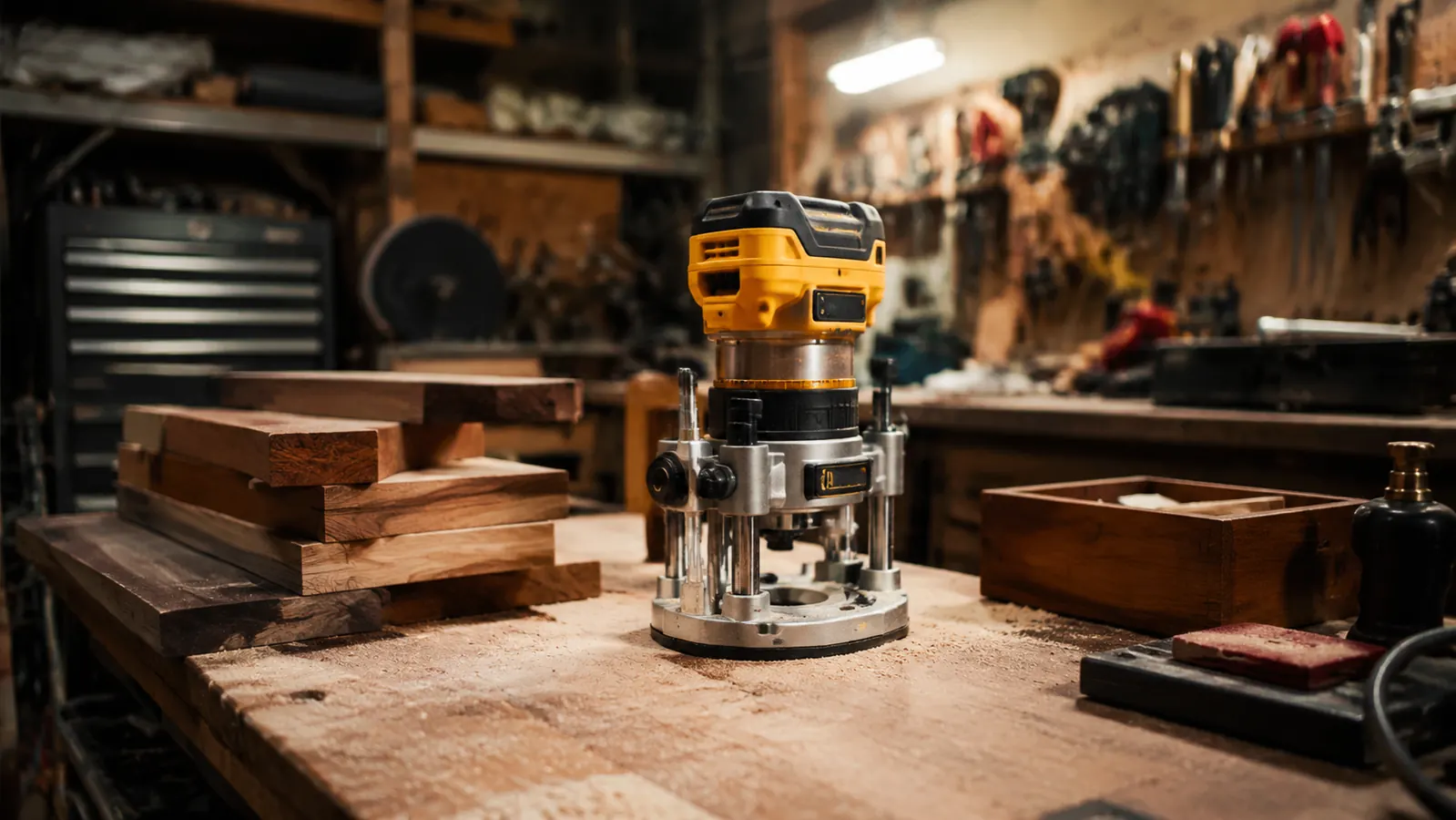
I am going to save you some grief right now. The DeWalt DCW600B is listed on Amazon as the 'DEWALT 20V Max XR Cordless Router, Brushless.' It has 4.8 stars and over ten thousand reviews. It looks like a full-size router. A lot of hobbyist woodworkers buy it expecting a cordless replacement for their corded shop router, the one they use for raised panel doors, large rabbets, and half-inch straight bits. It is not that. It is a compact trim router in a nice brushless body, and understanding that distinction before you buy is the difference between a tool you'll reach for every session and one that sits on the shelf disappointing you.
I picked up the DCW600B about two years ago, so I have covered the long-term use and durability side of this router in my DCW600B long-term review. This piece is different. I want to walk through the things the product listing glosses over, the things I wish someone had told me before I added it to my cart. If you are already deep in the DeWalt 20V ecosystem and want a cordless edge-profiling and template-routing tool, this may be exactly right for you. But if you are shopping for a single router that handles everything in your shop, stop reading right now and go look at a corded 1-3/4 HP router instead.
The Quick Verdict
A genuinely excellent trim router for cordless convenience, but it is a specialty tool, not a shop workhorse. Buy it knowing exactly what it is.
Amazon Check Today's Price →If you know what you're buying, the DCW600B is worth every dollar.
Check today's price on Amazon and confirm it includes the base you need. The tool-only listing ships with no battery and no charger.
Amazon Check Today's Price on Amazon →How I've Used It (and What Made Me Write This)
My shop is in a two-car garage in suburban Ohio. I build furniture, mostly case pieces and tables, with some smaller box work thrown in. I have been at this for 25 years, which means I came up running corded routers, a Bosch 1617 for most of that time. When cordless tools started getting serious motor specs, I was curious whether a cordless router could replace the Bosch for at least half my routing work. I bought the DCW600B on a busy Saturday when the cord on my Bosch was driving me crazy during a template routing session on curved cabinet doors.
The first thing I did when it arrived was reach for a half-inch straight bit to cut a dado in a cabinet side panel. That is when I learned about the collet situation the hard way.
The Collet Problem: 1/4-Inch Only, No Exceptions
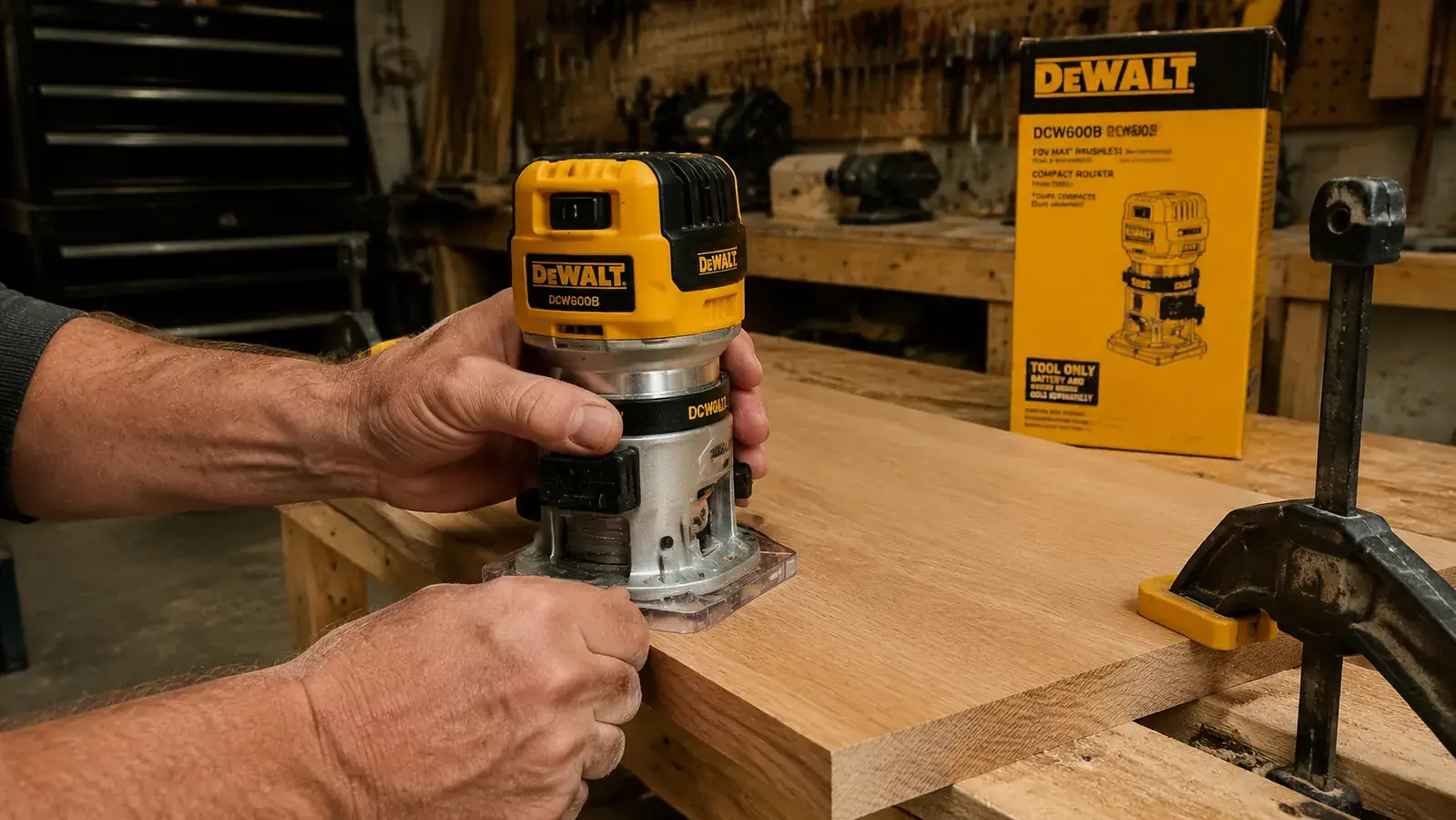
The DCW600B accepts only 1/4-inch shank bits. No half-inch collet is available for it. This is not a complaint about a missing accessory or something DeWalt overlooked. It is a design reality of compact trim routers. The motor and body geometry are sized around 1/4-inch tooling. If your bit library is heavy on half-inch shanks, which it probably is if you do any serious furniture or cabinet work, you are going to be running to the corded router constantly.
For context: half-inch shank bits include most straight bits over 3/8-inch diameter, most spiral upcut bits, most raised panel bits, most large roundovers, and most flush-trim bits with a bearing riding on a thick template. A huge portion of what I reach for in a furniture shop is half-inch tooling. The DCW600B handles the small stuff superbly: 1/4-inch roundover, 1/8-inch chamfer, small pattern-routing templates, edge profiling on thin stock. But the moment I need to cut a 3/4-inch dado in oak or run a raised panel profile, the cordless router goes back on the hook.
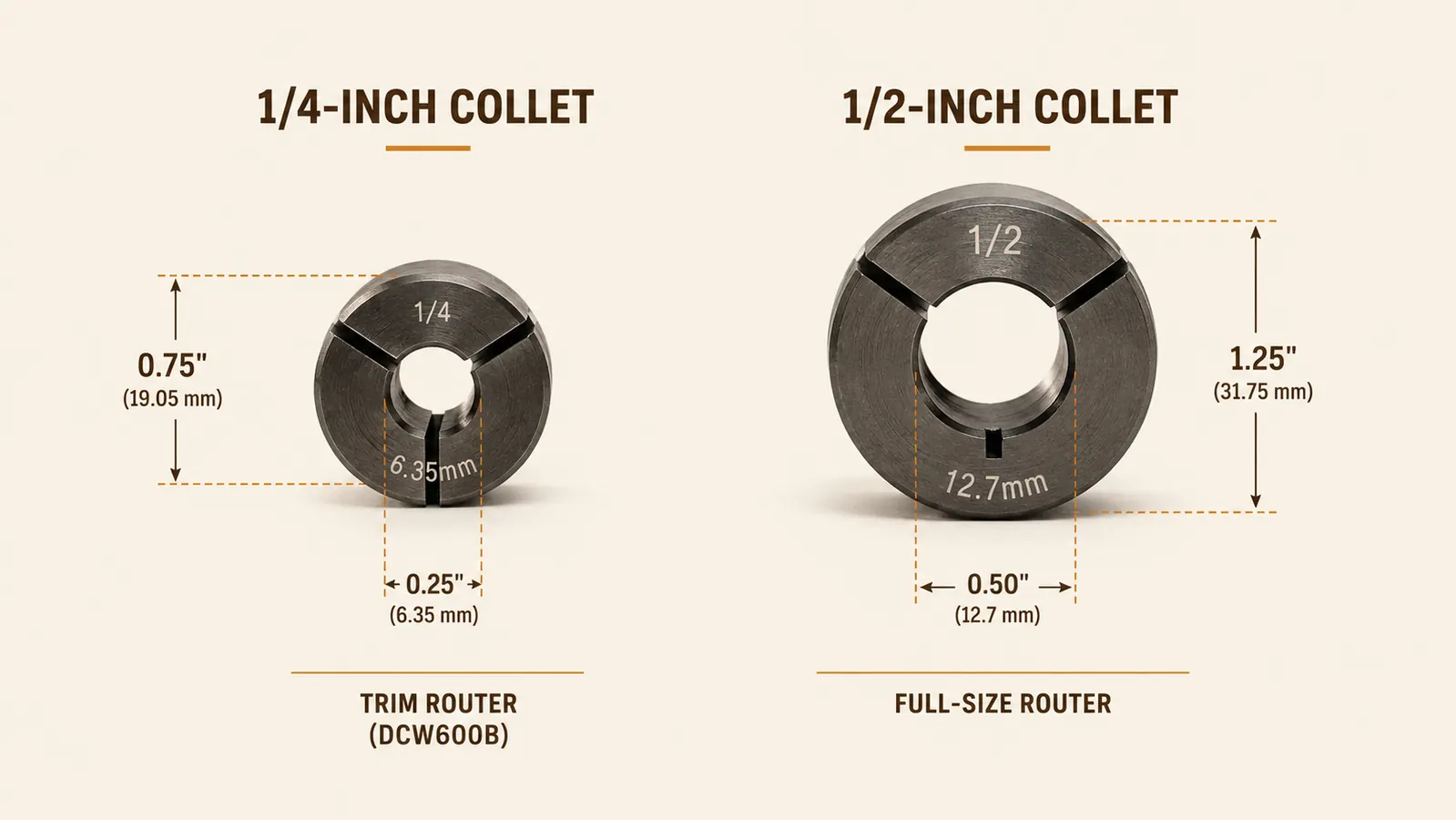
If you are browsing the reasons to go cordless on your next router, just keep this in mind as you read: every one of those reasons applies perfectly within the 1/4-inch shank world. Outside of that, you need both tools.
1.25 HP: What That Number Actually Means at the Bit
The DCW600B is rated at 1.25 HP. A full-size shop router is typically 1-3/4 to 3-1/4 HP. That is not a small gap. On the jobsite where the DCW600B is marketed primarily, that power level is fine for trim work, laminate, and MDF edge profiles. In a hardwood furniture shop, the story is more complicated.
Running a 1/4-inch roundover on soft maple at a relaxed feed rate, the DCW600B does not struggle at all. The brushless motor handles it without bogging, and the speed control (which runs from roughly 16,000 to 25,000 RPM) gives you room to tune for the material. Things change when I get into hard maple, white oak, or hickory with anything larger than a 3/8-inch radius cutter. The motor will complete the pass, but you can hear it working. Push the feed rate even slightly and the motor drops speed noticeably. The electronics protect it from stall, but the finished cut shows the difference, a slight roughness that a full-size router at full speed eliminates.
For softwoods, pine, poplar, even cherry, I have no complaints. For the hardest domestic species in anything more than a light profile, the 1.25 HP is the ceiling. Work within it and you are fine. Forget about it and lean on the tool and you will feel it.
The DCW600B is not slow. It is appropriately sized. Knowing the difference keeps you from blaming the tool for something that is really a job-fit problem.
Battery Runtime on Real Hardwood Cuts
This is the question I get asked most often. How long does the battery last when you are actually routing, not just spinning the collet in the air?
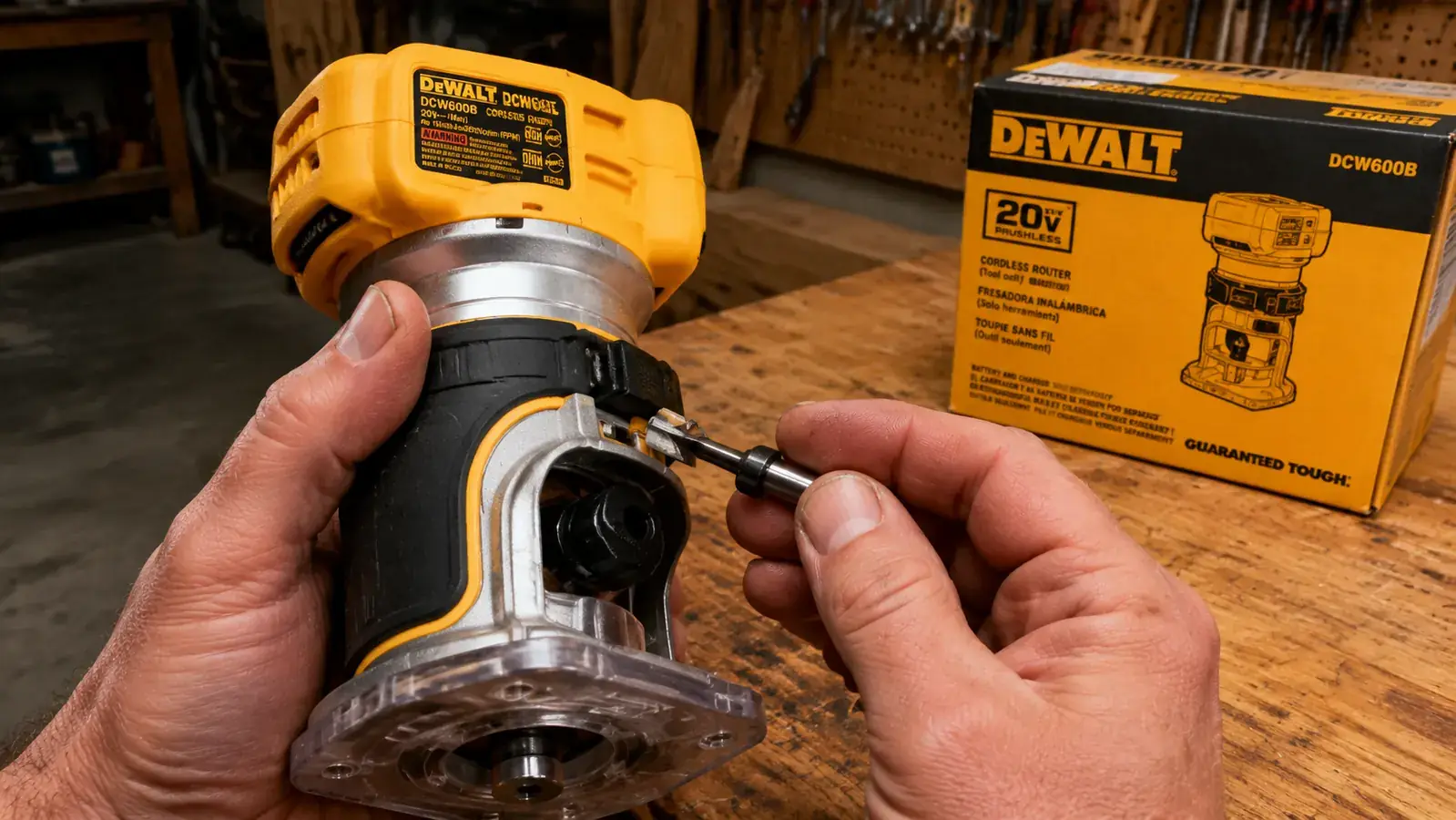
On a DeWalt 5.0 Ah 20V battery, running continuous edge profiles on hard maple boards (1/4-inch roundover, feed rate consistent with about 10-12 inches per second), I can run approximately 35 to 45 linear feet before the battery drops into the low-charge indicator zone. That sounds like a lot until you are profiling 8-foot boards and need to do both faces of every edge on a 14-board dining table top. You will burn through two batteries before you finish. On softer species like poplar or pine, add maybe 20 percent to that number.
For template routing on smaller parts, the picture is better. If you are cutting 6-inch curved templates on thin stock with a pattern bit, a single 5.0 Ah battery runs for a long session before you notice any drop. The duty cycle matters enormously. Sustained heavy cuts on hardwood are the worst case. Intermittent smaller cuts are where cordless routing really shines.
The honest takeaway: if you are doing production-level edge work on a long run of hardwood boards, plan on having two charged batteries in rotation. If you are doing occasional edge profiles and template work, a single 5.0 Ah battery per session is usually enough.
The 'Tool Only' Trap: What That Listing Really Costs You
The DCW600B sells as a tool-only package. No battery. No charger. The listing price reflects that. If you are already running DeWalt 20V Max tools in your shop, you already own batteries and a charger, and the tool-only price is a genuine deal. If you are not already in the 20V Max ecosystem, the real cost of this router is the tool price plus a battery plus a charger.
A DeWalt 5.0 Ah 20V battery runs about $60 to $70 on Amazon on a good day, sometimes more. A charger adds another $30 to $45 depending on which model you pick. That brings the real entry cost for a non-DeWalt buyer to somewhere in the $235 to $270 range total, depending on current prices. At that number you are looking at a different value calculation than the listing price implies.
I am not saying it is a bad deal at that price. A brushless cordless router with full variable speed and genuine performance is worth real money. But I have seen hobby woodworkers get burned buying the tool-only listing and then discovering at checkout that they also need two more items to actually use the thing. Read the listing header carefully. It says 'Tool Only' in capital letters for a reason.
What I Liked
- Brushless motor provides strong, consistent speed with real electronic protection against bog-down
- Variable speed from 16,000 to 25,000 RPM handles a wide range of 1/4-inch bit profiles and materials
- Genuinely compact and light, makes freehand template routing and edge work far easier than a corded full-size router
- Plunge base compatibility (sold separately) expands what you can do with this body significantly
- No cord drag is a real quality-of-life improvement for any routing task where you move around the workpiece
- If you are already in the DeWalt 20V ecosystem, the tool-only price is a strong value
Where It Falls Short
- 1/4-inch collet only, half-inch shanks are not an option at any price
- 1.25 HP shows its limits on sustained cuts in the hardest domestic hardwoods at larger bit diameters
- Battery runtime during sustained hardwood edge profiling requires a two-battery rotation for long sessions
- Tool-only listing means significant additional cost for buyers outside the DeWalt 20V platform
- Plunge base is a separate purchase, not included even in the kit version of this router
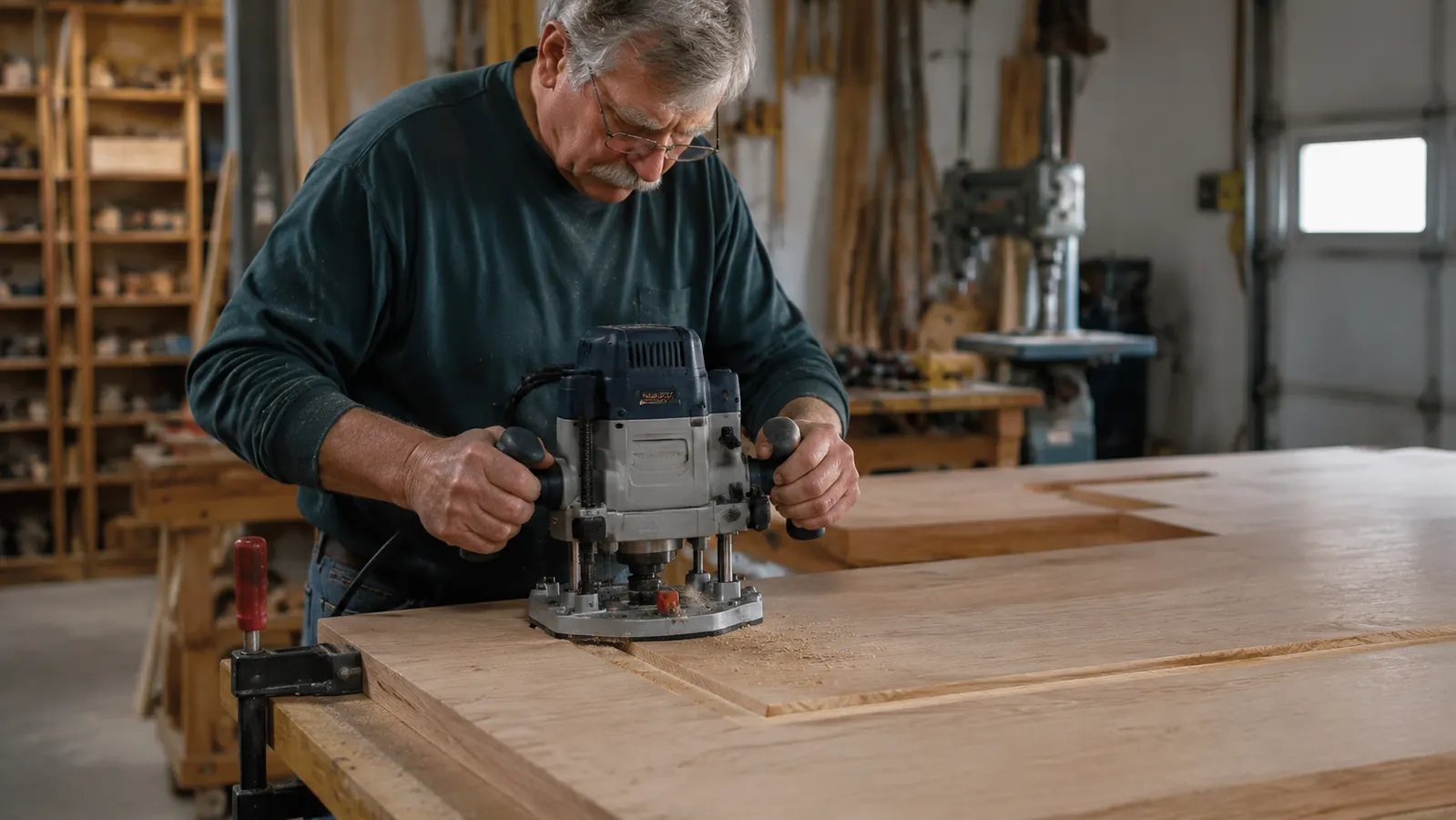
When You Absolutely Need a Corded Full-Size Router Instead
I want to be direct about this because I think it is the most useful thing I can tell you. There are several categories of routing work where the DCW600B is simply not the right tool, and no amount of enthusiasm for cordless convenience changes that.
First: any time you are running half-inch tooling. Raised panel bits, large-diameter straight bits, mortising bits on heavy-body collets, large roundovers for table edges on thick stock. All of these require a half-inch collet and typically benefit from 2+ HP of motor. The DCW600B does not do this work.
Second: any sustained production run on hardwood where you are routing a significant linear footage in a single session. The battery rotation overhead adds friction to a workflow that a corded router handles without interruption. When I am running the outside profile on 30 board-feet of white oak shelf stock, I plug in the Bosch. Full stop.
Third: any time you are doing plunge work in dense material at depth, cutting full slots or mortises in thick hardwood. The motor power and sustained torque of a corded 1-3/4 HP or larger router handles those cuts far more comfortably than the DCW600B can manage.
The DCW600B earns its place on the bench as a second router, the one you grab for cleanup passes, decorative edges, template work on curved parts, and any task where the cord would be in the way. As a sole router in a furniture shop, it is going to frustrate you within the first month.
Who This Is For
If you already own a corded full-size router and want a dedicated tool for template routing, edge profiling, and freehand work where cord management is a pain, the DCW600B is a genuinely excellent addition to your shop. It does those jobs better than running a heavy corded router through them, and it does them without the cord getting in your way on a curved part. If you are already in the DeWalt 20V ecosystem and have spare batteries, the tool-only price point makes the math easy.
Also a strong fit: woodworkers who build primarily from softwoods, plywood, and MDF, where the 1.25 HP ceiling rarely gets tested. Box makers, sign carvers, anyone doing inlay or small decorative routing. For those applications, the DCW600B is more than sufficient and the cordless freedom is a genuine daily benefit.
Who Should Skip It
Skip the DCW600B if you are looking for a single router to handle everything in a furniture and cabinet shop. You will be back shopping for a corded router within a few months. Skip it if you are not already in the DeWalt 20V ecosystem and the total cost of entry, tool plus battery plus charger, pushes your budget past what a capable corded router would cost. At that price range, a Bosch 1617EVS or similar 1-3/4 HP corded router gives you more versatility for similar money.
Skip it if your primary router work involves half-inch shank bits. No workaround exists. The collet is what it is, and no adapter lets you safely run half-inch tooling in a trim-router collet under load.
Already own DeWalt 20V batteries? The DCW600B is a smart add to your shop.
Check today's price and make sure you are looking at the tool-only listing if you have batteries, or the kit if you are starting fresh. Prices shift frequently.
Amazon Check Today's Price on Amazon →