
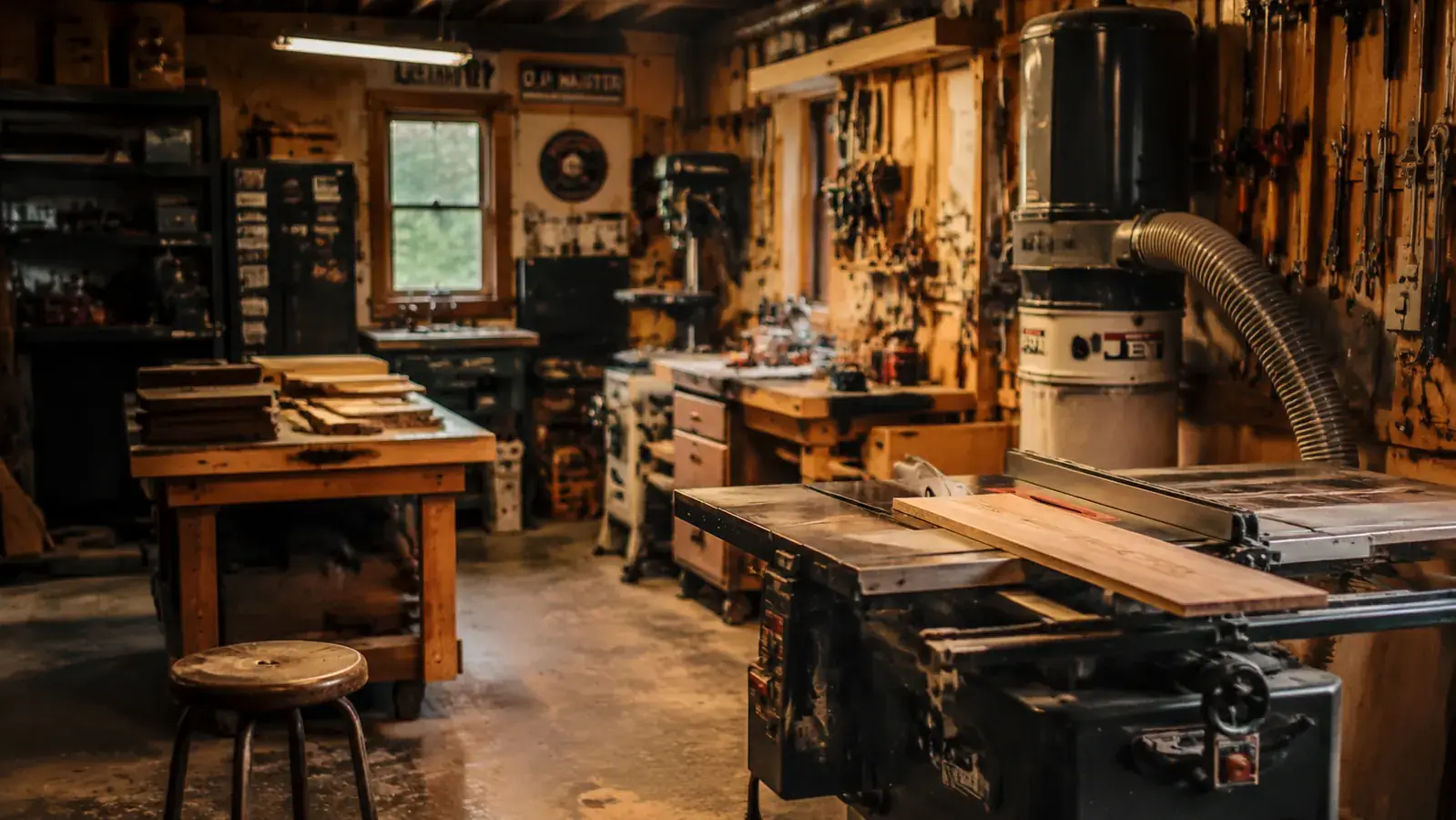
I spent the first three years of my shop life sweeping. Every time I ran the table saw I swept. Every time I ran the router table I swept. I had a little shop vac that I'd drag around and plug into whatever tool I was using, and I told myself that was dust collection. It wasn't. It was a delay tactic. Fine dust, the stuff that actually damages your lungs, passes right through a cheap shop vac filter and stays suspended in the air for hours. You breathe it on every trip back to the shop. I was making myself sick in slow motion and calling it good enough.
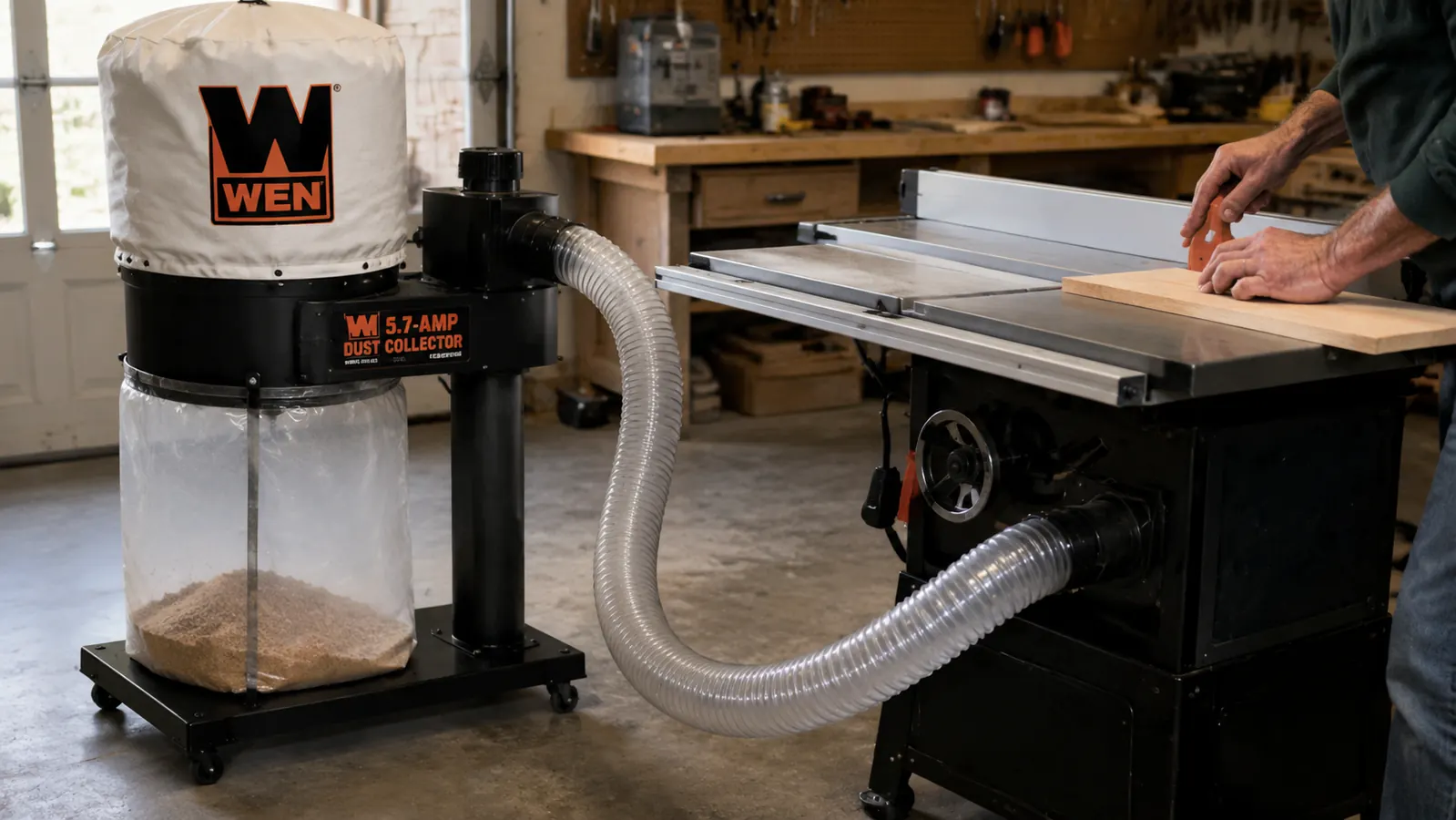
Setting up real dust collection in a home shop is one of the highest-leverage upgrades you can make. Your finishes get cleaner, your tools run cooler, your floor stays safer, and your lungs stay intact. The WEN 5.7-Amp dust collector with its 12-gallon bag and 4-inch hose is where most home woodworkers should start. It is priced right, it moves real air, and it gets out of the way on its mobile base when you're not using it. This guide walks through exactly how to set it up and, if you're ready, how to grow it into a proper shop-wide system.
Stop breathing fine dust. The WEN dust collector is the most direct fix for under $130.
The WEN 5.7-Amp unit with a 12-gallon bag, 4-inch hose, and mobile base is the starting point Dave recommends for any garage or basement shop. Check the current price on Amazon before you buy anything else.
Amazon Check Today's Price on Amazon →Step 1: Assess What Your Shop Actually Makes
Before you buy any hardware, spend one shop session cataloging your tools and what they produce. Dust collection is not one-size-fits-all. A table saw running cabinet-grade hardwoods produces a ferocious volume of chips and fine dust at the blade, and it needs serious airflow at the blade guard and under the table. A random orbit sander produces almost nothing but the finest particles, the ones you can barely see, and it needs filtration more than raw volume. A router table is somewhere in between, producing fine shavings on some bits and coarser debris on others.
Write down every powered tool you own and whether it is a heavy producer (table saw, miter saw, planer), medium producer (router table, bandsaw, jointer), or light producer (sander, scroll saw, drill press). This list tells you two things: how big a collector you need, and which tools to wire in first versus which ones can stay on a portable shop vac connection. For most one- or two-car garage shops with a table saw, a router table, and a sander or two, a single-stage collector like the WEN with at least 650 CFM at the inlet covers all of it with room to spare.
Step 2: Size the Collector for Your Shop
The standard guidance is 100 CFM (cubic feet per minute) of airflow per inch of duct diameter at each tool port. A 4-inch port needs 400 CFM. The WEN unit pushes around 650 CFM at open air, which means it can handle one 4-inch tool with flow left over for any system losses in the hose and fittings. If you are running two 4-inch tools simultaneously, you are underpowering one of them. The answer is either a bigger collector or a plan that ensures you only open one blast gate at a time, which is what most home woodworkers end up doing anyway.
For shops under 400 square feet with five or fewer stationary tools, the WEN is sized correctly as a starting point. If you have a planer that generates a literal river of shavings, plan now to add a pre-separator to keep the bag from loading up in ten minutes. More on that in Step 5. If you are running a floor-standing drum sander or a wide-belt sander, the WEN alone is not enough. Those machines need at minimum a 1.5 HP collector with a 5-inch main inlet.
One number people miss: static pressure. CFM tells you how much air moves in open conditions. Static pressure tells you how well the collector pulls through long hose runs and tight fittings. Cheap shop vacs have almost no static pressure, which is why they choke on a 10-foot flex hose run. The WEN, like most dedicated dust collectors with impeller-style motors, handles a 10-to-15-foot hose run without significant performance drop. Beyond 20 feet of flex hose on a single run, consider switching to rigid 4-inch PVC, which reduces friction losses dramatically.
Step 3: Choose the Right Location
Put the collector where it can vent. The bag on the WEN passes air back into the shop, which means fine particles that escape the bag re-enter your air. That is not ideal for interior basement shops with no air movement. In a garage with a door you can crack, or a basement with a window, place the collector close to that opening and point the bag exhaust toward it. If you are in a sealed basement with no outside air path, plan from day one to either upgrade to a canister-style collector with a fine-dust cartridge filter, or add an ambient air filtration unit to the ceiling.
The mobile base on the WEN is genuinely useful here. My shop is a tight one-car garage, and I roll the collector out from the wall when I run it and roll it back when I need the floor space for assembly. The base locks on all four corners and holds the unit solid even when the bag is full and heavy. Pick a home-base location against a wall or in a corner where you can run hoses without crossing the floor, then plan your hose routes from there.
Step 4: Plan Your Hose Runs and Tool Ports
For a simple setup with one or two tools, this is easy: run the 4-inch flex hose that comes with the WEN from the collector inlet to whichever tool you are using and move it as needed. That is how I started and it works fine for small shops where you only run one tool at a time anyway. The inconvenience is pulling and replugging the hose between tools.
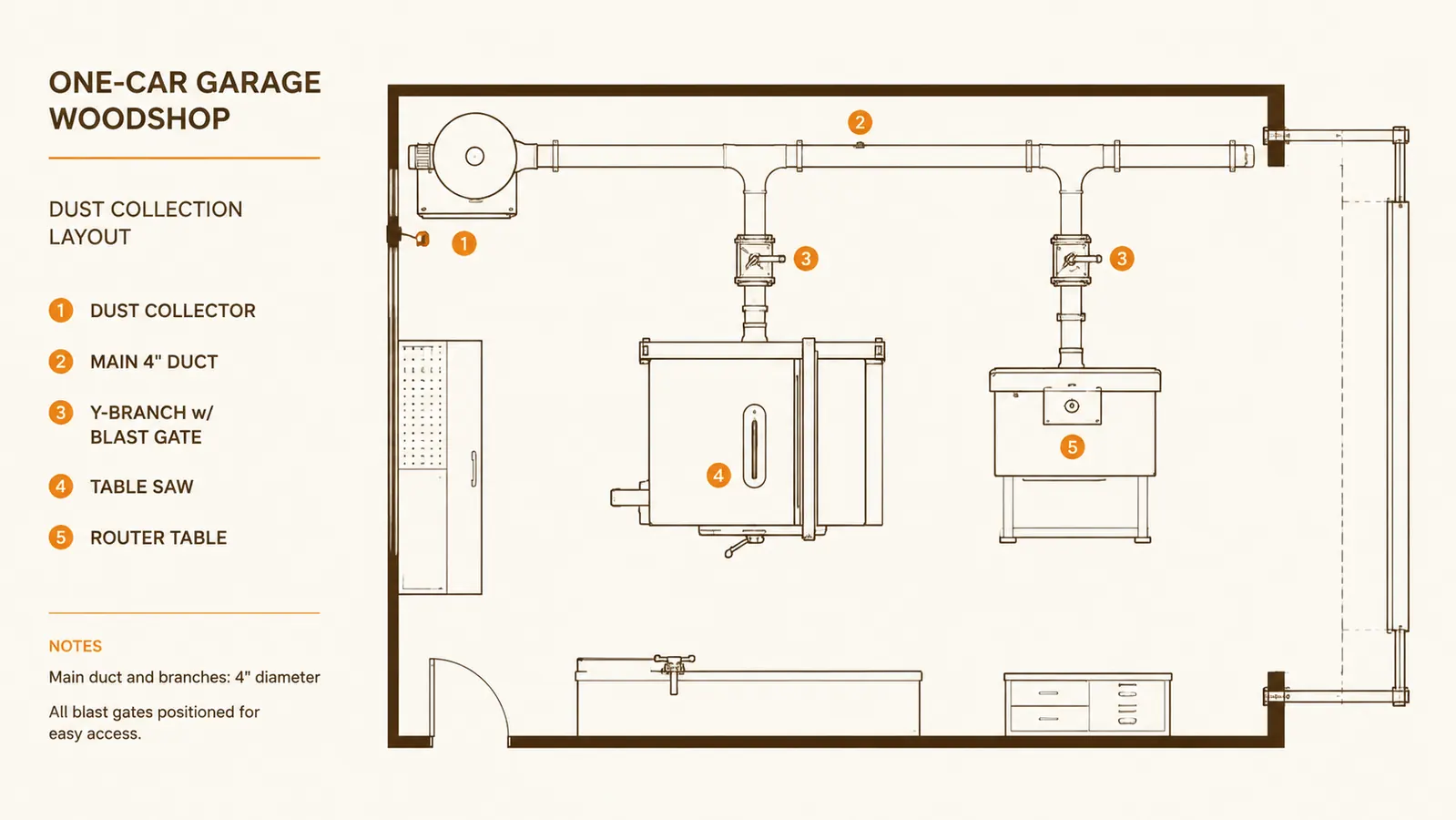
For a multi-tool permanent connection, you need to think about a trunk-and-branch layout. The trunk is a main duct that runs along the wall or ceiling from the collector to a central point in the shop. Branches drop from the trunk to each tool. In a one-car garage with tools along two walls, a 12-to-16-foot trunk of 4-inch rigid PVC along the back wall, with three or four 4-inch branches dropping to individual tools, is usually enough. Use 4-inch sweep elbows, not 90-degree hard elbows, everywhere you turn a corner. Sharp 90-degree bends kill airflow.
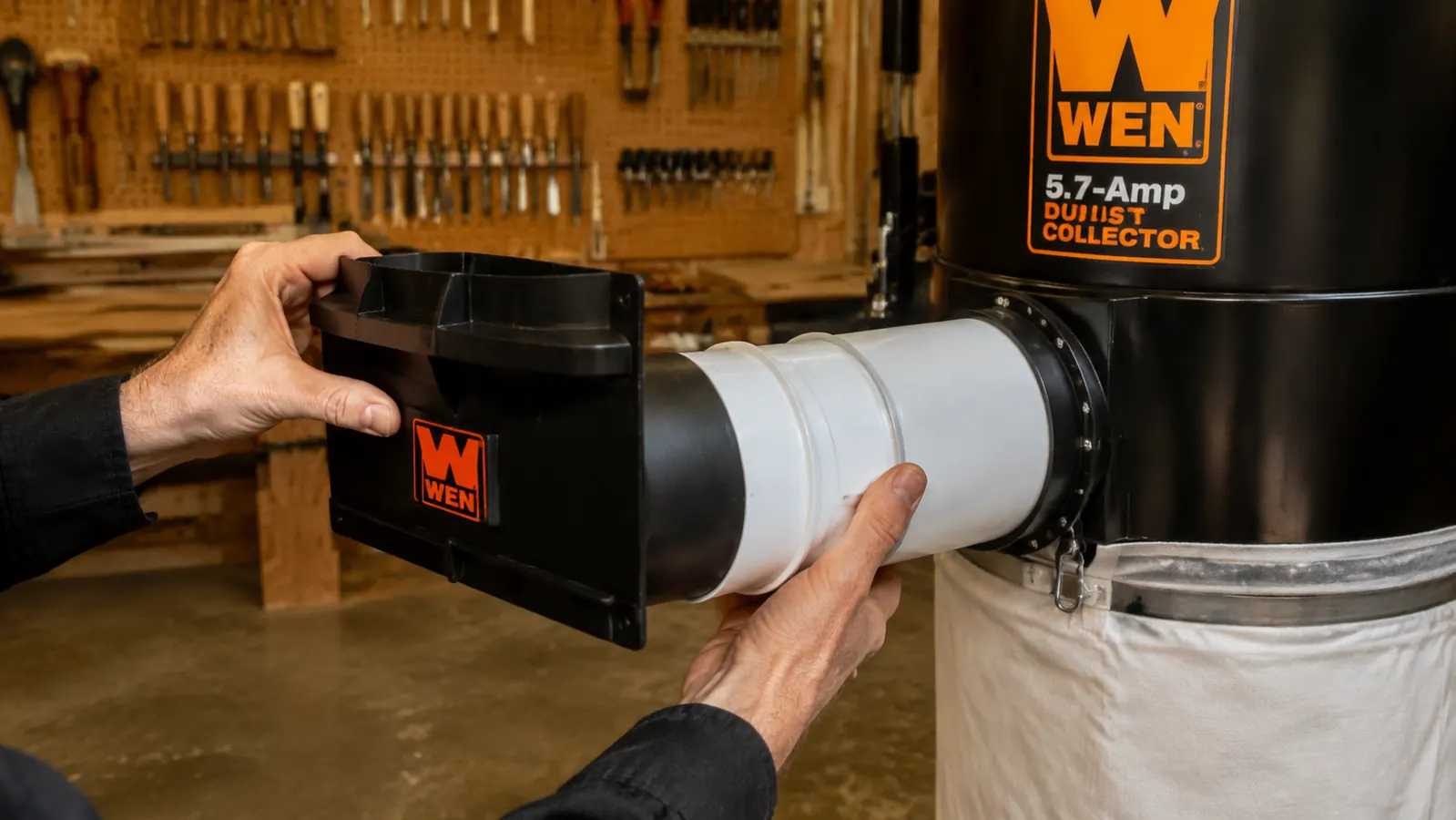
At each tool, you need a port adapter that matches the tool's dust port diameter. Most table saws run a 4-inch dust port under the blade and a smaller 2.5-inch port at the blade guard. The WEN hose connects directly to the 4-inch port. For the blade guard, use a reducer fitting and a short piece of 2.5-inch hose. Most routers and router tables have a 2.5-inch port at the fence and a 4-inch port under the table if there is one. Use whichever your shop vac hose fits, then step up to a 4-inch connection if you need more volume. Sanders typically run 1.25-inch or 1.5-inch ports and connect to the WEN through a reducer or a separate shop vac.
Step 5: Install Blast Gates
A blast gate is a sliding gate that opens or closes a branch duct. With the WEN running and two tools wired in, you need blast gates to control where the suction goes. Close the gate on the tool you are not using, and all the airflow concentrates at the one you are. Without blast gates, the collector splits its airflow between every open port and underperforms at all of them.
Buy or print plastic blast gates for every branch. I use the Rockler or Woodcraft PVC-style gates, which run about three to five dollars each and last years. Mount the gate on the branch right where it meets the trunk, or where the flexible hose connects to the rigid branch. Label each gate with a paint pen so you know which tool it controls. Tape a rule to the wall above the collector: one gate open at a time unless you have stepped up to a two-stage system with a larger collector.
One small quality-of-life upgrade: automatic blast gates controlled by a sensing relay. A device like the iVAC system opens the blast gate on whichever tool you turn on and closes the others automatically. It is a genuine convenience in a busy shop. Not necessary at the start, but worth knowing about once you have four or more tools wired in.
Fine dust, the kind you can barely see in the air, passes right through a shop vac filter and stays suspended for hours. You breathe it on every trip back to the shop. Real dust collection is not a luxury. It is basic shop safety.
What Else Helps
A few additions that pay for themselves quickly once you have the WEN running as your base unit.
An ambient air filtration unit hung from the ceiling catches the fine particles that escape your dust collector during a session and settle out over several hours after you stop working. A simple 1000 CFM ceiling-mount unit like the Jet AFS-1000B or the WEN air filtration unit runs on its own timer and cleans the shop air while you work on something else. In a basement shop this is almost mandatory. In a garage shop it is still a meaningful improvement.
A cyclone separator is the highest-impact add-on for the WEN or any single-stage collector. The separator sits between the tool and the collector inlet. Chips and heavy dust spiral out of the airstream and drop into a collection bucket before they ever reach the bag. That means the bag stays cleaner longer, airflow stays strong even late in a session, and you empty a bucket instead of fighting a clogged bag. A quality cyclone lid like the Oneida Dust Deputy, which costs around forty dollars, drops onto a 5-gallon bucket and installs in ten minutes. After you have the WEN running well, this is the first upgrade I would make.
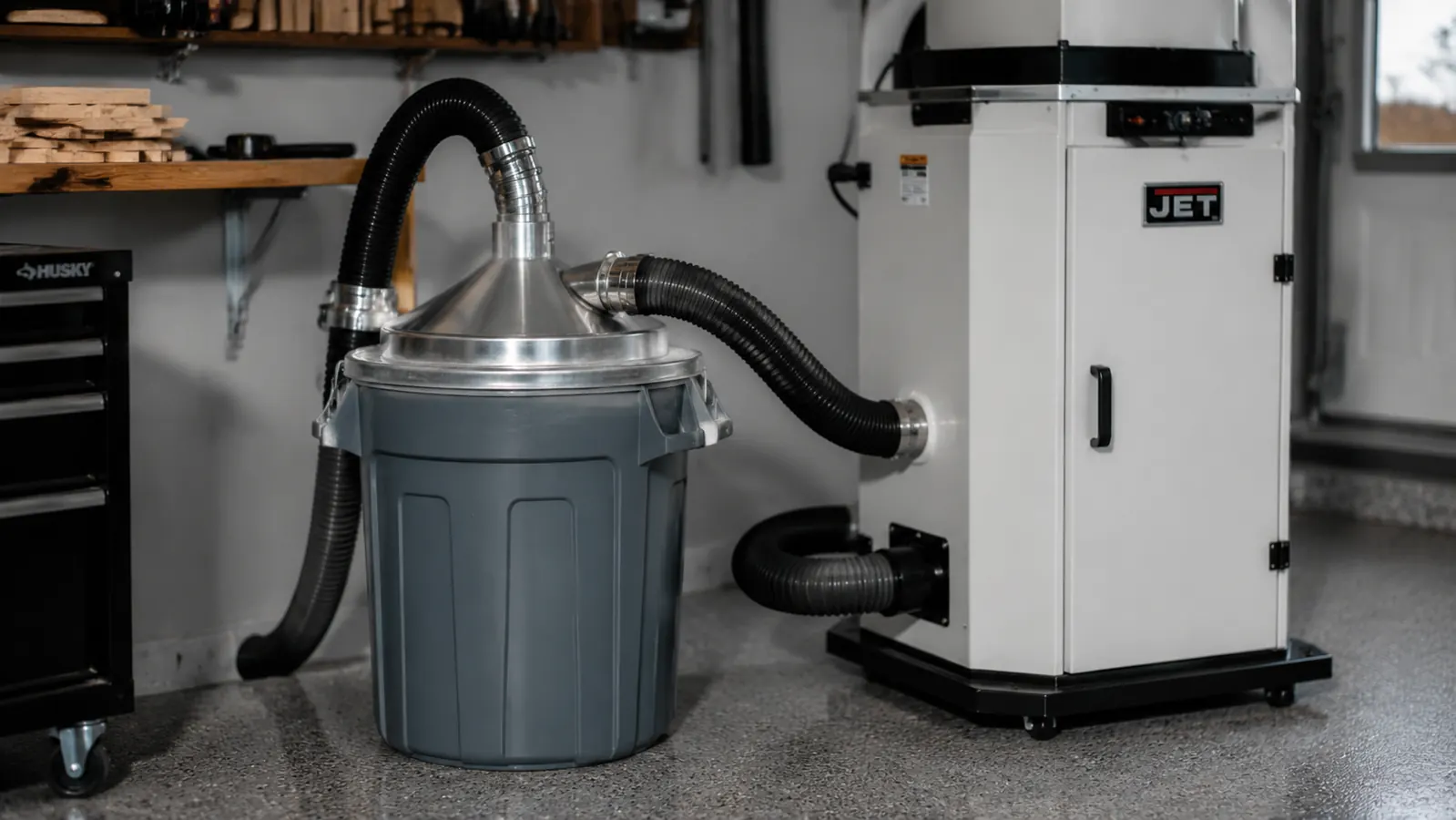
When you are ready to step up past the WEN entirely, the upgrade path runs like this: replace the single-stage bag collector with a 1.5 HP or 2 HP two-stage collector that separates chips before they hit the filter, add a true HEPA or sub-micron canister filter, and if your shop is large enough, move to a 6-inch main trunk with 4-inch branches. That is a real shop system and it costs real money, but it starts with the same principles you set up on day one. The blast gates, the branch layout, the tool ports, all of it carries forward. You are not starting over. You are just adding horsepower and filtration to a plan that already works.
The WEN collector is where this all starts. Get one in your shop before the next cutting session.
At under $130 with a 12-gallon bag, mobile base, and 4-inch hose included, the WEN 5.7-Amp dust collector is the most practical entry point for a home woodshop dust collection system. Check today's price and availability on Amazon.
Amazon Check Today's Price on Amazon →