
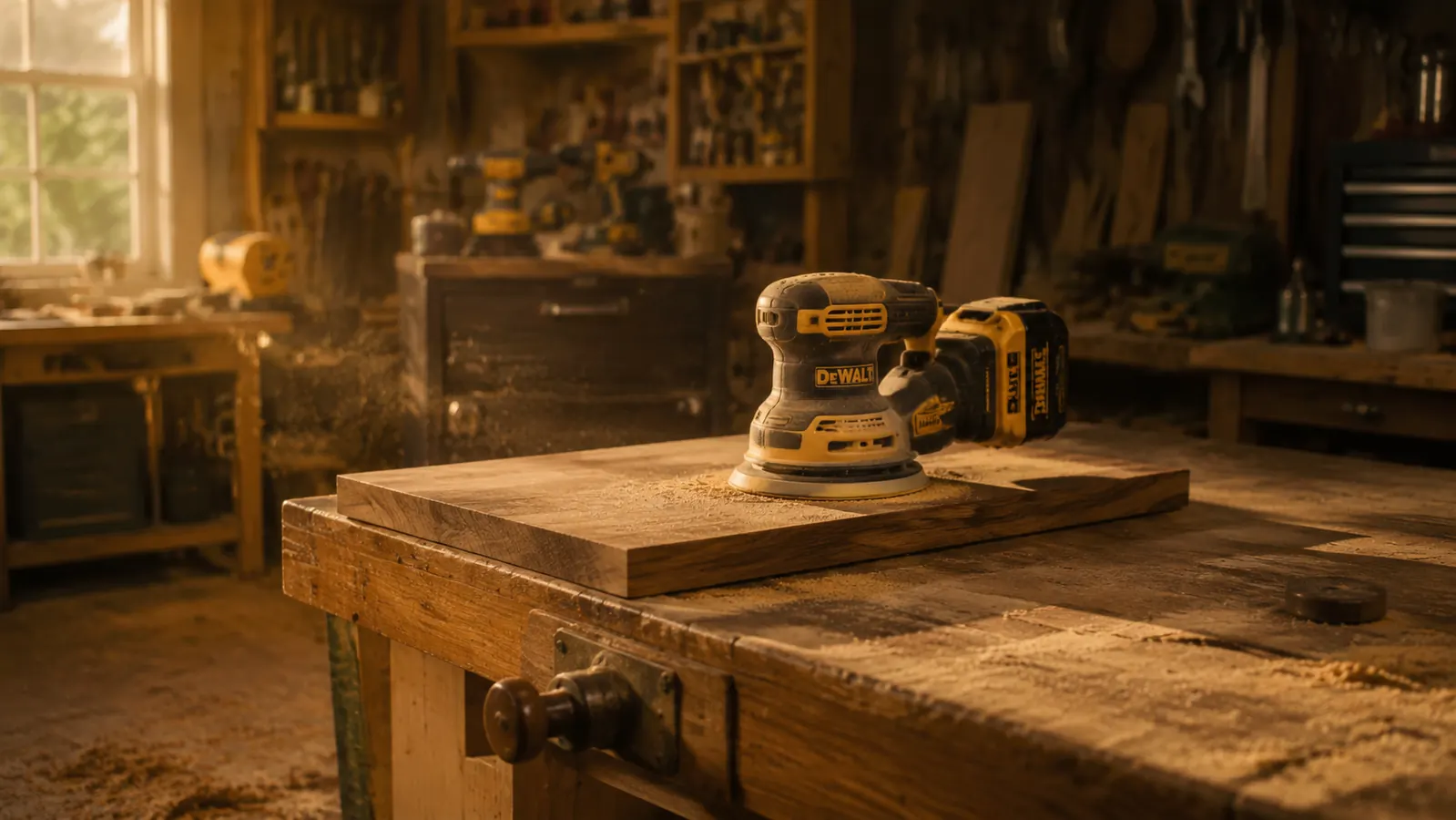
I bought my first random orbit sander in 2003. It was a Makita corded model, nothing fancy, and it worked fine for years. Then the cord started giving me trouble. Not the motor, not the pad, just the cord. That stupid, stiff, 8-foot cord that always seemed to find the exact wrong edge of whatever I was sanding.
I put up with it because that's what you do. You route the cord over your shoulder, you drape it away from the work, you keep one eye on where it's laying while the other eye watches the wood. It becomes a habit, part of the process. You don't even think about it after a while. At least, that's what I told myself.
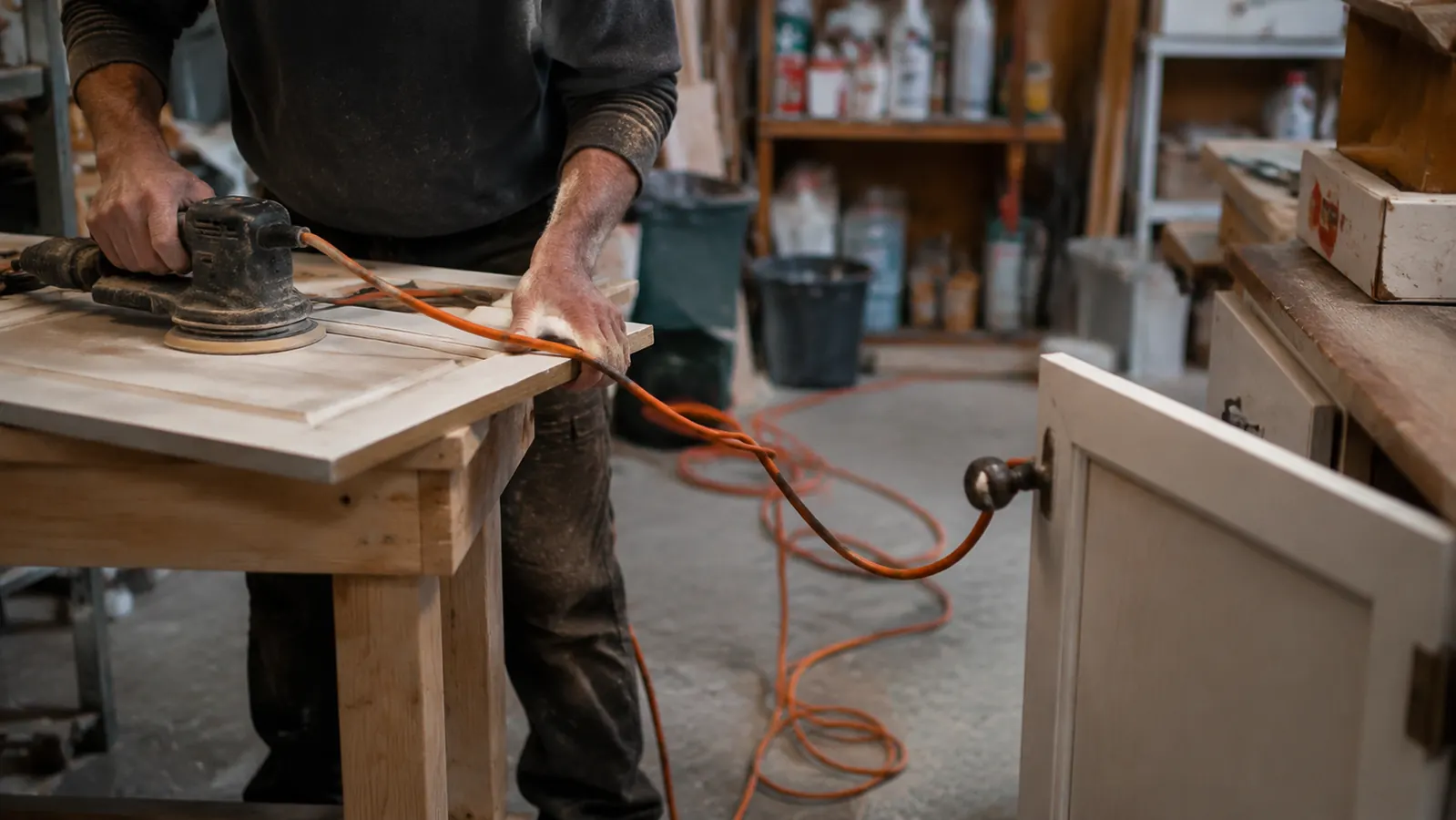
Then I ruined a cabinet door. I was finish-sanding a cherry panel, 120 grit, almost done, maybe six inches from the end of the pass. The cord caught on the corner of my bench vise and pulled the sander about a quarter inch off-line mid-stroke. I felt it happen. That little lurch you feel in your wrist when the cord goes taut at the wrong moment. I lifted the sander, looked at the panel, and there it was. A faint diagonal scuff right across the face where the sanding pattern broke. Not deep, but enough. Enough to show under finish.
I spent an hour trying to blend it out. I couldn't. I had to resaw the panel and start over. Two days of work on that door set, and I was re-doing one because of a cord.
The cord caught on my bench vise and pulled the sander off-line mid-stroke. I felt it happen. That little lurch in your wrist when the cord goes taut at exactly the wrong moment.
That was March of last year. I still didn't buy the cordless sander. I told myself it was a battery tool and battery tools didn't have the power. I told myself I'd have to stop and charge it mid-project. I told myself the old Makita still worked fine, the cord was just something to manage. All reasonable-sounding reasons that were mostly just inertia talking.
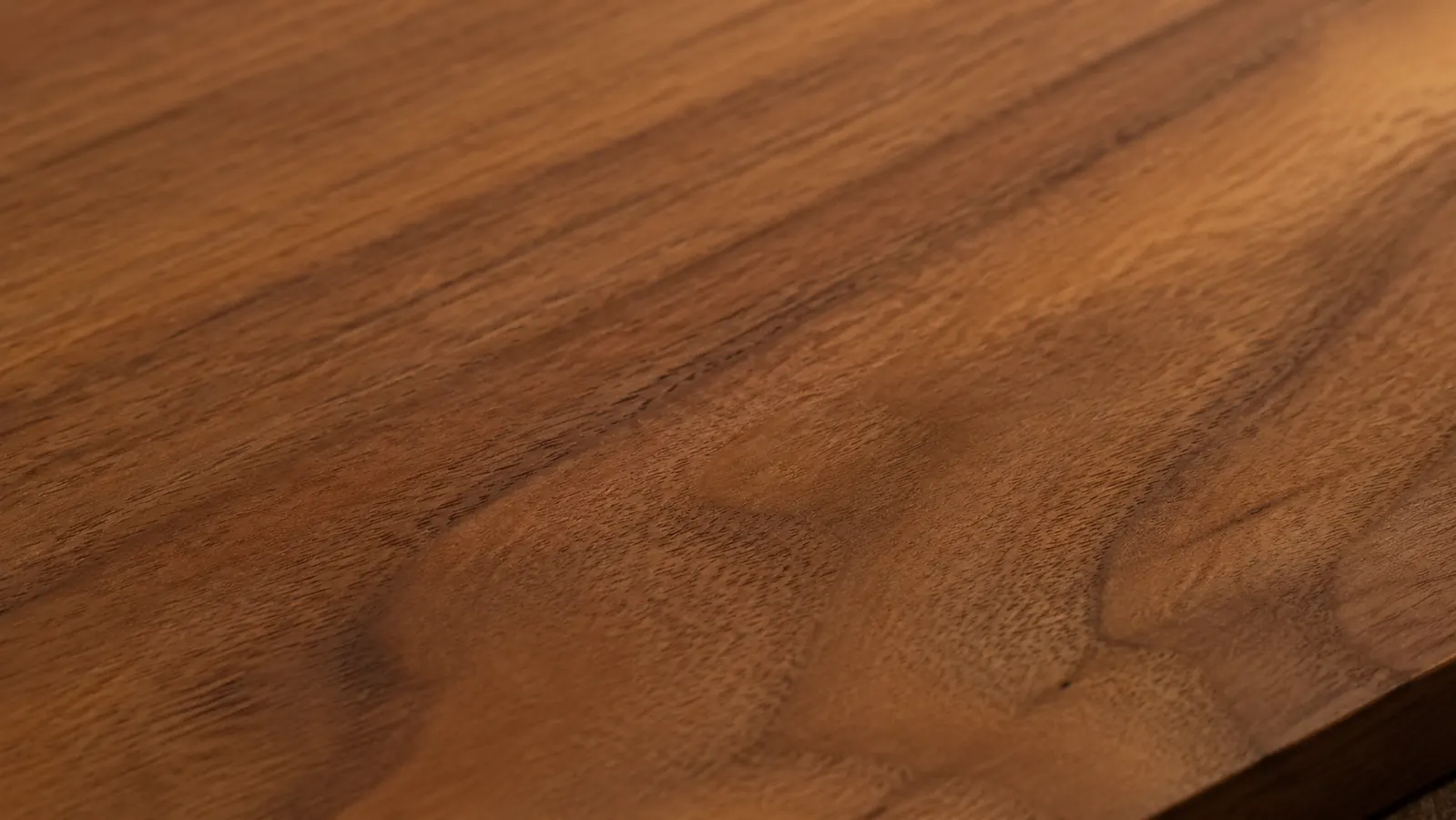
The second project I wrecked settled it. I was sanding a coat of dried shellac off a small walnut jewelry box my daughter had asked me to refinish. Delicate work. The cord snagged on the edge of the box itself and tipped the sander. I gouged the side of the box trying to recover. That one I could fix, barely, but it cost me another two hours and a lot of swearing.
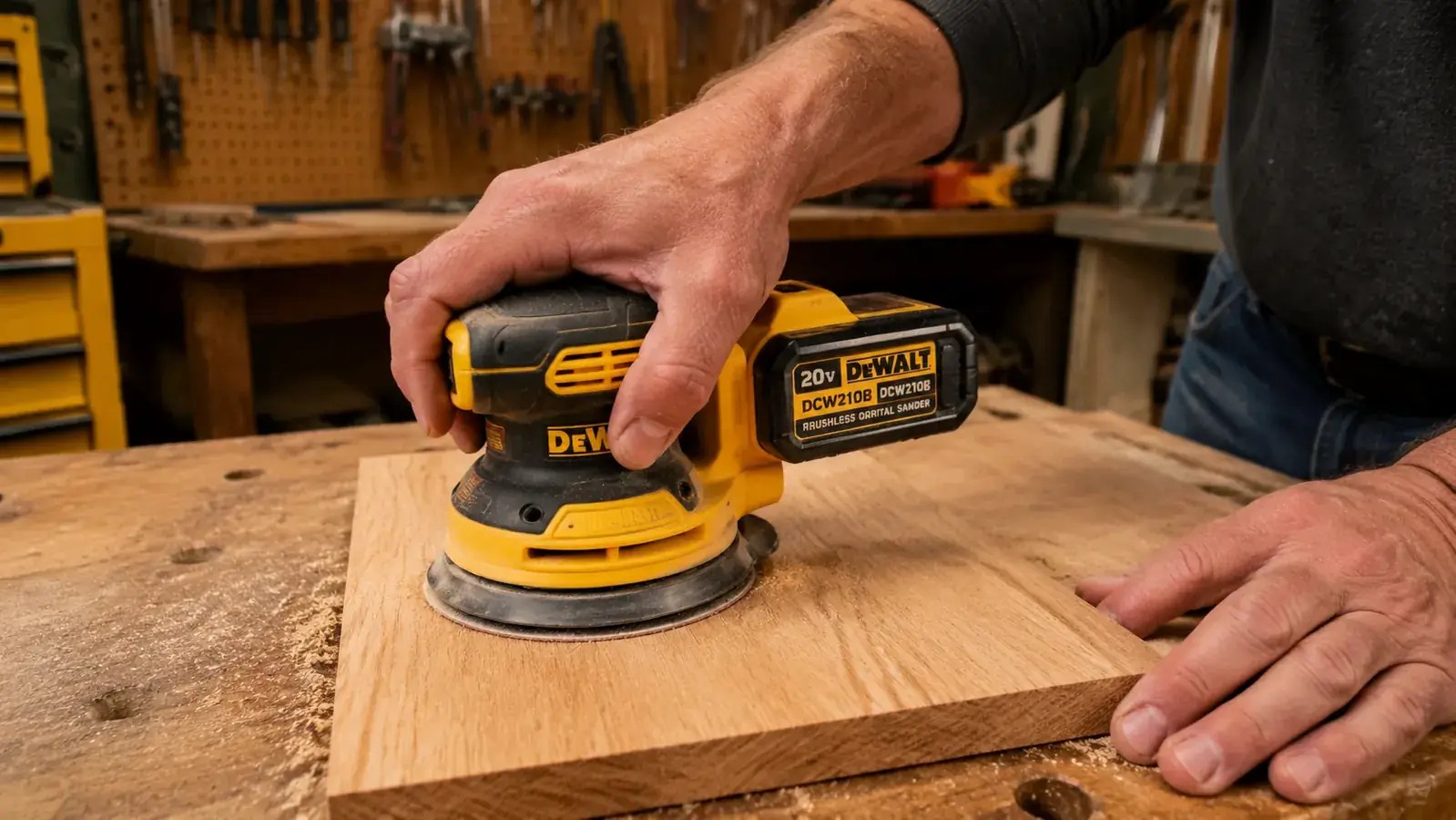
Done letting a cord drag your work off-line? The DCW210B is what I should have bought two projects ago.
The DeWalt 20V MAX Orbital Sander runs on the same 20V MAX battery as most of the DeWalt lineup. Variable speed, brushless motor, hook-and-loop pad, and no cord to fight. Currently 4.8 stars across over 13,000 reviews on Amazon.
Amazon Check Today's Price on Amazon →I picked up the DeWalt DCW210B on a Tuesday afternoon. I had a 2.0Ah battery from my DeWalt drill already charged. I took it out to the shop, snapped in the battery, and started sanding a maple shelf blank I had sitting on the bench.
The first thing I noticed was how much I was moving. Not the sander, me. Without a cord anchoring me to the outlet on the wall, I was circling the bench, coming at the work from different angles, sanding with the grain and then diagonal and then across again without stopping to re-route anything. I just moved. The sander went where I went. I finished that shelf in about half the time it would have taken me with the corded Makita, not because the DCW210B is faster, but because I wasn't fighting anything.
The power question, the one I'd been telling myself was a real concern, turned out to be nothing. The brushless motor on the DCW210B holds its speed under load in a way that my old corded sander, honestly, didn't always do. Variable speed dial on the front, 8,000 to 12,000 OPM, and it stays where you set it. I ran it on a full charge through about 45 minutes of sanding that afternoon, 80 grit to 120 to 180, and the battery still had juice left.
The dust bag is fine. Not great, not the thing I'd brag about, but it catches enough that I'm not coating the shop in a fine brown haze every session. I hook it up to my shop vac port when I'm doing a long run and forget the bag entirely. That's really the right move anyway.
What I'd Tell You If We Were Sitting at My Kitchen Table
I'd tell you I waited too long and it cost me two projects I care about. I'd tell you the battery concern is real only if you're trying to sand for six hours straight without stopping, and if that's your situation, buy a second 20V MAX battery and you're covered. I'd tell you the DCW210B is not the most expensive sander DeWalt makes and it's not trying to be. It's a solid, brushless, cordless sander that does exactly what a sander needs to do, without the one thing that drove me to ruin a cherry door and a walnut box.
If you're on the fence about going cordless, I get it. I was on that same fence for a year. But the cord is not a minor inconvenience. In a home shop, where you're working alone, minding the wood and the machine and the grain direction all at once, the cord is one more thing pulling at your attention. Pull it out of the equation and you'll sand better. Fewer lapses, fewer corrections, fewer moments where you feel the machine lurch and your stomach drops.
The old Makita is in a box in the corner of the garage now. I keep meaning to donate it. Maybe I will. But I haven't plugged it in since March, and I don't expect to. If you want the longer rundown on how the DCW210B holds up over time, I wrote that out in my full long-term review. And if you want to know the right way to use any random orbit sander to get a finish worth putting a coat on, that's in my guide to getting a glass-smooth surface.
If a cord cost you a project, you already know what to do.
The DeWalt DCW210B works with any 20V MAX battery. Tool-only, so you can use what you have. Over 13,000 reviews, 4.8 stars. Worth every penny of what it costs.
Amazon Check Today's Price on Amazon →